The Algeciras Breakthrough and the Metal Barrel#
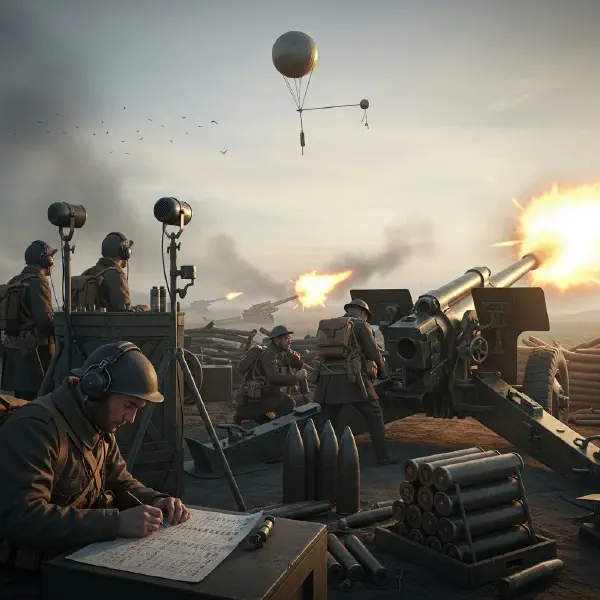
In 1343, during the siege of Algeciras, the first recorded use of cannon in Europe revolutionized siege warfare. These early gunpowder weapons were primitive, often made of metal staves hammered together with reinforcing hoops, mirroring the construction of wine barrels. However, the shift from mechanical energy storage to chemical propulsion introduced a new engineering nightmare: the containment of extreme internal pressures and temperatures. Early artillerymen were often at as much risk from their own guns as from the enemy, as poor casting processes made barrels liable to split or explode.
The Science of High-Pressure Containment#
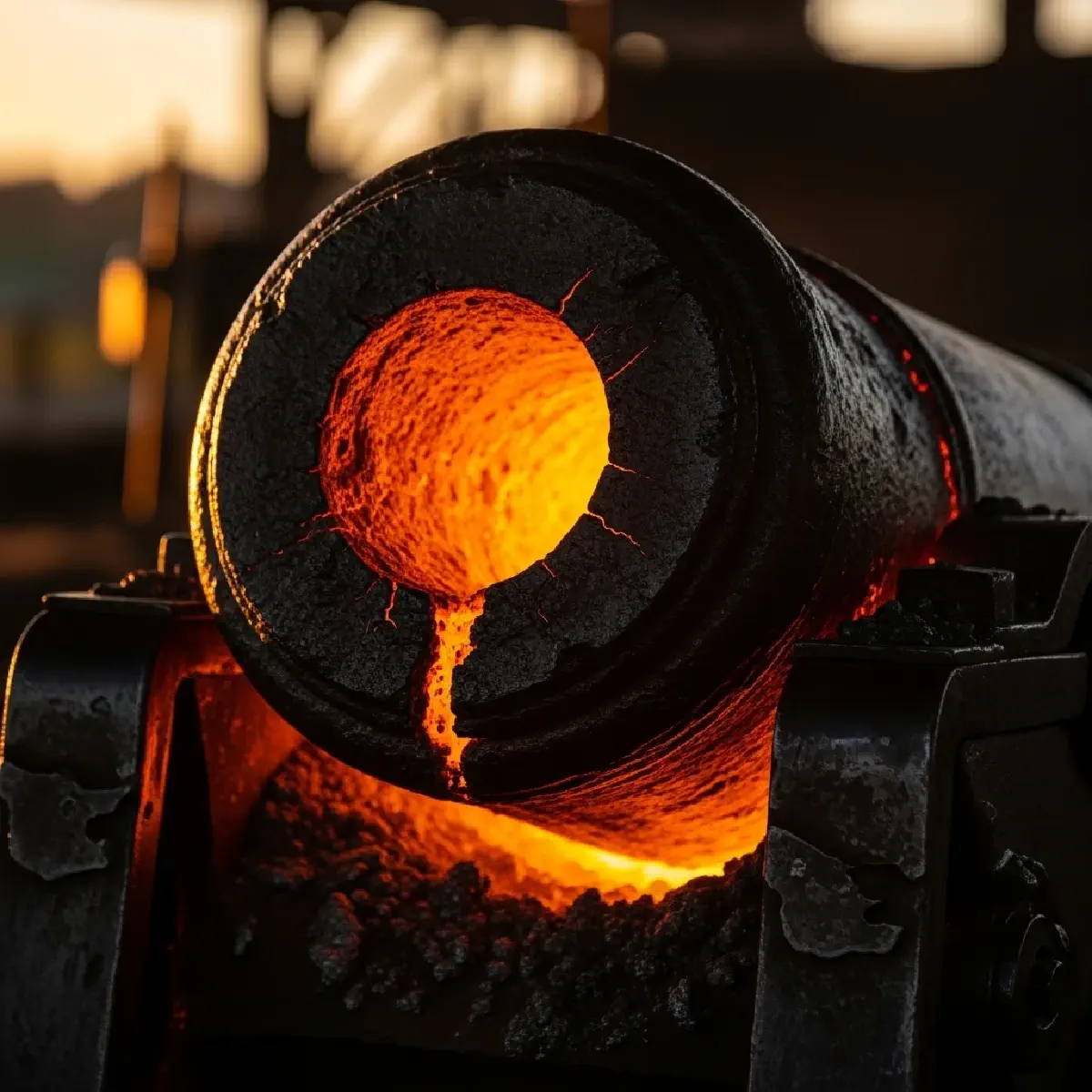
Every shot of a cannon subjects the inner bore to temperatures up to 1,000°C and pressures reaching several thousand atmospheres. This destructive environment leads to structural erosion, microcracks, and a violation of the geometry of the working surface. The engineering challenge was to create a vessel that could accelerate a projectile to 912 m/s while maintaining structural integrity over hundreds of cycles. The transition from smooth-bore cast iron to rifled steel tubes in the 1850s marked the birth of modern internal ballistics.
The Foundation of Internal Pressure Mapping#
Before the advent of modern software, engineers had to empirically map the forces inside a barrel. By using cylindrical punches that were driven against soft copper plates upon firing, they could measure the indentation depth to calculate peak internal pressure. This data led directly to the “soda bottle” profile, where barrels were designed with significantly thicker walls at the breech where the powder ignited and pressure was highest. This structural optimization allowed guns to be made larger and more powerful without a proportional increase in weight.
The Crucible of Propellant Chemistry#
The performance of a gun was fundamentally tied to the granularity of its “fire medicine”. Serpentine powder was a fine flour that separated during transport and burned unpredictably. The development of “corning”—forming damp powder into dense grains—allowed fire to spread more quickly between grains, increasing power by up to 300%. Engineers eventually realized that different weapons required different burn rates; heavy cannons used large “Mammoth” grains to reduce the initial pressure spike, while small arms used fine grains to ensure complete combustion before the bullet left the muzzle.
The Cascade of Muzzle Velocity and Wear#
The mathematics of ballistics, pioneered by figures like Benjamin Robins, allowed for the integration of gas pressure over the barrel length to calculate exact muzzle velocity. Robins’ model accounted for the energy required to accelerate the burning powder mass itself, which effectively adds one-third of the powder’s weight to the projectile’s mass. However, this power came at the cost of barrel life. Modern two-stage strengthening treatments, such as ball peening to create residual compressive stresses followed by hard alloy coating, are required to increase the metal’s resistance to the “thermal barrier” effect of high-speed shots.
The Modernity of Ancient Ballistics#
The transition from loose gunpowder to spaghetti-like sticks of cordite in the late 19th century allowed for prolonged, controlled acceleration and vastly longer ranges. Today, computer-based firing tables calculate elevation, weather conditions, and projectile weight to achieve targeting accuracy that was once a matter of “skilled art”. While we now use finite element method (FEM) simulations to determine the allowable durability limits of barrels, the fundamental struggle to contain chemical energy within a metallurgical structure remains the same as it was on the walls of Algeciras.