
The Invasion of 1494 and the End of the Tall Wall#
When Charles VIII of France invaded Italy in 1494, his modern siege cannons pulverized traditional medieval castles with unprecedented speed. Medieval fortresses, typically built on high hills with tall, perpendicular walls, were designed to outrange archers and resist ladders. However, these masonry walls proved tragically vulnerable to the momentum of solid cannonballs, which caused stone to shatter upon impact. The response was an architectural revolution: the trace italienne, or star fort. This was not a purely modern invention but a “renaissance” of ancient Roman geometric principles described by authors like Vitruvius and Vegetius.
The Active Defense of the Low Profile#
The engineering problem of the 16th century was twofold: how to absorb the kinetic energy of a cannonball and how to eliminate the “dead zones” where attackers could hide. The solution was a fundamental shift from height to thickness. Walls were lowered to present a smaller target and thickened with earth and brick, which deformed and absorbed impact rather than shattering like stone. The geometry of the fort was transformed into a polygon with angled bastions, ensuring that every inch of the wall was covered by overlapping fields of fire from the flanks of neighboring points.
The Foundation of Enfilade Fire#
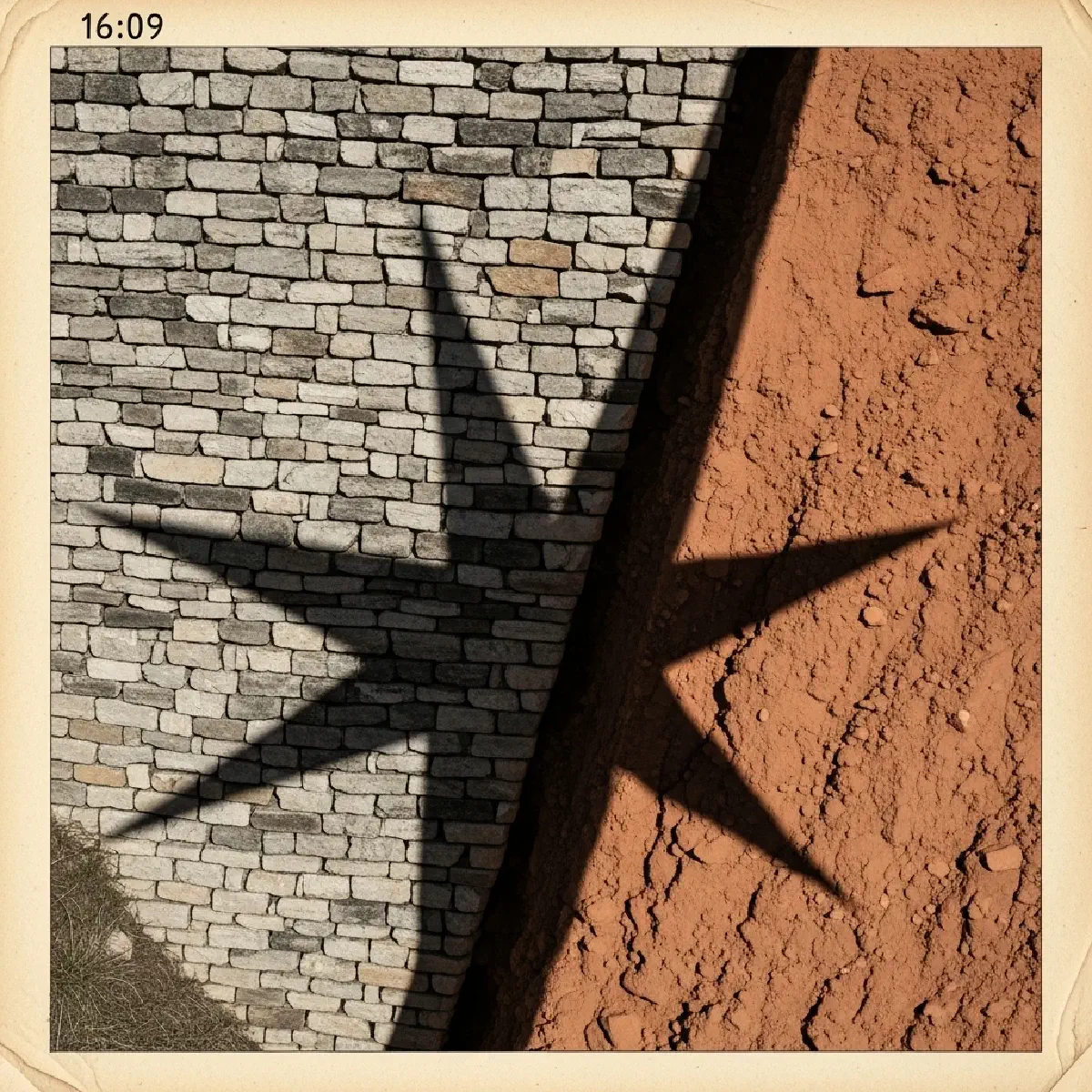
The most defining feature of the star fort was the angled bastion, which replaced the rounded towers of the medieval period. Round towers created “dead space” where direct fire could not reach attackers sheltering near the base of the wall. By extending towers into diamond-shaped points, engineers eliminated this cover, channeling attackers into carefully constructed “kill zones”. This allowed for “enfilade” or flanking fire, where defenders could shoot at the exposed sides of a charging enemy from protected positions along the curtain wall.
The Crucible of Impact Geometry#
To further negate the power of the cannon, engineers developed the glacis—a massive, gently sloping bank of earth in front of the ditch. The glacis served a critical hydrodynamic-like purpose: it almost totally hid the walls from horizontal fire and forced incoming projectiles to strike at an oblique angle. This minimized the normal force component acting perpendicular to the wall, dramatically reducing the energy transfer and preventing “point-blank” destructive shots. Additionally, ditches were widened to ensure that any infantry attempting to scale the lower walls remained exposed to high-elevation fire for as long as possible.
The Cascade of Strategic Consequences#
The rise of the trace italienne fundamentally changed the nature of warfare, shifting the focus from open-pitch battles to protracted sieges. Because these forts were so difficult to take, army sizes increased dramatically to effectively surround and invest them. The “defense in depth” provided by tiers of ramparts meant that an attacker needed to breach multiple layers before reaching the inner citadel. This architectural stalemate forced the development of specialized siege sciences by figures like Vauban, who developed systematic methods for zig-zagging trenches to approach walls without being eviscerated by enfilade fire.
The Modern Echo of Geometric Defense#
The star fort became obsolete in the 19th century with the invention of the explosive shell, which rendered intricate geometric wall patterns irrelevant against plunging fire. However, the core principle of using geometry to redirect force is still seen in modern tank design, where “sloped armor” is used to increase the effective thickness of steel against incoming projectiles. Just as the star fort utilized the glacis to deflect cannonballs, modern armored vehicles use angled plates to induce ricochets, proving that the geometric negation of force remains a cornerstone of defensive systems innovation.