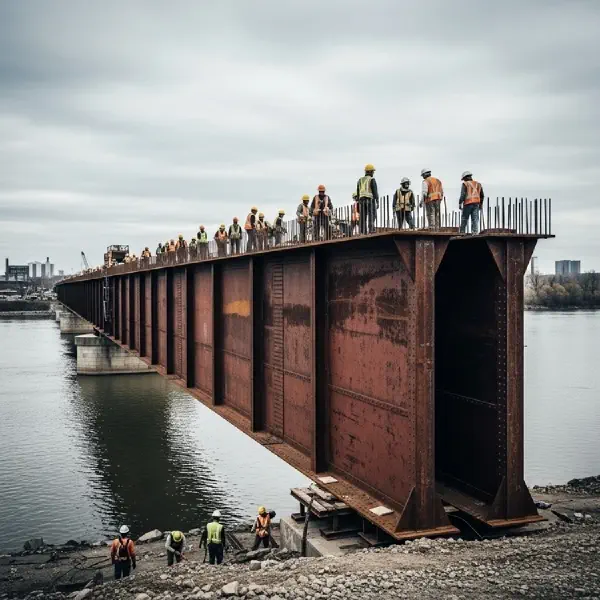
On February 25, 1987, an architectural photographer in Seattle captured the terrifying sight of a 15-story steel frame folding onto itself. The north addition to the University of Washington stadium, a massive assembly intended to seat 20,000 people, vanished into a cloud of dust in seconds. Just an hour prior, a worker had reported a single structural member beginning to buckle, allowing for a life-saving evacuation. In Golden, Colorado, seventeen years later, a similar theme emerged when a bridge girder for the State Route 470 overpass sagged and struck a vehicle, killing three people. Both incidents occurred during the “vulnerable window” of construction, when a structure is most dependent on temporary support. These failures highlight a persistent industry blind spot: the gap between a structure’s final strength and its temporary instability.
The Primacy of Temporary Stability#
A structure is not a building until it is complete; until that moment, it is a collection of components that must be artificially sustained. Temporary bracing is as vital to public safety as the permanent steel bents and concrete piles that follow.
The Mechanics of the Unbraced Cantilever#
The University of Washington stadium collapse was caused by inadequate temporary support for its nine steel bents. Each bent featured a cantilever truss with large wide-flange sections for the top chord and steel pipe sections for the bottom. In its finished state, the stadium would gain lateral stability from braced frame action, cross-bracing, and diaphragm action from the roof deck. However, none of these features were in place on the morning of the collapse. Without this bracing, the structure was inherently unstable under gravity loads alone. Forensic investigations proved that some stabilizing cables had been removed that morning to facilitate the speed of erection.
The Human Factor and Technical Bias#
Following the Seattle collapse, a labor union official incorrectly blamed the failure on “imported steel”. This highlights a common cognitive bias where observers look for material flaws rather than systemic procedural errors. Forensic analysis confirmed the steel met all design specifications; the failure was purely an issue of erection procedure and lack of support. Similarly, the Colorado SR 470 collapse was managed by a subcontractor whose safety officer had no engineering training. This individual designed a bracing scheme using steel angles cut on-site, which reduced their effective strength by 50%. No Registered Professional Engineer was involved in reviewing the plan.
The Failure of the Expansion Bolt#
In the Colorado incident, the failure of the temporary bracing system was a result of gross installation deficiencies. The girder was installed out-of-plumb, leaning toward the existing bridge, which significantly increased the loads on the braces. The expansion bolts used to secure the bracing to the concrete deck were improperly installed; the holes were oversized (0.90 in. for 0.75 in. bolts) and the bolts were not embedded to the minimum required depth of 3.25 in. Over three days, wind loads and lateral vibrations caused these incorrectly installed bolts to pull out. Because the contractor failed to install the intended cross-bracing, the entire system lacked the redundancy needed to prevent a collapse once the first brace failed.
Engineering the Process, Not Just the Product#
The Seattle project recovered and was completed in time for football season, but the economic loss was substantial. In Colorado, the lack of oversight by the Department of Transportation led to stricter requirements for prequalifying subcontractors. These cases prove that “falsework” is not secondary to the main project; it is the project. Modern standards now mandate that erection plans for safety-critical work be prepared and approved by Registered Professional Engineers. Stability failures remain a frequent risk in steel and precast concrete assembly, reminding us that gravity never waits for a project to be “finished”.