
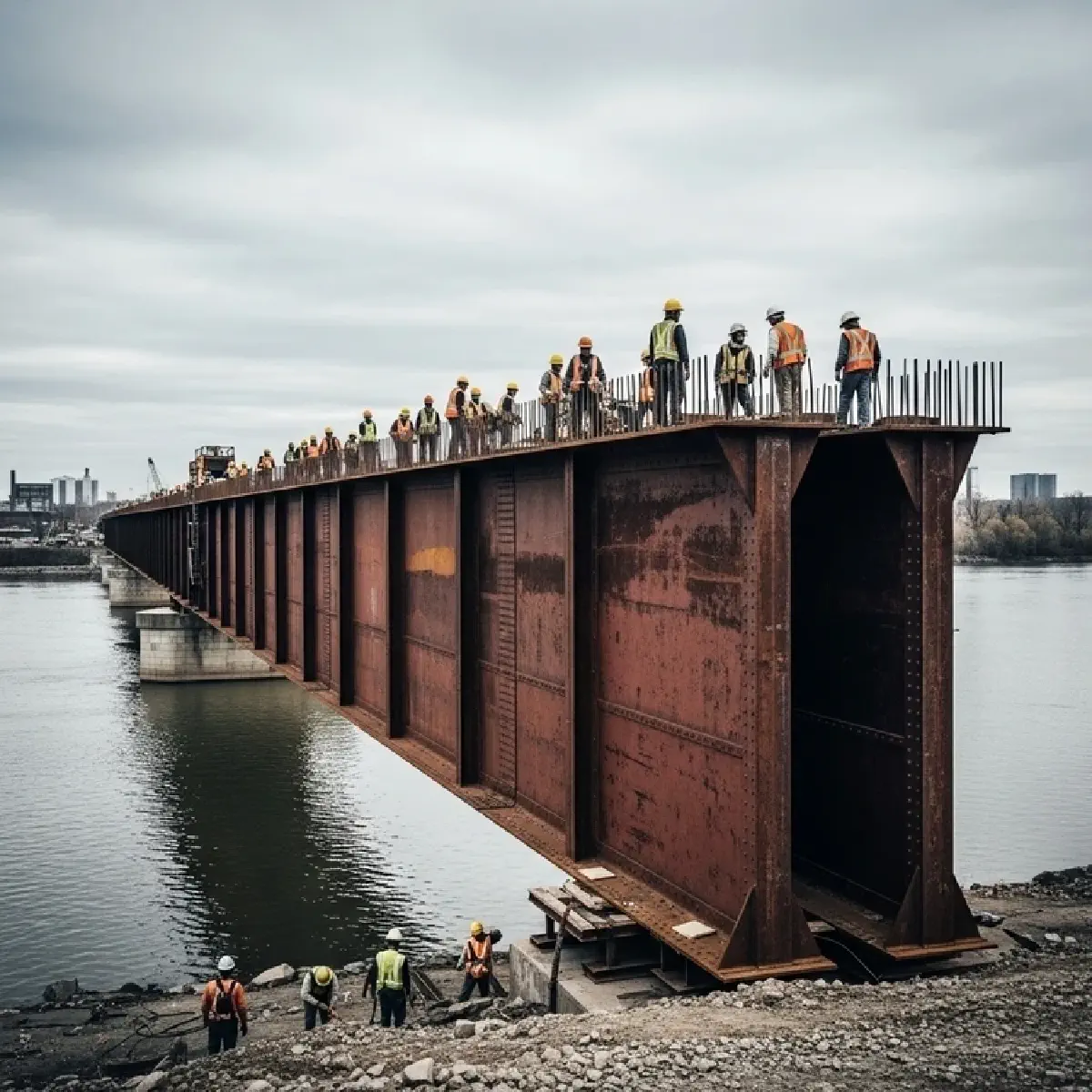
At 11:50 a.m. on October 15, 1970, the quiet of Melbourne was shattered by the sound of 2,000 tonnes (2,000 tons) of steel and concrete crashing into the Yarra River. The West Gate Bridge, intended to be an iconic 2,583 m (8,473 ft) link for 112.7 km/h (70 mi/h) traffic, had suffered a catastrophic failure during its construction. Thirty-five workers lost their lives in a collapse that took only seconds but was preceded by weeks of mounting technical tension. The project represented the cutting edge of box girder design, a system prized for its aerodynamic stability and low profile. Yet, as the twisted metal settled into the riverbed, it became clear that the bridge’s undoing lay in the intersection of specialized engineering and fragmented management. This disaster remains a foundational case study in how small misalignments in physics can amplify through poor communication to create tragedy.
The Imperative of Constructional Oversight#
The West Gate Bridge collapse demonstrates that the integrity of a structure is not merely a product of its final design but is entirely dependent on the rigor of its erection sequence. Engineering safety must extend beyond the finished blue-print to include every temporary state the material occupies during assembly.
The Mechanics of the Trapezoidal Skin#
The West Gate was designed as a five-span continuous steel box girder where the “skin” of the system resisted bending, shear, and torsion. This trapezoidal design utilized boxes 4 m (13.1 ft) deep and 16 m (52.5 ft) long, fabricated on the ground before being raised into position. These structures are efficient but notoriously sensitive; the steel plates are subject to distortion during fabrication, making buckling difficult to predict accurately. In this case, the construction method required joining two separate half-spans in the air to create a cantilever. Success depended on the perfect alignment of these massive components, a task that tested the limits of 1970s structural steel practice.
The Transatlantic Communication Gap#
The failure was deeply rooted in an “unusual erection plan” and a lack of coordination between stakeholders. The design engineer was located in London, halfway around the world from the Melbourne site, which complicated the immediate review of field problems. Furthermore, the original contractor was replaced partway through the project by a firm with limited experience in structural steel. This new contractor was forced to follow a complex procedure established by their predecessor without fully grasping the risks. When field difficulties arose, the absence of a localized, qualified engineering team meant that critical decisions were made without adequate technical vetting.
The Cascade of the Kentledge#
The immediate trigger for the collapse was a 114 mm (4.5 in.) misalignment in the camber of a new half-span. To force the alignment, workers used seven 8-ton concrete blocks, known as kentledge, to load down the steel. This massive weight caused an inner upper panel to buckle, creating a 88.9 mm (3.5 in.) bulge. In an attempt to “flatten” this bulge, bolts were removed from a transverse splice. Once 30 bolts were removed, the buckle spread into adjacent panels. The span lost its ability to support its own weight, and despite 50 minutes of visible warning, the site was not evacuated.
The Weight of Professional Responsibility#
The West Gate Bridge eventually opened in 1978, but its cost had ballooned from 22 million to 200 million Australian dollars. The Royal Commission of Inquiry placed the primary blame on the design engineer for failing to ensure an adequate margin of safety during the erection phase. It also cited the contractor for failing to recognize the extreme care required by the assembly plan. The tragedy forced the industry to adopt mandatory, detailed erection sequence plans that consider structural stability at every stage. Today, the bridge stands as a testament to the fact that technical expertise is useless if it is not integrated with experienced on-site leadership.