Beyond the Combustion Paradigm#
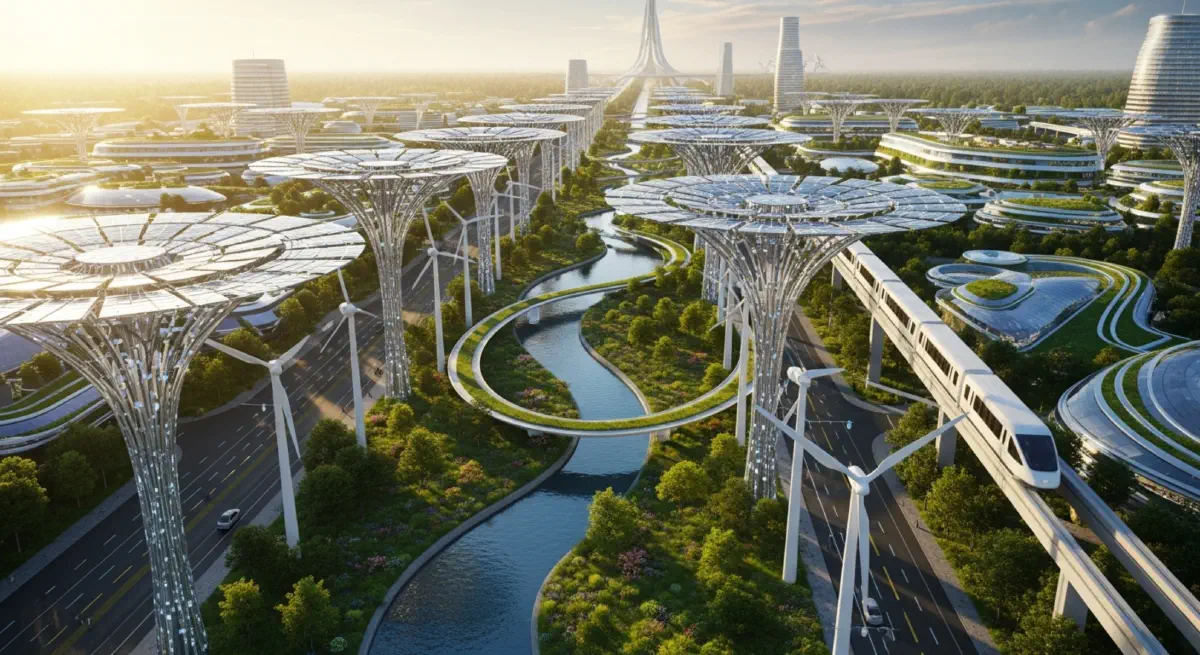
The defining project of the 21st century is thermodynamic redesign. We must transition from a civilization that finances complexity by burning ordered stores of ancient carbon to one that harvests energy from contemporary, renewable gradients while rigorously minimizing and cycling material waste. This is not merely a technical shift but a foundational reimagining of our relationship with energy and matter. The goal is to create a steady-state dissipative structure that maintains a high level of human well-being and cultural complexity within the constant, but diffuse, energy flows provided by the sun, wind, and planetary heat. Success requires obeying two cardinal principles: powering society with income, not capital, and designing all material flows to be circular, not linear.
The Pillars of a Post-Entropic Civilization#
A civilization aligned with thermodynamic reality would be architected around three interdependent systems: energy capture from renewable gradients, radical material circularity, and a social framework that values resilience over relentless growth. Each addresses a facet of the entropy debt. This is not a regression but an evolution toward a sophisticated, dynamic equilibrium—a society that thrives by working with, not against, the fundamental flows of the planet.
Engineering with Solar-Scale Gradients#
The renewable energy transition replaces concentrated fossil gradients with wider, shallower ones. A photovoltaic panel does not “consume” sunlight; it temporarily steers a portion of the vast, continuous solar energy flow through human infrastructure. The challenge is integration and storage, not scarcity. The total solar energy striking the Earth in 90 minutes exceeds humanity’s annual energy use. The key is designing a grid and an economy flexible enough to match demand to these variable, but predictable, flows. This necessitates a shift from baseload thinking to dispatchable demand—using smart systems to charge electric vehicles, run desalination plants, or synthesize fuels when the sun shines and the wind blows. It also requires diversifying gradients: complementing solar and wind with geothermal (tapping the Earth’s internal heat gradient) and next-generation nuclear, which offers a powerful, dense gradient with minimal land use and the potential for advanced waste recycling. The aim is a resilient, multi-gradient energy portfolio.
Closing the Material Loops: From Economy to Metabolism#
Energy decarbonization solves only half the equation. A sustainable civilization must also halt the one-way flow of materials from mine to dump. This is the domain of the circular economy, inspired by biological systems where waste equals food. It demands a three-pronged strategy: dematerialization (doing more with less, through design and digitalization), durability and repairability (designing products for long life and easy maintenance), and high-value recycling (designing materials and systems to keep molecules in continuous, non-degrading loops). For instance, a smartphone should be modular, its rare earth elements recoverable with 95% efficiency, and its casing biodegradable or infinitely recyclable. This requires policy levers like extended producer responsibility, material passports, and tax shifts from labor to virgin resource extraction. The built environment must become a material bank, where every beam, panel, and pipe is a logged asset for future disassembly and reuse.
Cultivating Thermodynamic Literacy and Resilience#
The final, most profound pillar is cultural. Our institutions, economics, and values are still wired for the fossil age of apparent abundance. We need to cultivate thermodynamic literacy—a widespread understanding that all wealth and activity are underpinned by energy and material flows with real-world consequences. Economics must internalize externalities, pricing carbon and pollution to reflect their true entropic cost. Progress metrics must shift from GDP, which conflates waste cleanup and disaster recovery with prosperity, to indicators of genuine wealth: the health of natural capital, the robustness of infrastructure, and social cohesion. Governance must prioritize long-term resilience over short-term extraction, managing shared gradients (like the atmosphere) as global commons. This cultural shift turns restraint from sacrifice into a marker of sophistication and foresight.
A Civilization in Dynamic Balance#
The vision is not of a static, impoverished world, but of a dynamic, sophisticated, and enduring one. It is a civilization that draws its creativity from the daily gift of sunlight, whose buildings and products are nutrient cycles in disguise, and whose citizens understand the physical roots of their prosperity. This path offers liberation from the existential anxiety of the entropy debt. It replaces the frantic boom-bust cycle of resource depletion with the steady rhythm of renewal. The transition will be the most complex thermodynamic project humanity has ever undertaken, requiring not just new technology but new laws, new business models, and a new story of what it means to prosper. Yet, the physics is clear: open, linear systems in a finite environment inevitably fail. Closed-loop, solar-powered systems can persist. The choice is between a final, exhausting blaze of fossil glory or learning, at last, to tend a perpetual flame.