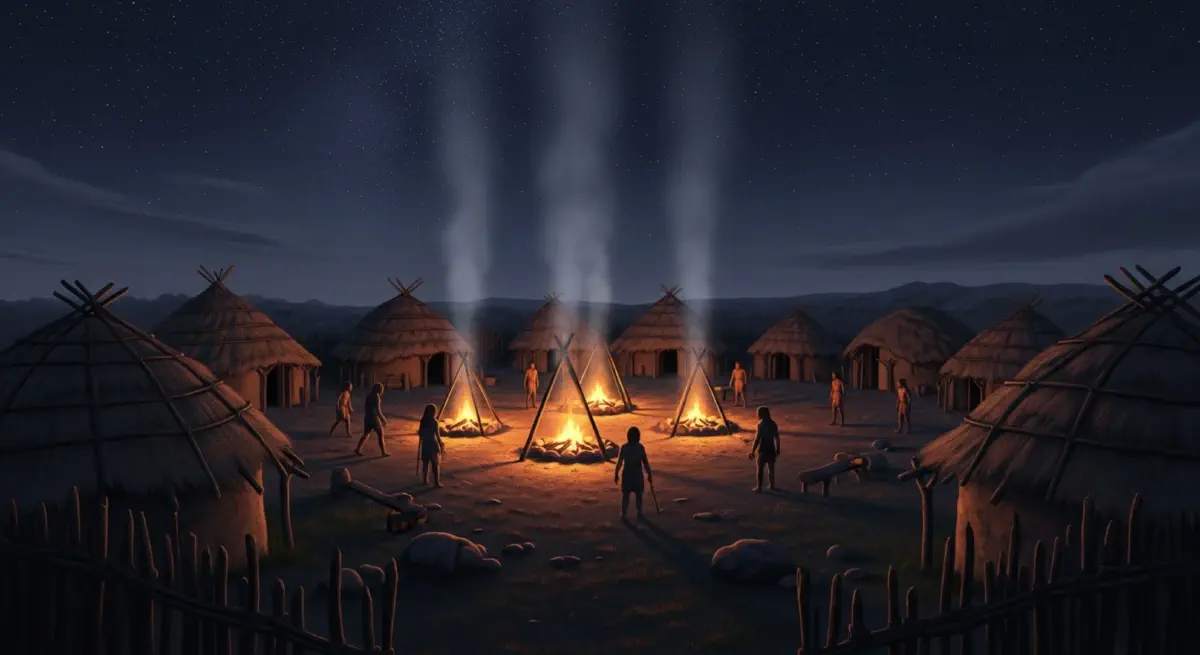
A Spark in the Dark#
Somewhere between 1.5 million and 400,000 years ago, a hominin did something unprecedented. They did not merely capture fire from a lightning strike or volcanic flow; they learned to ignite it, sustain it, and control its release of stored solar energy. This was not just a technological milestone. It was humanity’s first major thermodynamic revolution. With controlled combustion, our ancestors unlocked energy densities thousands of times greater than their own metabolism could provide. They could now cook, breaking down tough tubers and denaturing toxins, which increased usable caloric intake by an estimated 30-50%. More energy in meant less energy spent on digestion, fueling the expansion of a calorie-hungry organ: the brain. Fire was the original catalyst, transforming raw biomass into structured social possibility. It presented a paradox that would define all future progress: every leap in harnessing energy creates new forms of order, but also new, often invisible, forms of waste and vulnerability.
Civilization as a Dissipative Structure#
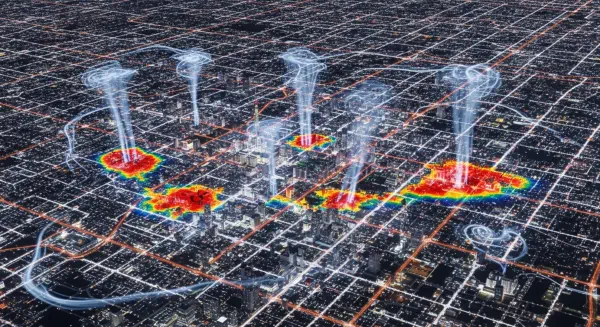
We must understand human societies not merely as cultural or political constructs, but as dissipative structures. This concept, drawn from non-equilibrium thermodynamics, describes systems—like whirlpools, hurricanes, or living cells—that maintain their internal complexity and order by continuously drawing energy from their environment and exporting entropy, or disorder, back out. A city is a quintessential dissipative structure. It maintains its organized streets, buildings, and social networks by importing vast flows of energy (food, fuel, electricity) and raw materials, while exporting waste heat, sewage, and garbage. The grand narrative of human history, from foraging bands to global empires, is the story of learning to capture ever-steeper energy gradients—the difference between high-energy and low-energy states—and channel that energy flow to build and sustain more complex societal structures. The measure of a civilization’s scale and sophistication has always been, at its physical core, its energy flux.
The First Gradient: Mastering Combustion#
Before agriculture, fire provided the first major external energy gradient. It altered the very material basis of life. Cooked food increased net energy gain, allowing for smaller guts and larger brains—a biological reinvestment of thermodynamic surplus. Fire extended the day, providing light and warmth, which reduced predation risk and created time for social bonding and tool-making. It became a tool for ecosystem engineering, used for hunting and clearing land. Critically, controlling fire required and reinforced social coordination and knowledge transmission, laying the groundwork for culture. This initial mastery of an exosomatic (outside-the-body) energy source set a template: technological innovation is, fundamentally, the discovery of a new way to degrade a concentrated energy source into useful work and diffuse waste.
The Agricultural Crucible: Storing Sunlight#
The Neolithic Revolution was a thermodynamic optimization, not an energy windfall. Early farming was often more labor-intensive and nutritionally poorer than foraging. Its advantage was predictability and storability. Agriculture allowed humans to capture and stockpile solar energy in the form of grains, creating a dense, portable, and taxable energy reserve. This created a surplus that could support non-food-producing specialists—priests, soldiers, artisans—enabling social stratification and urbanism. However, this new order came with severe entropic costs. Monocropping depleted soil nutrients, a form of material entropy. Irrigation led to salinization. The energy stored in granaries had to be protected, leading to militarization and social inequality. The system’s complexity now required constant energy input to maintain against the relentless pull of decay, conflict, and environmental degradation.
The Imperial Metabolism: Scaling the Gradient#
Bronze Age empires like Rome and Han China represented a new scale of energy metabolism. They operated as continent-scale engines, using bureaucratic and military systems to funnel energy gradients from peripheries to cores. Roman annona (the grain dole) was a massive thermodynamic transfer, moving the stored solar energy of Egyptian and North African wheat to fuel the population of Rome. The empire’s famous roads and aqueducts were not just engineering marvels; they were low-friction conduits for energy and material flow. Yet, this scaling amplified the system’s vulnerabilities. Maintaining these flows against logistical entropy—decaying infrastructure, rebellion, distant frontier wars—required ever more energy. When the cost of capturing new energy gradients (through conquest) exceeded the energy returned, or when internal waste streams (like lead poisoning from pipes or soil exhaustion) accumulated, the complex structure could no longer be sustained. The empire, as a dissipative structure, collapsed to a lower-energy state.
The Fire’s Legacy#
The controlled spark of our distant ancestors ignited a chain reaction that still defines our trajectory. Fire taught us that progress is thermodynamic: it requires identifying a gradient, harnessing its flow, and managing the resulting waste. The transition from foraging to farming to empire was not a straight line of improvement, but a series of adaptations to manage increasingly complex energy flows and their entropic consequences. Each stage solved problems of scarcity and stability but created new, larger-scale problems of waste, vulnerability, and maintenance. We inherited from this first revolution a relentless logic: complexity must be fed. The hearth fire that warmed a small band has scaled into the global industrial furnace, but the underlying physical principles remain immutable. Recognizing this is the first step to understanding why our current civilization, for all its technological marvels, faces a thermodynamic crisis of unprecedented scale. The question is no longer whether we will transition, but whether we can design the next transition with an awareness of entropy that our ancestors, for all their brilliance, could not yet see.