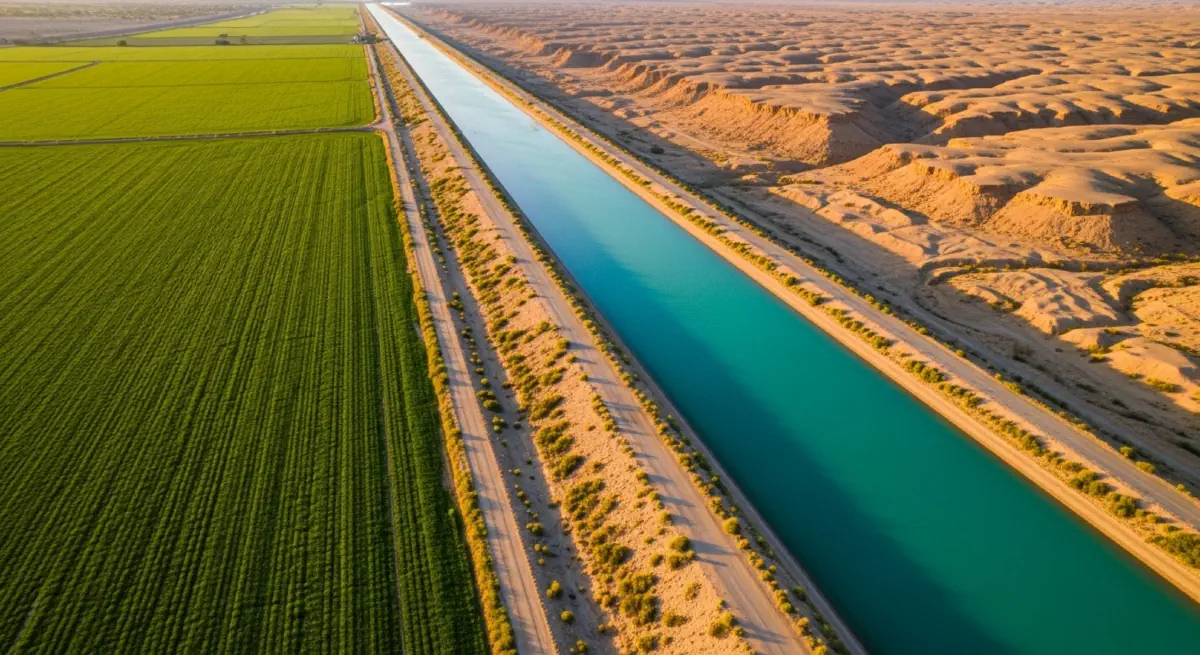
The Water Productivity Gap (WPG) reveals chronic underperformance: WPG = Highest-efficiency irrigated caloric yield (kcal/m³) ÷ national average caloric yield per m³ for the same crop type. The global average WPG for irrigated wheat is approximately 3–5: the best-practice yield per cubic metre is 3–5× the global average. This gap represents agricultural water that is consumed without producing proportional food value.
Virtual water trade is the mechanism that prevents water scarcity from becoming famine: The Middle East and North Africa region imports approximately 50–60 km³/yr of virtual water embedded in food — equivalent to the annual flow of the Nile. This invisible transfer substitutes for water that does not exist in the importing countries. Disrupting the food trade routes that carry this virtual water would trigger food crises in countries already at or below water stress thresholds.
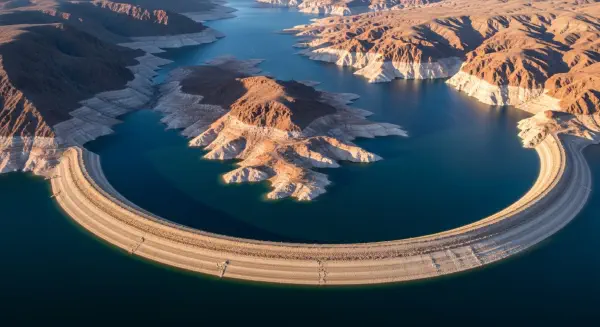
Aquifer depletion is drawing down a non-renewable account: The Ogallala Aquifer holds approximately 3,600 km³ of water accumulated over 6–25 million years. Current depletion averages approximately 26 km³/yr against natural recharge of approximately 0.1 km³/yr — a SCDR-equivalent ratio of 260:1. At current depletion rates, significant portions of the aquifer serving Kansas and Texas will be economically depleted within 25–50 years.
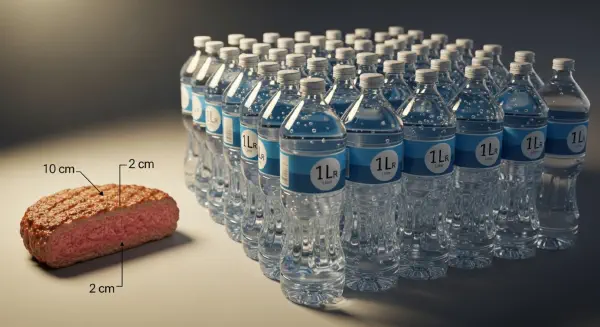
Diet transition is the most powerful lever on aggregate water demand: Moving the protein share of diet from ruminant livestock toward legumes, poultry, and plant-based proteins reduces water demand per kilocalorie by a factor of 5–15. A population-scale dietary shift toward the lower quartile of meat consumption would free approximately 1,000–1,500 km³/yr of agricultural water — comparable to several Nile Rivers annually.
Water pricing at cost is the precondition for WPG improvement: Irrigated agriculture receives water at approximately 10–30% of its economic cost in most major agricultural regions due to infrastructure subsidies and historical allocation rights. This systematic underpricing removes the economic incentive to invest in efficiency improvements that would close the WPG. Israel's drip irrigation revolution — achieving WPG approximately 4–5× the regional baseline — was enabled by a pricing structure that made every cubic metre of water a cost to be minimised.
Allan, J.A. (1998). Virtual water: A strategic resource — Global solutions to regional deficits. Ground Water, 36(4), 545–546.
Chapagain, A.K., & Hoekstra, A.Y. (2004). Water footprints of nations (Vol. 1). UNESCO-IHE.
Hoekstra, A.Y., & Mekonnen, M.M. (2012). The water footprint of humanity. Proceedings of the National Academy of Sciences, 109(9), 3232–3237.
Gleick, P.H. (2014). The world's water: The biennial report on freshwater resources. Pacific Institute.
Micklin, P. (2007). The Aral Sea disaster. Annual Review of Earth and Planetary Sciences, 35, 47–72.
Scanlon, B.R., Faunt, C.C., Longuevergne, L., Reedy, R.C., Alley, W.M., McGuire, V.L., & McMahon, P.B. (2012). Groundwater depletion and sustainability of irrigation in the US High Plains and Central Valley. Proceedings of the National Academy of Sciences, 109(24), 9320–9325.
Oki, T., & Kanae, S. (2006). Global hydrological cycles and world water resources. Science, 313(5790), 1068–1072.
Foley, J.A., Ramankutty, N., Brauman, K.A., Cassidy, E.S., Gerber, J.S., Johnston, M., ... & Zaks, D.P. (2011). Solutions for a cultivated planet. Nature, 478(7369), 337–342.
Postel, S. (1999). Pillar of sand: Can the irrigation miracle last? W.W. Norton.
Gleick, P.H., & Palaniappan, M. (2010). Peak water limits to freshwater withdrawal and use. Proceedings of the National Academy of Sciences, 107(25), 11155–11162.
Shiklomanov, I.A. (1993). World fresh water resources. In P.H. Gleick (Ed.), Water in crisis: A guide to the world's fresh water resources. Oxford University Press.
Mekonnen, M.M., & Hoekstra, A.Y. (2016). Four billion people facing severe water scarcity. Science Advances, 2(2), e1500323.
Pimentel, D., Berger, B., Filiberto, D., Newton, M., Wolfe, B., Karabinakis, E., ... & Nandagopal, S. (2004). Water resources: Agricultural and environmental issues. BioScience, 54(10), 909–918.
FAO. (2020). The state of the world's land and water resources for food and agriculture (SOLAW 2021): Systems at breaking point. Food and Agriculture Organization of the United Nations.
Examines the governance architecture of water — nineteenth-century law, political seniority allocation, and sub-economic pricing — against the arithmetic of transboundary conflict, desalination economics, and governed commons.
Applies water productivity data by food type and the Israel irrigation efficiency model to demonstrate that the Water Productivity Gap could be substantially closed through dietary and irrigation change without additional dam construction.
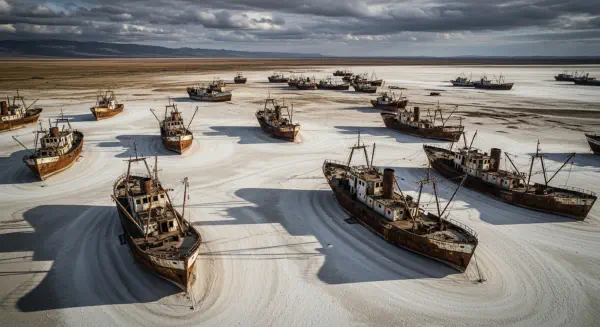
Reconstructs the Aral Sea collapse as a Water Productivity Gap failure, and applies the same arithmetic to the Ogallala Aquifer depletion and Saudi Arabia's fossil groundwater draw-down — both proceeding toward the same terminal outcome.
Introduces Tony Allan's virtual water concept and applies Water Productivity Gap analysis to show that food trade is a hidden water transfer whose geopolitical implications are rarely captured in trade or food security frameworks.