The Farmer Who Stopped Ploughing#
In 1993, Gabe Brown's farm near Bismarck, North Dakota, received 150 millimetres of rain in a single event that filled his newly seeded fields with water and killed most of that year's crop. The following year, a late spring frost destroyed his winter wheat. In 1995, a hailstorm flattened his crops again. And in 1996, another hailstorm hit. Four consecutive years of near-total crop failure left him in severe debt to his bank, facing the same choice that had driven hundreds of thousands of Great Plains farmers out of farming. He could not afford to continue farming the way he had been farming.
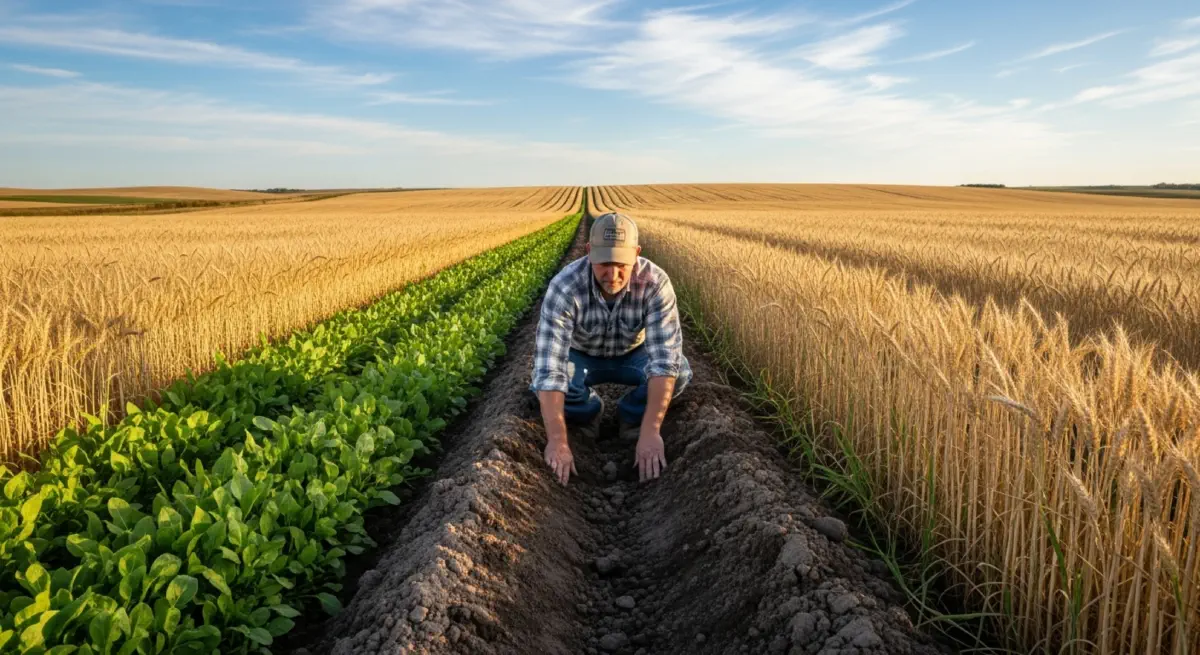
Unable to pay for conventional synthetic inputs, and with no cash to rent a ploughing contractor, Brown stopped ploughing. He left the debris of his destroyed crops as ground cover. He planted a mixture of cover crop species — not a single variety, as conventional practice dictated, but fourteen or fifteen species simultaneously — across his fields. When he finally had crops to sell, he integrated cattle into the cover crop rotation, letting them graze down the residues rather than mechanically removing them. These practices — born of financial necessity rather than ideological commitment to any farming philosophy — transformed the biology and physics of his soil over the next fifteen years in ways that his subsequent soil testing quantified with increasing precision.
Brown's organic matter content in 1993 was approximately 1.7% — near the historical post-cultivation baseline for North Dakota cropland, which had seen its original 6–8% organic matter content depleted by decades of conventional tillage. By 2012, after nineteen years of no-till, diverse cover cropping, and integrated livestock, organic matter had reached approximately 6.1%. His SCDR — estimated from erosion measurements and cover crop biomass — had dropped from approximately 8–12 (conventional tillage baseline for his soil type and slope) to approximately 0.3–0.5: the soil was gaining faster than it was losing.
The Evidence Base for Soil Regeneration#
The No-Till Literature#
The academic evidence base for no-till soil carbon accumulation is now substantial. A meta-analysis by Poeplau and Don published in Agriculture, Ecosystems & Environment in 2015 examined 139 paired field comparisons of no-till versus conventional tillage soils. Mean soil organic carbon in the 0–30 cm layer was approximately 8% higher in no-till plots after a median of 18 years of adoption. The accumulation rate was approximately 0.3–0.5 tonnes C/hectare/year in the transition period, slowing toward a new higher equilibrium after 20–30 years. A subsequent 2017 meta-analysis by Bai et al. covering 235 published studies found mean carbon accumulation rates of approximately 0.32 tonnes C/hectare/year in the 0–30 cm layer, consistent across climate zones.
The SCDR improvement from no-till stems from three concurrent mechanisms: physical (the absence of ploughing eliminates the primary mechanism driving soil aggregate disruption and organic matter oxidation), biological (undisturbed soil biology rebuilds mycorrhizal networks, macrofauna populations, and stable aggregate-protected organic carbon), and hydraulic (higher organic matter increases water infiltration, reducing surface runoff and erosive water velocity). Water erosion under continuous no-till with cover is typically 80–95% below erosion from conventionally tilled bare soil under equivalent rainfall intensity, according to USDA NRCS erosion model comparisons.
No-till agriculture now covers approximately 180 million hectares globally — approximately 12.5% of global arable land — concentrated in the Americas (Brazil, Argentina, USA, Canada), Australia, and Kazakhstan. The adoption trajectory has been approximately 4–5% per year globally over the past fifteen years. At this rate, no-till would cover approximately 350–400 million hectares by 2040. Complete conversion would require additional market and policy signals, since no-till with cover cropping typically requires higher management intensity and may show yield penalties in the 3–8 year transition period before soil health recovery supports competitive yields without synthetic inputs.
The Cover Crop Premium#
Cover crops — non-cash crops grown primarily to cover soil between main crop cycles — address the biological and physical exposure processes that conventional monoculture creates. A typical cash-grain rotation in the US Corn Belt (corn-soybean with winter fallow) leaves the soil surface bare, physically exposed, and biologically dormant for approximately 4–6 months per year. A continuous cover crop programme using overwintered mixtures of cereal rye, hairy vetch, crimson clover, and radish maintains a living root in the soil year-round, adds organic matter annually from root exudates and aerial biomass, and suppresses weeds without herbicide through physical competition and allelopathic soil chemistry.
USDA and university extension trials across the Corn Belt over the past two decades have documented consistent SCDR improvements under cover cropping: erosion reductions of 50–90%, organic matter accumulation of 0.15–0.40 tonnes C/hectare/year, and moisture retention improvements of 20–30 mm/growing season equivalent that translate to drought resilience. The economic case is mixed in the short term: cover crop seed costs approximately $30–80/hectare, termination adds $15–30/hectare, and yield in the first 3–5 years of adoption may be 3–8% below conventional comparators as the system adjusts. After 7–10 years, comparison trials on Brown's farm and at research stations in Iowa, Ohio, and Illinois begin to show yield parity or advantage, attributed to improved soil water holding capacity and reduced fertiliser requirements.
The Policy Architecture Required#
The market failure preventing rapid no-till and cover crop adoption mirrors the market failure in water pricing: the benefits accrue diffusely (reduced flooding, improved water quality, carbon sequestration, long-run yield resilience) while the costs fall on individual farmers in a short-term productivity penalty during transition. The Conservation Reserve Program (CRP), the Environmental Quality Incentives Program (EQIP), and the recently expanded USDA Inflation Reduction Act climate-smart agriculture programmes provide partial cost-sharing for cover crop adoption — approximately $30–50/hectare/year in some regions — that closes a portion of the economic gap but does not fully compensate farmers for the transition risk.
Carbon markets, if sufficiently liquid and credibly monitored, provide an additional potential revenue stream: at a soil carbon credit price of $20–50/tonne CO₂e, a farm achieving 0.4 tonnes C/hectare/year accumulation (~1.5 tonnes CO₂e/hectare/year) earns $30–75/hectare/year in carbon credits — sufficient to cover cover crop costs in many scenarios. The credibility infrastructure for soil carbon credits — measurement, reporting, and verification systems that can confirm actual soil carbon changes at farm scale — is developing but not yet mature. Remote sensing combined with machine learning models is being piloted to estimate soil organic carbon changes from satellite spectral data with sufficient precision to underpin credible markets at scale; several startups and established financial institutions are active in this space.
The soil bank analogy that structures this series is ultimately the most precise frame. A bank that draws down its capital 10–40 times faster than it is being deposited is not a going concern. A farm that restores its SCDR below 1.0 is not merely performing better agronomically — it is restoring the capital base that makes the farm viable across multiple human generations. Gabe Brown's farm in North Dakota is not unique: it is an existence proof, replicated now at hundreds of commercial farms across four continents, that the soil bank can be regenerated. The question is not whether the technology exists to do this. The question is whether the price signals, the policy support, and the knowledge transfer capacity exist to scale it in the time available before the capital depletion becomes irreversible.