The Biologist Who Weighed a World#
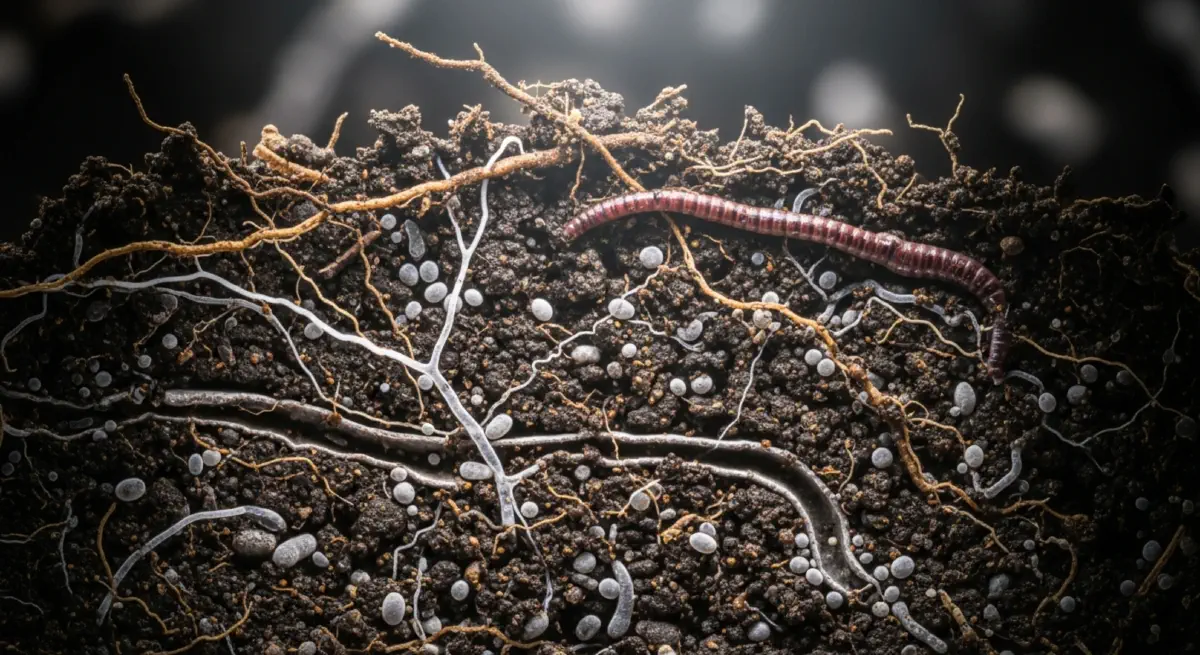
In 1994, Elaine Ingham, a soil microbiologist at Oregon State University, published a laboratory analysis of a single gram of agricultural topsoil from a conventionally tilled wheat field in the Willamette Valley. Her laboratory's extended microscopy and plating counts established the microbial composition: approximately 600 million bacteria of approximately 10,000 distinct species; 20,000 metres of fungal hyphae; 10,000 protozoa; 20–30 nematodes. Ingham noted that this count was from a degraded soil — a field under conventional tillage with regular fungicide and herbicide application. Healthy, undisturbed grassland topsoil, she had found in comparative studies, contained five to ten times more organisms per gram: up to five billion bacteria, hundreds of thousands of metres of fungal hyphae, and millions of protozoa.
She then attempted to value what those organisms performed. The nitrogen-fixing bacteria alone — converting atmospheric nitrogen gas to plant-available ammonium — were providing nitrogen inputs equivalent to approximately 50–100 kilograms of synthetic fertiliser per hectare per year in healthy grassland soils. The mycorrhizal fungi were exchanging approximately 20–30% of a plant's photosynthesised carbon for phosphorus and water that the fungal hyphae could access in micropores too small for plant roots. The bacterivore nematodes grazing on bacteria were mineralising approximately 30–50% of plant-available nitrogen from bacterial biomass. The predatory beetles and arthropods in the soil profile were consuming pest organisms that would otherwise damage root systems. And the earthworms — up to five million per hectare in healthy temperate grassland — were physically mixing, aerating, and structuring the soil at a rate equivalent to the top 30 centimetres of soil being completely turned over approximately once every one to five years.
This biological economy — invisible, unpriced, and largely unknown to the agricultural policymakers who set the incentives for farming practices — was providing services worth trillions of dollars annually in substitution value for the synthetic inputs and machinery that would be needed to replicate its functions. The Soil Capital Depletion Rate measures the physical loss of soil mass. The biological SCDR — the rate of depletion of soil biological capital — is arguably more consequential and harder to reverse.
The Biology That Industrial Agriculture Destroys#
Tillage and the Fungal Network#
The mycorrhizal network — the web of fungal hyphae connecting plant root systems through the soil — is among the most important biological structures in terrestrial ecology. In an undisturbed natural ecosystem, approximately 80–90% of terrestrial plant species form mycorrhizal associations with soil fungi. The fungal partners of the network extend the effective root exploring volume of their plant hosts by approximately 100–1,000 times: the finest fungal hyphae, approximately 2–5 micrometres in diameter (100× thinner than a root hair), penetrate soil pores inaccessible to roots and transport phosphorus, nitrogen, water, and micronutrients back to the host plant in exchange for photosynthate (carbohydrate). In phosphorus-limited soils — which includes most natural and agricultural soils outside heavily fertilised systems — mycorrhizal phosphorus uptake accounts for approximately 70–90% of all plant phosphorus acquisition.
Deep ploughing — the inversion of the top 20–30 centimetres of soil to bury crop residues and disturb weed germination — severs fungal hyphal networks throughout the plough layer. Recovery of mycorrhizal networks after a single ploughing event takes approximately 4–8 weeks in warm, moist conditions; continuous ploughing prevents recovery altogether. A continuously ploughed field maintained under synthetic phosphorus fertilisation is operating without mycorrhizal phosphorus uptake, substituting synthetic NPK for a biological service that the fungal network would supply. The additional cost — the synthetic phosphorus produced from finite phosphate rock deposits at a processing cost of approximately $300–500/tonne P₂O₅, applied at rates of 10–50 kg P/hectare/year — is a direct measure of the economic value of the mycorrhizal service that tillage destroyed.
The dependence on synthetic phosphorus fertiliser has an additional long-run constraint: phosphate rock — the mined mineral from which all synthetic phosphorus fertiliser is produced — is a finite, non-renewable resource. Global phosphate rock reserves are concentrated in Morocco (approximately 72% of worldwide reserves), and best estimates from the USGS suggest economically recoverable reserves will support current production rates for approximately 300–400 years. Soil biological capital is renewable through management; phosphate rock reserves are not. A food system that destroys its biological phosphorus cycling capacity in favour of synthetic phosphorus substitutes is trading a renewable asset for a finite one.
The Carbon Machine in the Soil#
Agricultural soils globally have lost approximately 50–70% of their pre-cultivation carbon content through tillage, residue removal, and land use change. The IPCC's Special Report on Climate Change and Land (2019) estimated that agricultural and land use change emissions account for approximately 23% of annual greenhouse gas emissions — approximately 12 Gt CO₂e/yr — with a significant portion consisting of soil organic carbon oxidation from tillage and drainage of peatlands.
The arithmetic of soil carbon restoration is among the most compelling in climate policy: each 1% increase in soil organic matter content across global agricultural soils represents sequestration of approximately 4–8 Gt CO₂e (the "4 per mille" initiative, launched at COP21 in 2015, proposed that a 0.4% annual increase in global soil carbon stocks would offset all annual fossil fuel emissions — an ambitious but not physically impossible target if agricultural soils are progressively restored toward historical organic matter contents). The carbon sequestration potential exists because the biological sink has been depleted — the soil microbiome, given appropriate conditions, will rebuild its carbon stock if tillage is reduced and organic matter returns are increased.
The mechanism is direct: under no-till management with cover crop integration, the cessation of tillage stops the mechanical disruption that exposes protected soil organic matter to rapid aerobic decomposition. Undisturbed fungal hyphae continue adding glomalin — a glycoprotein that constitutes approximately 27% of stable soil carbon in most agricultural soils — to the soil aggregate structure. Cover crop root systems contribute approximately 0.3–0.5 tonnes C/hectare/year through root exudates and root biomass to soil aggregates that protect carbon from decomposition. Over 5–15 years, soil organic matter can increase by 0.5–1.0 percentage points in many soil types, sequestering 10–25 tonnes CO₂e/hectare in the transition period. The rate of accumulation slows as the soil approaches a new equilibrium, but the stock remains elevated as long as the management practice continues.
The Nitrogen Economy Underground#
The nitrogen cycle in healthy soil is a closed-loop process of remarkable efficiency. Atmospheric nitrogen (N₂, approximately 78% of the atmosphere) is fixed into plant-available ammonium by free-living soil bacteria (primarily Azotobacter and Clostridium species) and by symbiotic nodule-forming bacteria (Rhizobium species in legume root nodules). Fixed nitrogen is used by microorganisms and plants for protein synthesis, then returned to the soil through organic matter decomposition, mineralisation by bacterivore nematodes, and the waste products of the soil food web. Denitrifying bacteria close the loop by returning excess ammonium to atmospheric nitrogen.
Industrial synthetic nitrogen fertiliser — Haber-Bosch process ammonia, produced from natural gas at approximately 1.5–2.0 tonnes of CO₂e per tonne of nitrogen — was developed precisely because the biological nitrogen cycle could not supply sufficiently high nitrogen concentrations at the timing and rate that high-yielding crop varieties needed. But 30–50% of synthetic nitrogen applied to agricultural fields is not taken up by crops — it runs off into waterways (contributing to the hypoxic dead zones in the Gulf of Mexico, Baltic Sea, and over 400 other coastal locations globally) or is denitrified to N₂O, a greenhouse gas approximately 300× more potent than CO₂ over a 100-year horizon. The nitrogen economy of industrial agriculture purchases short-term productivity at the cost of biological nitrogen cycling capacity, persistent eutrophication of water bodies, and N₂O emissions that contribute approximately 3% of annual global greenhouse gas forcing. The next post examines whether this accounting can be reversed — whether the soil bank can be regenerated, and at what cost.