The Professor Who Weighed the Earth#
In 1941, Hans Jenny, a soil scientist at the University of California at Berkeley, published Factors of Soil Formation — a book remarkable not for its size (it was only 281 pages) but for what it accomplished: reducing the enormously complex process of soil genesis to a mathematical framework. Jenny's equation — soil = f(climate, organisms, topography, parent material, time) — expressed for the first time the relationship between the geological and biological forces that produce the material that feeds humanity. Time was the variable Jenny lingered longest on. A centimetre of productive topsoil took, depending on climate and parent material, approximately 200 to 1,000 years to form through the interacting processes of bedrock weathering, organic matter accumulation from decaying vegetation, biological mixing by earthworms and microorganisms, and the slow acidification produced by plant roots. In humid temperate climates, the faster end of that range applies: a centimetre of topsoil per 200–500 years. In semi-arid grassland — the American Great Plains, the Central Asian steppe, the North Chinese Loess Plateau — formation rates slow to the lower end: a centimetre per 500–1,000 years.
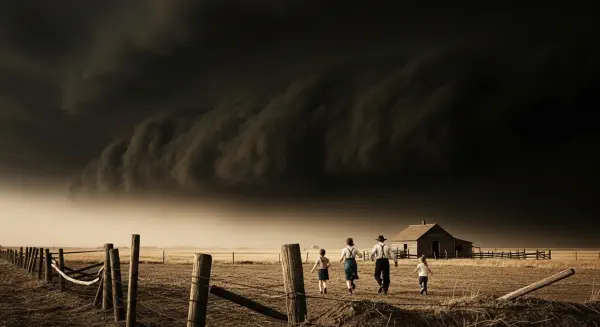
Jenny was writing in the shadow of the Dust Bowl, which had consumed millions of hectares of Great Plains topsoil in the previous decade. He understood, with the precision of a scientist who had studied soil formation for two decades, what the wind was carrying away. It was not merely the surface of a field. It was the accumulated biological and geological capital of several human millennia, redistributed by a single generation's ploughing.
The Soil Capital Depletion Rate (SCDR) formalises Jenny's insight as an accounting ratio: SCDR = annual topsoil loss (tonnes/hectare/year from erosion and degradation) ÷ annual topsoil formation rate (tonnes/hectare/year from weathering, organic matter accumulation, and biological activity). An SCDR of 1.0 means formation equals loss — the soil capital account is in balance. An SCDR below 1.0 means the soil is recovering — the biological capital is accumulating faster than it is being lost. An SCDR above 1.0 means the soil capital is being drawn down — the account is going negative, and the asset underpinning the food system is declining.
The Capital That Built Civilisation#
How Topsoil Forms#
The formation of productive topsoil is a biological achievement at least as much as a geological one. The parent material — bedrock, glacial till, alluvial sediment — provides the mineral substrate, but mineral substrate alone does not support food production. The transformation of mineral parent material into productive soil requires the colonisation by organisms in a specific sequence, each stage creating conditions for the next.
Pioneer organisms — cyanobacteria, fungi, mosses, lichens — colonise bare rock surfaces, secreting organic acids that dissolve minerals and accumulating dead organic matter that begins the soil organic carbon pool. As the organic matter builds, plant colonisation becomes possible, and plant roots extend the mineral weathering process deeper while their annual death and decay adds large volumes of organic carbon. Earthworms, arthropods, nematodes, and insects physically mix the building organic matter with the mineral material, creating the aggregate structure — the soil crumbs visible in a handful of healthy topsoil — that gives mature soil its remarkable combination of water retention, drainage, and aeration. The bacteria and fungi living in these aggregates decompose complex organic molecules, cycle nutrients, and stabilise carbon in forms that resist rapid decomposition.
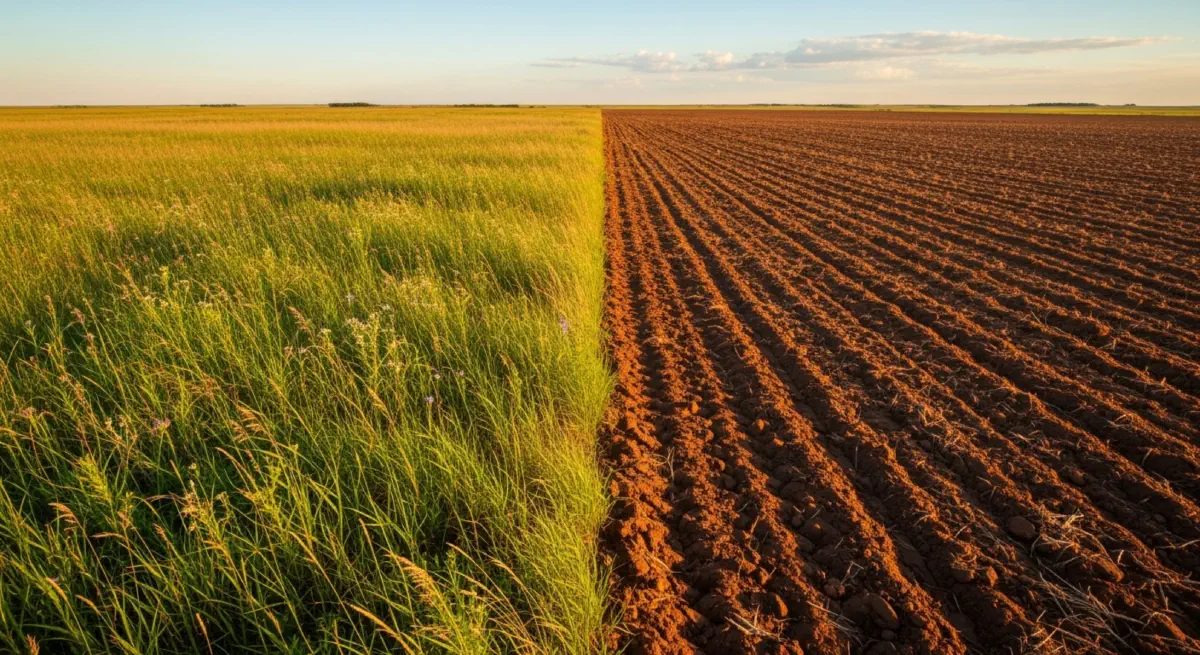
The rate of this process is governed primarily by climate, specifically by the product of temperature and moisture — the factor that determines biological activity rate. In tropical rainforests, where temperature and moisture are both continuously high, organic matter decomposition and mineral weathering both proceed rapidly, and soils in undisturbed conditions maintain a dynamic equilibrium. But this also means tropical forest soils are fragile: the nutrient capital is locked in the living biomass, not the soil, and clearing the forest exposes a soil whose biological activity rapidly oxidises the accumulated organic matter, leaving a rapidly depleted mineral substrate within 5–10 years. The extraordinarily productive agricultural soils of the American Midwest — the mollisols of the Corn Belt, with organic matter contents of 3–7% and depths of 60–120 centimetres — accumulated under a specific regime of long-grass prairie, moderate rainfall, and periodic fire over approximately 10,000–12,000 years following the last glaciation. They are the product of a specific ecological history. Once destroyed, they do not re-form on any human timescale.
The Global SCDR Picture#
The most comprehensive global assessment of soil erosion and degradation — the FAO and ITPS Status of the World's Soil Resources report published in 2015 — estimated that approximately 33% of the world's soils are moderately to highly degraded through erosion, nutrient depletion, salinisation, acidification, and compaction. Global annual topsoil loss through water and wind erosion is estimated at approximately 24–40 billion tonnes per year across all land types, of which approximately 7–10 billion tonnes comes from actively cultivated cropland.
Expressing this as an SCDR: average topsoil formation on agricultural soils under managed conditions is approximately 0.5–1.0 tonne/hectare/year in temperate cultivated land, rising to 1.5–2.0 t/ha/yr under undisturbed grassland conditions. Average agricultural erosion on cultivated cropland globally is approximately 10–20 t/ha/yr — a range with enormous variation by slope, cover, tillage method, and rainfall intensity. The arithmetic gives a global average SCDR for actively cultivated land of approximately 10–40. We are eroding agricultural topsoil 10 to 40 times faster than it is forming.
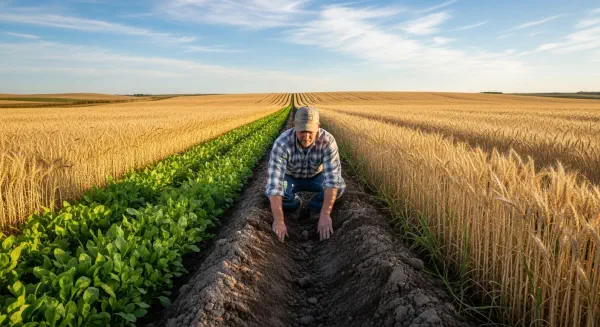
The geographic variation within this average is enormous and consequential. Highly erodible soils in the Chinese Loess Plateau, under historical terrace agriculture and wind erosion, have recorded SCDR values exceeding 100. Ethiopian highland soils under steep-slope cultivation with limited erosion control have recorded SCDR values of 50–200. In contrast, the best-managed no-till cropland in the US Corn Belt under a corn-soybean rotation with cover crops has achieved SCDR values approaching 1.0–2.0 — an order of magnitude better than conventional deep-till operations on the same soils. The SCDR trajectory is not determined by geography alone. It is determined primarily by management practice — which means it is, in principle, reversible.
The Depth That Remains#
David Pimentel at Cornell estimated in a widely cited 2006 paper that topsoil depth under US agriculture had declined from an average of approximately 23 centimetres before European settlement to approximately 15 centimetres by the mid-twentieth century. Subsequent USDA surveys in specific high-erosion watersheds found areas where ploughing to tillage depth had essentially encountered the subsoil — the B horizon — meaning that the functional topsoil had been substantially consumed. Crop yield on eroded soils is directly measurable: studies from multiple US university extension services show yield declines of approximately 6–10% for each 25 millimetres of topsoil lost, with the decline accelerating as the remaining topsoil approaches the minimum depth required to sustain a root zone.
Jenny's accounting, applied forward from current SCDR estimates, produces a disturbing projection: at a global average SCDR of 20 for cultivated land, and a starting productive depth of 20–25 centimetres, the functional working depth available to crop roots will be materially compromised within 200–400 years of current practice without intervention. On geological timescales, this is an instant. On political timescales — the horizon addressed by carbon policies, pension funds, sovereign debt — it is distant enough to be consistently deprioritised. The Dust Bowl made the SCDR visible for one terrible decade. The slower version of that calculation is underway on every tilled slope on earth. The next post examines the most dramatic episode in that history.