The SCDR ratio defines civilisational risk: The Soil Capital Depletion Rate (SCDR = annual topsoil loss ÷ annual topsoil formation rate) for global agricultural land averages approximately 10–100. Global topsoil loss runs approximately 24 billion tonnes per year; natural formation rates average approximately 0.5–1 tonne/hectare/year on agricultural soils. At a SCDR of 20–100, the world is spending soil capital 20–100 times faster than it is being created. On the timescale of a human lifetime, this is a manageable degradation. On the timescale of three to four generations — the horizon of any serious food security planning — it is an existential constraint.
The Dust Bowl was an SCDR crisis made visible: The 1930s American Dust Bowl resulted from SCDR values exceeding 500 on some Great Plains soils during the worst erosion events — topsoil moving at hundreds of tonnes per hectare per year through aeolian transport, versus formation rates of fractions of a tonne per hectare per year. The social, economic, and ecological consequences reshaped American agricultural policy for a generation. The same structural conditions — deep ploughing of semi-arid grassland, exposed monocultures without cover, no soil organic matter to bind particles — are currently present in portions of the North China Plain, sub-Saharan Africa, and South Asia.
Soil carbon is the climate variable nobody adequately prices: Global agricultural soils have lost approximately 50–70% of their pre-cultivation carbon content through tillage, organic matter oxidation, and erosion. The carbon sequestration potential of restoring soil organic matter to historical levels is estimated at 1.5–3.0 Gt C/year — roughly 10–20% of annual global CO₂ emissions. Unlike direct-air capture technologies, soil carbon sequestration generates co-benefits: improved water retention, reduced erosion, increased crop yield, reduced fertiliser demand. Its cost per tonne of CO₂ equivalent sequestered is estimated at $0–50/tonne under regenerative agriculture transitions, compared to $100–300/tonne for mechanical carbon capture.
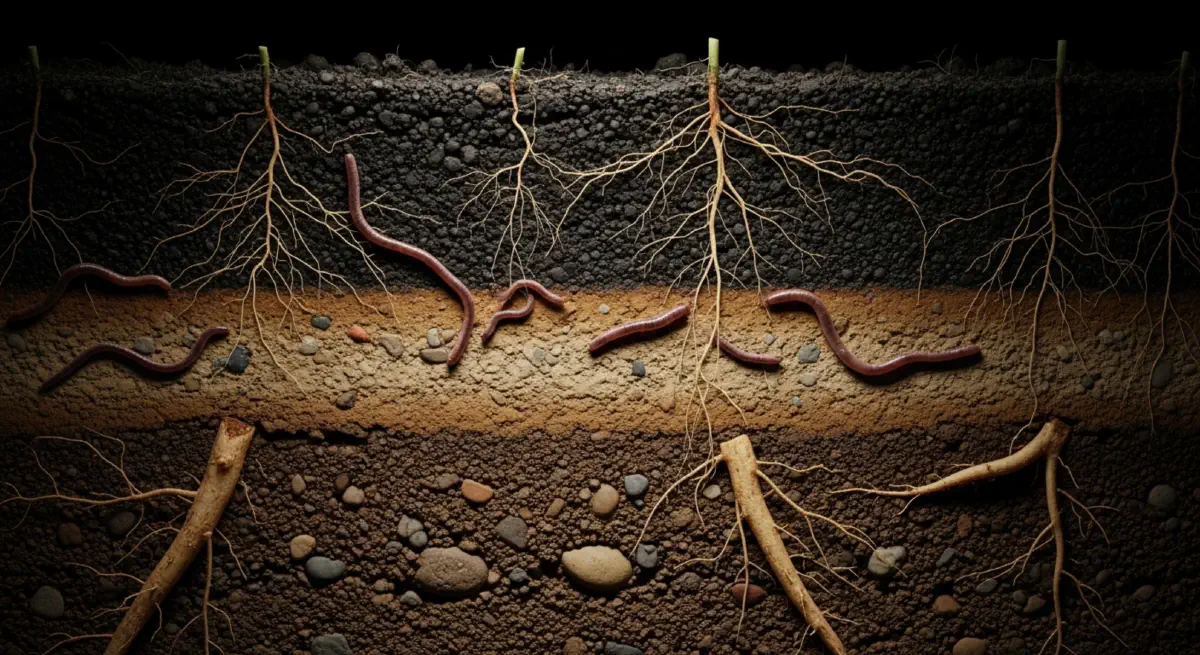
The biological economy of soil performs irreplaceable services: Mycorrhizal networks — fungal connections between plant root systems through soil — transfer phosphorus, nitrogen, water, and carbon between plants in symbiotic exchanges that industrial agriculture breaks through tillage and fungicide application. The services performed by soil microbiota — nutrient cycling, pathogen suppression, structure formation, carbon stabilisation — have not been adequately economically valued, but estimates from TEEB (The Economics of Ecosystems and Biodiversity) suggest global soil ecosystem services exceed $1.7 trillion per year. Industrial agriculture purchases synthetic substitutes for some of these services (nitrogen fertiliser, fungicide, pesticide) while destroying the underlying biological infrastructure.
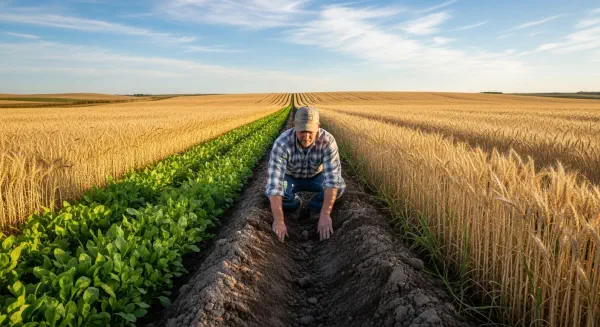
Regenerative agriculture demonstrates SCDR < 1 is achievable at farm scale: Long-running trials and commercial farm data show that no-till combined with cover cropping, crop rotation diversity, and integrated livestock management can achieve net positive soil carbon accumulation on previously degraded land — meaning SCDR < 1, where formation exceeds loss. This transition requires 5–15 years of managed adaptation, potentially lower yields in transition years, and a market structure that rewards soil carbon accumulation. The data emerging from pioneer farms in the US, Australia, and Europe demonstrates the agronomic feasibility. The policy gap is in the market signals and transition support programmes needed to scale it.