A lease on the bottom of the world#
In June 2021, The Metals Company (TMC), a Canadian mining firm listed on NASDAQ, triggered a little-known clause in the United Nations Convention on the Law of the Sea. Through its ISA-licensed subsidiary, Nauru Ocean Resources Inc., TMC submitted a formal request to the International Seabed Authority to complete the regulatory framework for commercial deep-sea mining within two years. The "two-year rule" — embedded in the 1994 Implementing Agreement to UNCLOS — obligated the ISA to at least consider a contractor's application to mine after two years, even if finalised regulations were not in place. The submission was not a mining application. It was a legal mechanism to force the ISA's hand and narrow the window during which precautionary governance could delay commercial extraction.
By the July 2023 ISA Council meeting, regulations were not complete. The ISA is governed by a 36-member Council and an Assembly of all 168 member states; achieving consensus on environmental standards, royalty structures, liability frameworks, and benefit-sharing mechanisms for deep-sea mining has proven more difficult than the commercial interest behind the two-year trigger anticipated. As of early 2024, the ISA had not approved any commercial mining plan. The exploratory licences it had issued, however, covered approximately 1.5 million square kilometres of ocean floor — an area larger than the combined landmass of France, Germany, Spain, and Italy — across the Clarion-Clipperton Zone, the Indian Ocean, and the Western Pacific.
The mineral deposited on that floor took 5 to 20 million years to accumulate. The ecological communities living on and within it have never been fully surveyed.
The commons that went unlisted#
The deep seabed beyond national jurisdiction is designated "the common heritage of mankind" under UNCLOS Article 136 — a legal category created in 1970 by UN General Assembly Resolution 2749 to prevent the appropriation of a global commons by technologically advanced states. The ISA was established to administer this commons on behalf of all nations and to ensure that benefits from any deep-sea resource extraction are shared broadly rather than accumulated by the corporations and states with the technical capacity to extract.
The Marine Extraction Ratio for deep-sea mining is unlike the MER calculations for fisheries or ocean acidification, because the service values being denominated are almost entirely unquantified. Unlike surface fisheries, where decades of scientific monitoring have established baseline biomass estimates and ecosystem service relationships, the deep-sea environment was effectively invisible to science until remotely operated vehicles, sediment cores, and acoustic surveys began mapping it systematically in the 1980s and 1990s. The polymetallic nodule fields of the Clarion-Clipperton Zone (CCZ) — a 6-million-km² region of the eastern Pacific between Hawaii and Mexico — have been surveyed at intervals of tens of kilometres; the actual spatial distribution of nodule fauna at the metre scale is not mapped. The number of species living in the sediment of a single nodule field is estimated in the thousands, the majority undescribed.
The MER for a commercial CCZ mining operation is therefore not a ratio of two known quantities. It is a ratio of a quantified numerator — the market value of the minerals in the nodules — against a denominator that is simultaneously enormous in ecological terms and approximately zero in any accounting framework currently in use. The commercial pressure to mine is inversely proportional to the investment in ecosystem service valuation that would make a rational MER calculation possible.
What is in the floor#
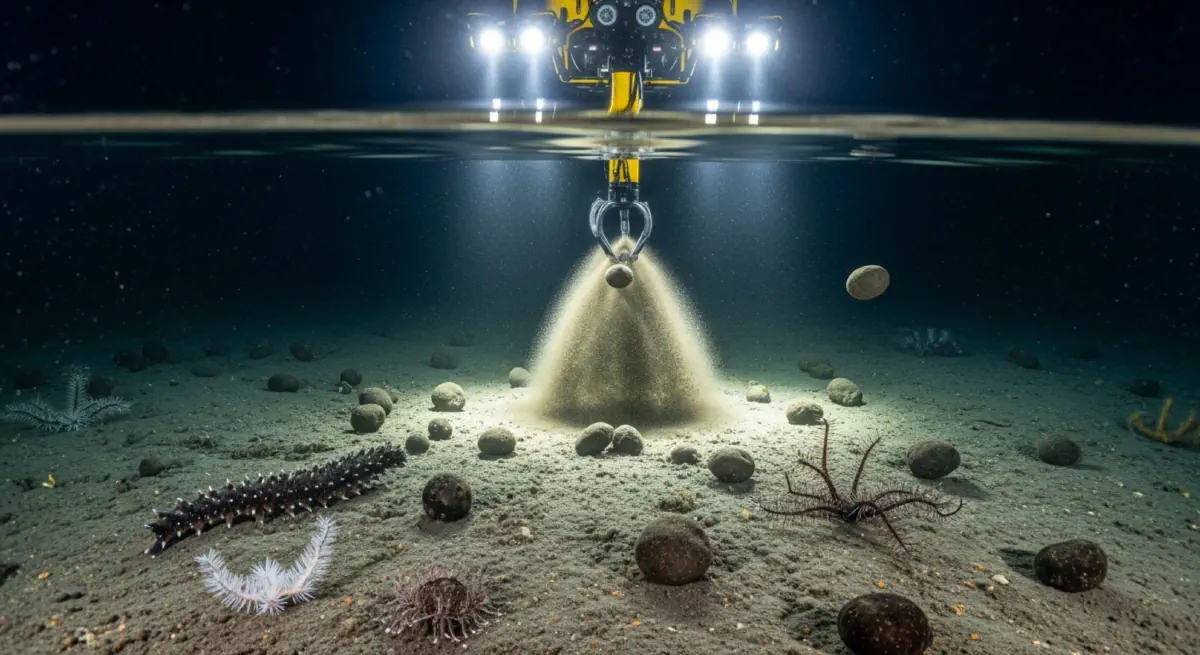
The Clarion-Clipperton Zone contains polymetallic nodules — potato-sized accretions of manganese, iron, nickel, cobalt, copper, and rare earth elements that form around hard substrate (shark teeth, whale bone fragments, volcanic rock) at sediment-water interfaces approximately 4,000–6,000 metres below the surface. Nodule formation rates are approximately 10–20 millimetres per million years — among the slowest geological processes on Earth.
The mineral stocks are staggering in the context of the clean energy transition. A 2020 analysis published in Nature by Dutkiewicz et al. estimated that nodule deposits in the CCZ alone contain more nickel than all known terrestrial reserves, more cobalt than the Democratic Republic of Congo possesses (which holds approximately 50% of current global production), and approximately 340 million tonnes of manganese. The lithium-ion battery chemistries that require cobalt and nickel — currently supplied from mines in the DRC and Indonesia under working conditions that generate substantial ESG investor concern — have created commercial arguments that deep-sea mining represents a more "ethical" supply source for battery metals.
The argument has a structural problem. It compares the known harms of terrestrial mining operations against the unknown harms of deep-sea mining operations, in environments that have not been adequately characterised to make the comparison honest. A 2021 study in Current Biology by Andrew Sweetman and colleagues estimated that the Clarion-Clipperton Zone harbours over 5,000 species, with approximately 90% of species found so far unique to that environment. Nodule removal destroys the hard substrate that all these organisms require, and sediment plumes from mining equipment can extend hundreds of kilometres from the mining site, settling on undisturbed nodule fields.
The recovery timescales from deep-sea mining disturbance are not well constrained. The IOM (formerly DEEPSEA VENTURES) DISCOL experiment — a 1989 plough-track experiment in the Peru Basin — surveyed recovery of disturbed sediment communities over subsequent decades. At last assessment (37 years after disturbance), organism density and diversity in ploughed tracks remained significantly below the surrounding undisturbed seafloor. At nodule formation rates of 10–20 mm per million years, the physical substrate itself would take geological time to regenerate. The ecological community dependent on that substrate would take comparably long, if it recovered at all.
The governance architecture#
The ISA collects exploration fees and will, if a royalty architecture is agreed, collect production royalties from deep-sea mining operations. It distributes a portion of revenues to developing nations through its Enterprise subsidiary and finance committee. The governance architecture is designed around the premise that mining will eventually proceed — it was constructed under the assumption that deep-sea mining was technologically inevitable — and that the ISA's role is to ensure it proceeds in an orderly, equitable, and environmentally monitored way.
The environmental protection architecture has not kept pace with commercial development pressure. The ISA's environmental management plan for the Clarion-Clipperton Zone designates nine Areas of Particular Environmental Interest (APEIs) — reference zones to be preserved from mining to allow undisturbed ecosystem monitoring. The APEIs cover approximately 261,000 km², representing approximately 4.3% of the CCZ — a proportion widely considered inadequate by marine ecologists to serve as a representative biodiversity baseline, particularly given the high endemism of CCZ species. The environmental impact assessment requirements for mining plans lack standardised methodologies for quantifying service values, meaning that operators are not currently required to calculate anything resembling a Marine Extraction Ratio when submitting extraction plans.
The sponsoring state architecture creates an additional structural problem. Commercial operations require sponsorship by an ISA member state, which takes on liability for the operation's compliance with ISA regulations. Nauru, with a total land area of 21 km², sponsoring a mining operation covering thousands of square kilometres of ocean floor on behalf of a NASDAQ-listed Canadian company, represents a liability structure that the UNCLOS framework was not designed to accommodate.
The MER above 10,000#
The MER for deep-sea polymetallic nodule mining, calculated honestly, would require estimating the ecosystem service value of the approximately 60,000–100,000 km² that each major commercial operation would disturb per operational decade. The species baseline, the food web dependencies, the sediment carbon cycling (deep-sea sediments store substantial organic carbon), and the potential pharmaceutical and biotechnological value of the unique organisms involved would all need to enter the denominator. None of these valuations exist for any proposed mining site.
What does exist is the mineral resource estimate for the numerator. At current battery metal prices — nickel approximately $15,000–30,000/tonne, cobalt approximately $30,000–50,000/tonne — the recoverable mineral value of a single commercial-scale CCZ nodule field could reach tens of billions of dollars over its operational lifespan. The ecosystem service value of that same field is unknown. The reasonable lower bound estimate, extrapolating from the Costanza-type valuation of analogous deep-sea environments, suggests that the denominator is larger than the numerator by a factor that makes the MER for deep-sea mining among the highest of any marine extraction activity currently contemplated.
The commons and the ledger#
The deep seabed was designated common heritage before anyone knew what was in it or what it did. The law anticipated commercial interest in minerals. It did not anticipate that the ecological communities attached to those minerals would prove to be among the most diverse, most ancient, and least replaceable ecosystems on Earth. The governance architecture being assembled at the ISA is attempting to reconcile a 1970s-era legal framework with a 2020s commercial reality, under the supervision of a body whose members include both the corporations seeking extraction rights and the Pacific island states whose exclusive economic zones are adjacent to the proposed mining zones.
The Marine Extraction Ratio, as a framework, suggests a simple test for any deep-sea mining regulatory decision: before issuing a commercial mining licence, require the operator to calculate the ecosystem service value of what they are proposing to permanently destroy, compare it to the market value they propose to extract, and publish the ratio. If the ratio cannot be calculated because the ecosystem is inadequately characterised, the characterisation is a prerequisite for the licence, not an assessment to be conducted during the operation. This is not a radical standard. It is the equivalent of requiring a developer to demonstrate that the building they are demolishing is not on a load-bearing wall before they take out the support columns.
The ocean's balance sheet — the one that the Costanza paper tried to force into view in 1997, the one that the Atlantic cod collapse demonstrated was missing in 1992, the one that the acid account is silently expanding every year — has not been formalised in any governance instrument that applies to the deep seabed. The floor below the floor may be the most consequential unresolved commons problem of the twenty-first century precisely because it is the commons that was declared most emphatically to belong to everyone and governed most inadequately as a result.
The series has moved from the economy of the ocean surface to the chemistry of its water column to the ecology of its floor. Each level of the ocean runs on ecosystem services that the extraction system ignores and the accounting system does not record. The Marine Extraction Ratio is not a solution — it is a diagnostic. The question it poses, at every level of the ocean and for every resource in it, is whether we know what we are spending before we spend it.