A calculation made in the dark#
In February 1968, a survey vessel working the Grand Banks of Newfoundland returned data showing the largest Atlantic cod biomass estimate ever recorded: approximately 8 million tonnes of reproductive adults in the Northwest Atlantic stock. Fishing fleets from Canada, the Soviet Union, Spain, Portugal, West Germany, and a dozen other distant-water nations were already at work when the survey was completed. The estimate confirmed what fishers already assumed: the Grand Banks were inexhaustible.
By 1975, the biomass estimate had fallen to under 4 million tonnes. Canadian scientists at the Bedford Institute of Oceanography began publishing papers in the late 1970s indicating that catch rates were declining sharply relative to effort invested — the key early signal of a stock in trouble. The scientific advice was to reduce quotas substantially. The Department of Fisheries and Oceans set quotas at approximately twice the scientifically recommended levels through the 1980s, under pressure from the industry to maintain employment in Newfoundland, Nova Scotia, and New Brunswick communities where cod was both the dominant employer and the dominant cultural institution. By 1992, the reproductive biomass of the Northwest Atlantic cod had fallen to approximately 100,000 tonnes — a 99% reduction from the 1968 peak. On July 2, 1992, Canada's Fisheries Minister John Crosbie imposed a total moratorium on cod fishing in the area.
The moratorium, the largest mass layoff in Canadian history, affected approximately 40,000 people along the Atlantic coast. The cod have not come back.
The most efficient fishery in history was also the most destructive#
The collapse of the Atlantic cod is not primarily a story about technology, though technology accelerated every aspect of the catastrophe. It is a story about the relationship between what is measured and what is managed — about how an accounting system that records only extraction value systematically generates the conditions for the collapse of the system it is extracting from.
Marine Extraction Ratio for a specific fishery can be disaggregated from the whole-ocean calculation. In the Northwest Atlantic system, the relevant denominator is not simply the market value of cod landed — it encompasses the entire ecosystem function that cod performed: as a top predator regulating capelin, sand lance, and invertebrate populations; as a driver of benthic nutrient cycling through the behaviour of demersal feeding; as the scaffold on which the coastal culture and food security of an entire sub-national region was built. The market price of cod at the fish dock captured none of these services. The quota system was calibrated against that market price. The consequence was that the fishery extracted not just below-sustainability yield from the cod stock, but the entire ecosystem service bundle that the stock represented.
The technology of overfishing#
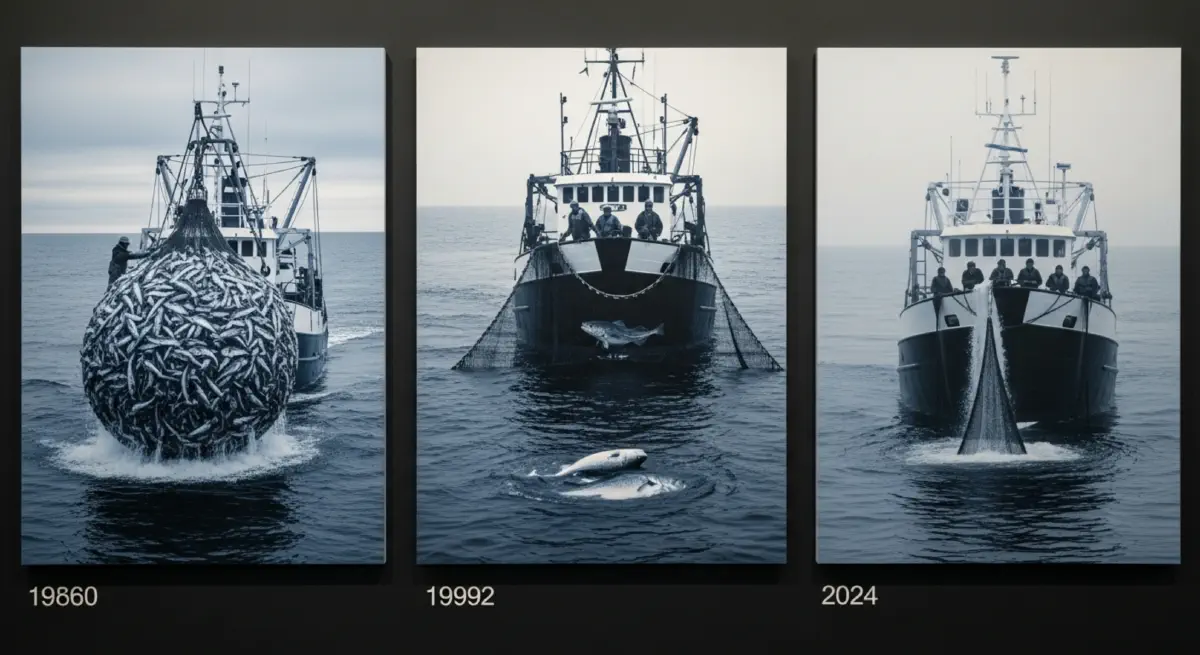
Industrial fisheries developed their capacity to find and extract marine biomass faster than any natural recovery process could tolerate. The sonar systems fitted to deep-water factory trawlers by the 1960s allowed precise location of offshore shoals; vessels that had once searched for days could now detect fish schools within hours. The factory stern trawler — a Soviet innovation of the late 1950s that allowed fish to be processed, frozen, and packaged at sea — eliminated the logistical constraint of return-to-port that had previously served as a natural throttle on extraction intensity. A single factory trawler could process 100–150 tonnes of fish per day, filter through, and freeze a catch between port calls.
The total fishing effort applied to the Grand Banks roughly tripled between 1955 and 1968. F/Fmsy — fishing mortality rate relative to the rate that would theoretically produce maximum sustainable yield — in the Northwest Atlantic cod fishery was estimated at approximately 2.5–3.5 through much of the 1970s and 1980s. To sustain catch at that mortality rate would have required a reproductive rate that cod simply do not possess: Atlantic cod reach sexual maturity at approximately five to seven years and produce a large but highly vulnerable annual recruitment cohort, meaning mortality above MSY thresholds depletes the spawning stock faster than recruitment can replace it.
The Canadian extension of its exclusive fishing zone to 200 nautical miles in 1977 — displacing the distant-water fleets that had dominated offshore extraction — did not reduce fishing pressure. It transferred it to domestic vessels, subsided by the Canadian government through the fish company consolidation of the early 1980s. The quota set for the Canadian domestic fleet after 1977 was no more consistent with scientific advice than the international quota it replaced.
The mathematics of a stock collapse#
Maximum Sustainable Yield (MSY) is the theoretical maximum catch level that a fish population can sustain indefinitely — the yield from a stock managed at exactly the population size at which productive capacity is maximised. For Atlantic cod, the MSY was estimated at approximately 250,000–400,000 tonnes per year through much of the high-productivity period. Actual catch during the boom years of the 1960s and 1970s regularly exceeded 800,000 tonnes — two or more times MSY — as catches were sustained temporarily by harvesting the existing stock faster than demographic recovery could compensate.
The delay between overfishing and collapse creates a deceptive stability. A fishery harvesting at 2× MSY does not experience an immediate decline in catch if the existing stock is large enough; it maintains catch levels by progressively harvesting the reproductive biomass that would have generated future cohorts. This is precisely the dynamic that makes the market price signal useless as an indicator of ecosystem health. Cod prices at the dock reflected short-term supply and demand; they did not reflect the depletion of future catch potential. The fishery appeared economically healthy through the 1970s. The ecosystem was not.
A 2004 meta-analysis by Ransom Myers and Boris Worm, published in Nature, examined data from seventeen ecosystems worldwide and found that industrial fisheries had, on average, reduced the biomass of large predatory fish species to approximately 10% of pre-industrial levels within the first decade of industrialised exploitation. The pattern — initial high catch, gradual effort intensification, declining catch-per-unit-effort ignored by quota-setters, stock collapse — repeated across species, oceanographic zones, and regulatory systems with a consistency that ruled out accident or coincidence as the explanation.
The subsidy engine of collapse#
A 2019 analysis by Rashid Sumaila and colleagues, published in Marine Policy, estimated global fisheries subsidies at approximately $35.4 billion per year. Of that total, approximately $22.2 billion — 63% — qualified as "capacity-enhancing": fuel subsidies, vessel construction subsidies, port infrastructure investments, and tax exemptions that directly reduced the cost of fishing effort, stimulating the deployment of greater extraction capacity than the economic return from the fishery would justify unaided. These subsidies are, in effect, government-funded investments in accelerating the extraction of a public resource toward the point of collapse.
The economic logic is not obscure. Individual fishing operations rationalise heavy capitalisation and high effort in a common-pool resource environment: if you do not catch the fish, someone else will. The state subsidy system reinforces this logic at the national scale — if our fleet does not exploit the stock, another country's fleet will. The result is a globally coordinated failure to manage a commons, financed by the taxpayers of the nations doing the most damage.
The Atlantic cod moratorium ultimately cost Canadian federal and provincial governments approximately $4 billion in adjustment, retraining, and social support payments over the decade following 1992. The fishery that generated those costs had itself received approximately $781 million in federal subsidies in the decade before the collapse (Schrank, 2005). The subsidy investment produced negative net returns at the system level. It was a rational response to the incentive architecture of a common-pool resource that was unpriced and unprotected.
Thirty years and counting#
The Northwest Atlantic cod stock has not recovered to commercially viable levels in the three decades since the moratorium. The biological explanation involves a phenomenon known as "ecosystem regime shift": the removal of cod as the dominant predator in the Northwest Atlantic released populations of shrimp, crab, and small forage fish — species that cod prey upon — to levels at which they now exert competitive pressure on juvenile cod recruitment. The cod altered the ecosystem that cod require. Recovery requires not just the cessation of cod mortality but the reversal of a structural ecological transformation that the absence of cod has sustained.
The economic question is equally uncomfortable. The shrimp and crab fisheries that filled the commercial vacuum left by cod's collapse have generated substantial revenues — Newfoundland crab landings alone have exceeded $1 billion in some recent years — creating a constituency with an interest in maintaining the current depressed state of cod stocks, since cod recovery would require reducing crab and shrimp harvest pressure. The accounting system that failed to register the cod stock's service value during its decline now structures the political economy of its potential recovery.
The Marine Extraction Ratio for the Northwest Atlantic from 1968 to 1992 was not calculated at the time because no system existed to calculate it. Almost every element required — the ecosystem service value of cod's predatory function, the value of the coastal culture and food security the fishery anchored, the future fishing value foregone by harvesting below replacement level — was outside any accounting framework in use. It remains outside most accounting frameworks today. The next post examines another form of unbooked liability: the acidification of the ocean itself, and what happens when the chemistry that makes marine ecosystem services possible shifts past certain thresholds.