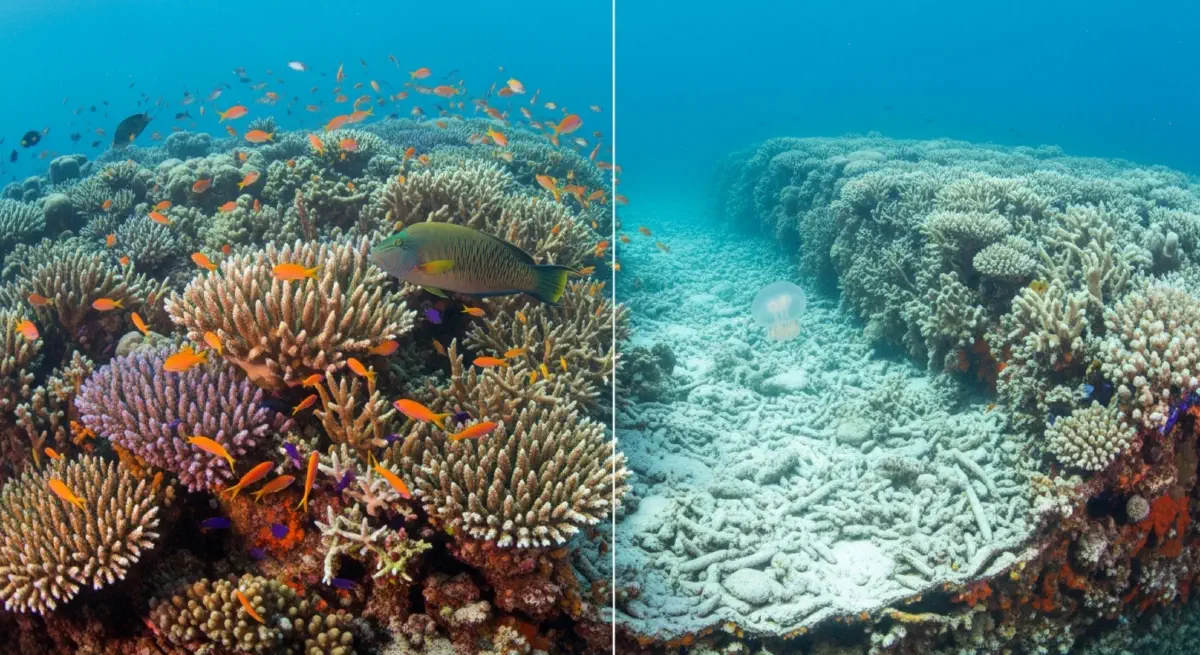
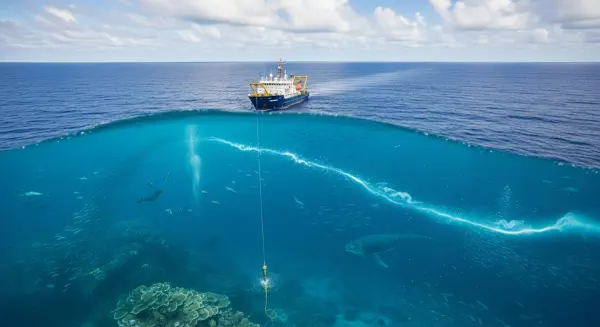
The Marine Extraction Ratio reveals a systematic undervaluation of ocean services: MER = Annual economic value of marine resource extraction (fisheries + aquaculture + shipping externalities + deep-sea mining) ÷ Annual estimated value of marine ecosystem services (fishery support, carbon sequestration, coastal protection, biodiversity pharmacology, oxygen production). For the global ocean economy, the numerator is approximately $2.5 trillion/yr; the denominator is approximately $20–49 trillion/yr. The ocean generates 8–20× more economic value through ecosystem services than is extracted from it — yet the services go unpriced and the extraction is taxed at minimal rates.
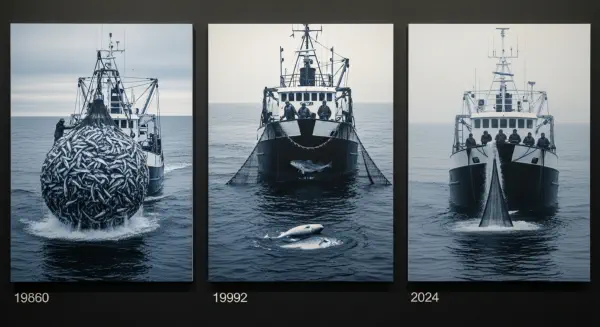
Fisheries collapse follows a quantifiable pattern that was consistently ignored: The Northwest Atlantic cod collapse, the Peruvian anchoveta cycle, the Patagonian tooth fish, and the Australian orange roughy all follow the same mathematical trajectory: gradual stock depletion toward Maximum Sustainable Yield, regulatory failure to maintain catch within MSY, stock collapse below MSY threshold from which recovery is severely retarded or impossible. Approximately one-third of global fish stocks are currently exploited above sustainable levels. The fisheries subsidy system — approximately $35 billion/yr globally in capacity-enhancing subsidies — actively accelerates this trajectory.
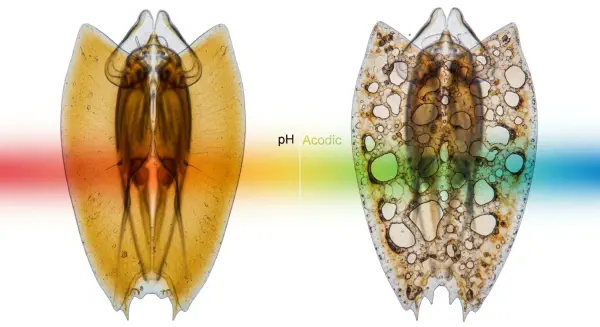
Ocean acidification is an unbooked liability accumulating on the global balance sheet: Pre-industrial ocean pH was approximately 8.2. Current pH is approximately 8.08–8.10, representing a 26–30% increase in hydrogen ion concentration (acidification). The trajectory extends to approximately pH 7.95–8.0 under RCP 8.5 scenarios by 2100. Calcium carbonate dissolution at projected pH levels will materially compromise the ability of coral reef systems (estimated ecosystem service value approximately $375 billion/yr), pteropods (key forage species in polar and sub-polar food webs), and commercially important shellfish (global aquaculture value approximately $85 billion/yr) to form shells and skeletons. None of this projected liability is incorporated in any national account, carbon price, or climate damage function at present.
Ocean blue carbon is one of the most cost-effective climate solutions available: Coastal marine ecosystems — mangroves, seagrasses, tidal marshes — store carbon at rates approximately 5–10× higher per hectare than terrestrial forests. Global coastal wetland carbon stocks are estimated at 33–44 Gt CO₂e, accumulated over centuries. Their destruction through coastal development and aquaculture conversion releases this stock at approximately 1 Gt CO₂e/yr — comparable to the emissions of aviation globally. Restoration and protection of coastal wetlands represents one of the few climate solutions with concurrent economic, biodiversity, fishery, and coastal protection co-benefits.
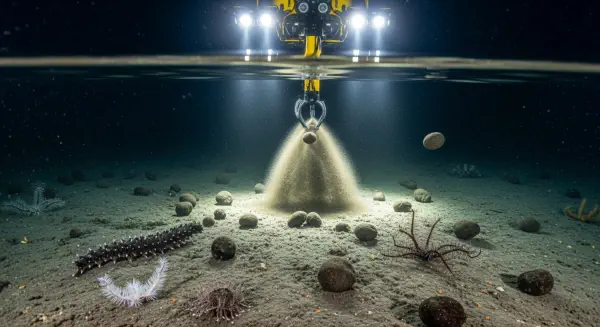
The deep-sea mining governance gap represents the most consequential unresolved commons problem of the twenty-first century: The deep seabed beyond national jurisdiction is designated "the common heritage of mankind" under UNCLOS, administered by the International Seabed Authority (ISA). The ISA's regulatory framework for commercial deep-sea mining was still incomplete as of 2024 despite the expiry of the two-year period following a formal mining application in 2021 that triggered the "two-year rule" requiring a decision framework. The ecological baselines required to assess impact are inadequately surveyed; the ecosystem service value of deep-sea environments is largely unquantified; and the concentration of mineral wealth creates powerful commercial incentives that have influenced ISA member states' positions. The MER for deep-sea mining, incorporating the lost ecosystem services of destroyed nodule fields, is unknown and may be unstable.
Costanza, R., d'Arge, R., de Groot, R., Farber, S., Grasso, M., Hannon, B., ... & van den Belt, M. (1997). The value of the world's ecosystem services and natural capital. Nature, 387(6630), 253–260.
Sumaila, U.R., Ebrahim, N., Schuhbauer, A., Skerritt, D., Li, Y., Kim, H.S., ... & Pauly, D. (2019). Updated estimates and analysis of global fisheries subsidies. Marine Policy, 109, 103695.
Pauly, D., & Zeller, D. (2016). Catch reconstructions reveal that global marine fisheries catches are higher than reported and declining. Nature Communications, 7, 10244.
Hutchings, J.A., & Myers, R.A. (1994). What can be learned from the collapse of a renewable resource? Atlantic cod, Gadus morhua, of Newfoundland and Labrador. Canadian Journal of Fisheries and Aquatic Sciences, 51(9), 2126–2146.
Sabine, C.L., Feely, R.A., Gruber, N., Key, R.M., Lee, K., Bullister, J.L., ... & Rios, A.F. (2004). The oceanic sink for anthropogenic CO₂. Science, 305(5682), 367–371.
Orr, J.C., Fabry, V.J., Aumont, O., Bopp, L., Doney, S.C., Feely, R.A., ... & Yool, A. (2005). Anthropogenic ocean acidification over the twenty-first century and its impact on calcifying organisms. Nature, 437(7059), 681–686.
De'ath, G., Fabricius, K.E., Sweatman, H., & Puotinen, M. (2012). The 27-year decline of coral cover on the Great Barrier Reef and its causes. Proceedings of the National Academy of Sciences, 109(44), 17995–17999.
Mcleod, E., Chmura, G.L., Bouillon, S., Salm, R., Björk, M., Duarte, C.M., ... & Silliman, B.R. (2011). A blueprint for blue carbon: Toward an improved understanding of the role of vegetated coastal habitats in sequestering CO₂. Frontiers in Ecology and the Environment, 9(10), 552–560.
ISA. (2021). Deep-sea mineral resources. International Seabed Authority.
Levin, L.A., Mengerink, K., Gjerde, K.M., Rowden, A.A., Van Dover, C.L., Clark, M.R., ... & Smith, C.R. (2016). Defining "serious harm" to the marine environment in the context of deep-seabed mining. Marine Policy, 74, 245–259.
FAO. (2022). The state of world fisheries and aquaculture 2022: Towards blue transformation. Food and Agriculture Organization.
IPBES. (2018). The IPBES assessment report on land degradation and restoration. Intergovernmental Science-Policy Platform on Biodiversity and Ecosystem Services.
Hoegh-Guldberg, O., Mumby, P.J., Hooten, A.J., Steneck, R.S., Greenfield, P., Gomez, E., ... & Hatziolos, M.E. (2007). Coral reefs under rapid climate change and ocean acidification. Science, 318(5857), 1737–1742.
IPCC. (2019). Special report on the ocean and cryosphere in a changing climate. Intergovernmental Panel on Climate Change.
Sala, E., Mayorga, J., Bradley, D., Cabral, R.B., Atwood, T.B., Auber, A., ... & Lubchenco, J. (2021). Protecting the global ocean for biodiversity, food and climate. Nature, 592(7854), 397–402.
Examines deep-sea mining proposals against the Marine Extraction Ratio, documenting that the ISA has licensed exploratory access to seabed ecosystems whose service value dwarfs the mineral value being extracted — with no agreed authority to approve the transaction.
Quantifies the economic cost of ocean acidification by tracing a 30% acidity increase against the calcium carbonate-dependent ecosystem services it is progressively destroying — a cost that has never been formally entered into any national balance sheet.
Reconstructs the arithmetic of the 1992 Northwest Atlantic cod collapse — visible decades before the moratorium — and applies it to current fishery dynamics to assess where the Marine Extraction Ratio is approaching comparable thresholds.
Applies the Marine Extraction Ratio to Costanza's ocean ecosystem service valuation to establish the gap between what the ocean earns in unpriced services and what we extract from it annually.