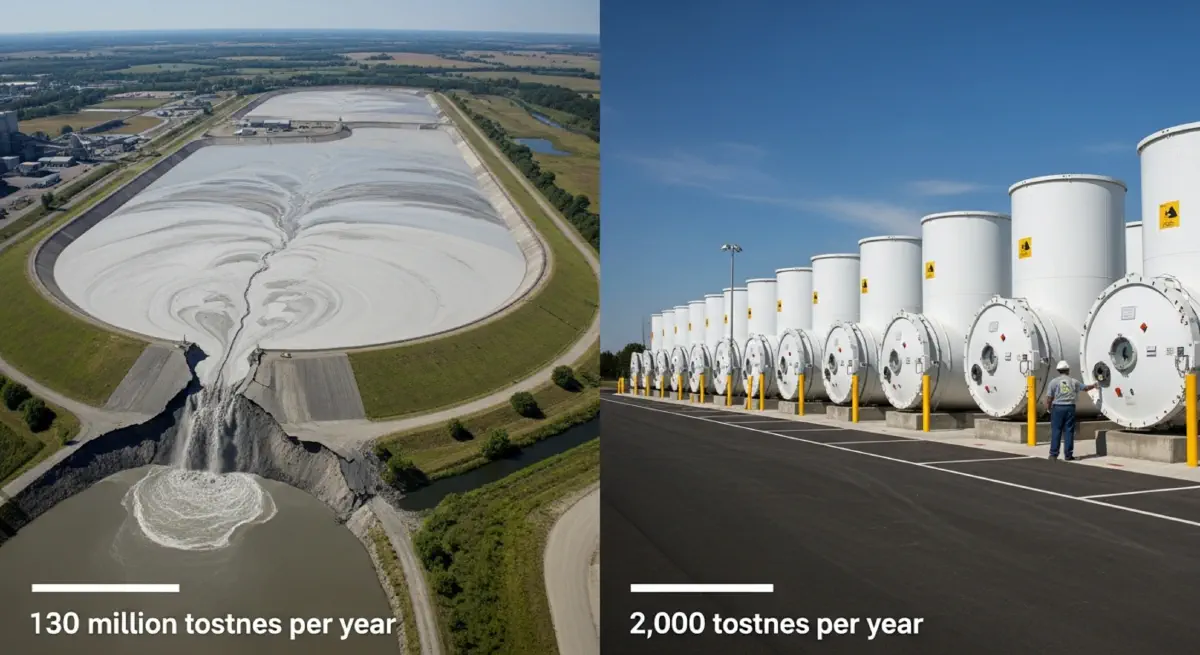
A dry cask in a parking lot#
At the Calvert Cliffs Nuclear Power Plant in Maryland, approximately 1,500 tonnes of spent nuclear fuel currently sit in dry storage casks in a parking lot adjacent to the reactor buildings. Each cask is approximately 6 metres tall, 2.5 metres in diameter, made of steel and concrete, welded shut. A visitor standing beside one would receive approximately 2–3 millirem per hour of radiation — equivalent to approximately three chest X-rays per hour, about twenty times background level — but would need to stand there for roughly 16 hours to accumulate the dose of a standard chest CT scan. The casks are stored outdoors. They require no active cooling. They have operated without incident since the first generation began in the late 1980s.
The Calvert Cliffs dry cask pad is not an anomaly. Seventy-four sites across the United States store spent nuclear fuel in this format, accumulating inventory at approximately 2,000 metric tonnes per year. The total US commercial nuclear waste inventory — the entirety of all civilian spent fuel generated in six decades of commercial nuclear operation — was approximately 90,000 metric tonnes as of 2022. This is a number that is routinely described in media discussion of nuclear energy as "vast," "enormous," and "insurmountable." Its actual physical dimensions invite a different description.
A waste comparison no one makes#
The volume argument about nuclear waste is typically made without a comparison class. The Lifetime Risk-Adjusted Carbon Score does not incorporate waste volume (waste management carries a small additional lifecycle carbon contribution that is included in the IPCC figures), but the waste comparison is relevant enough to the public perception of nuclear risk to address directly. The comparison class is the waste stream of the energy sources that nuclear has partially displaced or would replace.
Coal combustion in the United States generates approximately 130 million metric tonnes of combustion residuals — fly ash, bottom ash, flue gas desulfurisation gypsum, boiler slag — annually. These residuals contain toxic heavy metals: mercury, arsenic, lead, chromium, cadmium, beryllium, and barium, concentrated from the coal during combustion and chemically stable permanently (unlike radioactive isotopes, toxic heavy metals do not decay). Approximately 60% of coal ash is "beneficially reused" as construction material; the remaining 40% — approximately 52 million metric tonnes per year — is disposed of in surface impoundments and landfills. The EPA has documented 157 cases of documented damage from coal ash impoundment failures, including the 2008 Kingston Fossil Plant coal ash spill in Tennessee, which released 4.1 million cubic metres of toxic slurry into the Emory River and took approximately $1.2 billion and three years to remediate.
The entire US nuclear waste inventory of 90,000 metric tonnes is approximately 0.07% of a single year's production of coal combustion residuals. The nuclear waste requires secure geological disposal because some isotopes remain radioactive for thousands to tens of thousands of years; but it is solid, dense, located in known positions, not mobile, and not able to wash into rivers. The coal ash is chemically toxic permanently and is being produced faster than it can be responsibly managed.
The volume in perspective#
The physical volume of all US commercial spent nuclear fuel can be estimated from the fuel assembly dimensions. A standard 17×17 array pressurised water reactor fuel assembly is approximately 4.06 metres long and 0.214 metres square; one assembly contains approximately 450 kg of uranium. The 90,000 metric tonnes of spent fuel inventory corresponds to approximately 200,000 fuel assemblies. Stacked symmetrically into a rectangular configuration approximately 1.5 metres deep per layer, with the assemblies in their fuel assembly geometry, the entire inventory would occupy a volume of approximately 42,000 cubic metres — roughly equivalent to nine large Walmart Superstores by floor area, or a single commercial landfill cell receiving approximately 30 days of US municipal solid waste.
The standard rebuttal to this comparison is that the nuclear waste requires exceptional isolation over very long timescales, while municipal waste does not contain long-lived radionuclides. This is accurate. The relevant question is not whether the two waste streams require the same management — they do not — but whether the volume of nuclear waste is, as commonly characterised, of an unprecedented scale that renders nuclear power unmanageable as a waste producer. It is not.
The geological disposal solution#
Geological disposal — the placement of spent nuclear fuel in stable rock formations at depths of approximately 400–700 metres below the surface, designed to isolate the waste from the biosphere for 100,000 years — is technically proven and politically stalled in most countries. Finland's Onkalo spent nuclear fuel repository, under construction since 2004 in Olkiluoto, will be the world's first commercial deep geological repository. The site is in 2-billion-year-old bedrock with groundwater flow rates measured in centimetres per decade. The repository is licensed; construction is complete for the first demonstration phase; waste emplacement is expected to begin in the 2020s.
Sweden has selected a similar crystalline bedrock site at Forsmark; the Geological Disposal Facility in the United Kingdom is in site selection; Germany is conducting a national site selection process. The United States' Yucca Mountain repository programme, licensed at a site in Nevada in 1987, has been effectively cancelled since 2010 through a combination of political opposition from Nevada Senator Harry Reid and subsequent administrative budget starvation, despite the availability of a suitable technically characterised site and the allocation of approximately $15 billion in waste fund fees from nuclear power purchasers for repository construction.
The US waste management stalemate is primarily political, not geological. The technical problem of safely isolating approximately 90,000 tonnes of solidified waste in stable rock at depth has been solved in the engineering literature; it awaits a political decision to implement the standard technical solution.
What the closed fuel cycle changes#
Reprocessing spent nuclear fuel — chemically separating the remaining fissionable uranium and plutonium from the fission products — reduces the volume of high-level waste requiring geological disposal by approximately 80% while simultaneously recycling fuel value. France reprocesses all of its spent fuel at La Hague; the process generates mixed-oxide (MOX) fuel used in French reactors, vitrified high-level waste glass, and lower-volume intermediate-level waste streams. The French nuclear waste inventory per TWh of generation is substantially lower than the US once-through fuel cycle on a volume basis.
The tradeoff is reprocessing cost (approximately 50–70% more expensive than direct spent fuel storage per unit of electricity generated) and, in the political economy of proliferation, the availability of separated plutonium as a weapons-relevant material. The Clinton administration eliminated US commercial reprocessing in 1977 specifically on proliferation grounds — a decision that has never been reversed despite the technical availability of reprocessing approaches using advanced reactor designs (fast reactors) that consume the actinides rather than producing separated plutonium.
Generation IV fast reactor designs — the GE-Hitachi PRISM, the Moltex SSR, TerraPower's Natrium — can burn the long-lived actinides that constitute the primary long-term radiotoxic hazard in spent fuel. If these designs were deployed at commercial scale, the radiotoxic lifetime of the remaining waste would fall from approximately 100,000 years (current spent fuel) to approximately 300 years — a period over which institutional controls and engineered barriers can be evaluated against realistic societal timescales rather than geological ones. The waste problem, in a closed-cycle fast reactor system, becomes approximately comparable in management timescale to the longest-lived toxic chemical wastes produced by the chemical and mining industries.
The accounting, completed#
The nuclear accounting, taken in full, produces a finding that is counterintuitive relative to the public perception of nuclear energy but consistent across multiple independent lines of analysis:
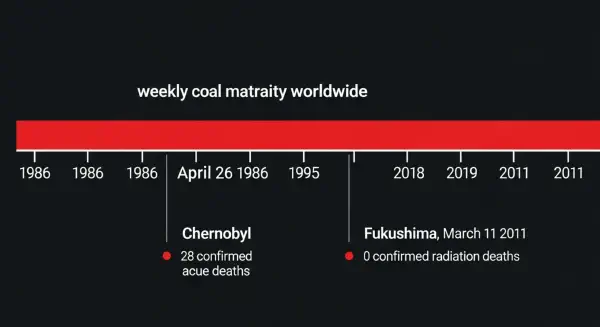
Nuclear power carries a lifecycle carbon intensity of approximately 12 gCO₂e/kWh — equivalent to onshore wind and substantially lower than any fossil fuel source. Nuclear power carries a mortality rate of approximately 0.07 deaths/TWh — the lowest of any energy source studied, including accidents at Chernobyl and Fukushima. Nuclear power's commercial waste inventory, accumulated over six decades of US operation, has a physical volume smaller than one month of US coal ash production. Deep geological disposal of that waste is a solved technical problem awaiting political implementation.
Nuclear construction in the West is genuinely expensive and requires institutional rebuilding to become cost-competitive with the historical South Korean and French fleet cost experience. Small modular reactors may provide a manufacturing path to cost reduction, but their economics remain unproven at commercial scale. The comparison with renewable alternatives — which carry their own material demands (lithium, cobalt, rare earth elements), land use requirements, grid balancing costs, and waste streams — is not resolved in favour of renewables across all metrics for all grid configurations.
The Lifetime Risk-Adjusted Carbon Score does not resolve the nuclear debate. It establishes what the debate should be about: not whether nuclear has ever had a serious accident (it has), but whether the accident rate generates a mortality and carbon burden that is comparable to or lower than the alternatives (it does), and whether the political economy of energy policy is capable of updating its treatment of nuclear risk in proportion to the evidence (this remains the central open question).
The accounting has been completed. The policy that would follow a rational reading of that accounting has not been implemented. The gap is not a gap in data.