The reactor that was never supposed to be this expensive#
In August 2023, Vogtle Unit 4 at Plant Vogtle in Georgia was connected to the US power grid. The two new units at Vogtle — Units 3 and 4, built by Southern Nuclear Company using Westinghouse AP1000 technology — became the first new nuclear reactors to achieve commercial operation in the United States in approximately 25 years. They also became the most expensive power plants ever constructed in the United States. The combined cost of Units 3 and 4 had escalated, from an initial estimate of approximately $14 billion in 2012, to a final cost of approximately $34 billion by commercial operation — more than double the original budget, seven years later than the original schedule. At approximately $10,000 per kilowatt of installed capacity, the Vogtle units were approximately three to five times more expensive than comparable capacity built in South Korea during the same period.
The engineers who designed the AP1000 did not change their blueprints between 2012 and 2023. The nuclear physics did not become more complicated. The regulatory requirements, while significant, were not materially more demanding than those applied to the APR1400 reactors being built in the United Arab Emirates by a South Korean construction consortium — plants that came in broadly on schedule and at approximately $4,000–5,000 per kW. What changed at Vogtle was the institutional capacity to build the thing: the workforce, the supply chain, the contractor relationships, the regulatory process familiarity, and the engineering workforce practices associated with commercial nuclear construction — all of which atrophied during the roughly 30-year gap in US nuclear building between the last plant completed in the 1990s and Vogtle's initiation in 2013.
The construction cost problem is not the physics problem#
The Lifetime Risk-Adjusted Carbon Score for large conventional light-water reactors (LWRs) of the type currently operating globally — the AP1000, the EPR, the ABWR, the APR1400 — is among the lowest of any electricity generation technology available at baseload scale. The LRACS does not incorporate construction cost; it measures carbon per kWh and mortality per TWh. On both metrics, the existing LWR fleet performs at functional equivalence with onshore wind and significantly better than all fossil fuel sources.
The economic question — whether nuclear power is financially competitive as new construction — is separate from the LRACS question, and the conflation of the two is one of the principal confusions in energy policy discourse. A reactor with a very low LRACS can be uneconomic as new construction if its overnight capital cost is too high relative to alternative generation. A reactor with a very low LRACS can also be economically rational as a continuation of existing assets, since existing plants carry no construction cost burden and operate at variable costs of approximately $20–30/MWh for fuel and operations — below the marginal cost of most natural gas generation.
The construction cost problem in the United States and Western Europe is a real problem. It is also a specific, diagnosable problem — not a fundamental attribute of the technology. Jessica Lovering, Arthur Yip, and Ted Nordhaus published a comprehensive analysis of historical nuclear construction costs in Energy Policy in 2016, using data from every commercial nuclear plant ever completed globally. Their finding was striking: construction costs did not exhibit a universal learning curve (declining with accumulated experience, as is normal for technology deployment). In the United States and Western Europe, construction costs rose dramatically with each successive plant built through the 1970s and 1980s. In Japan, South Korea, and France after initial plant construction, costs declined. The divergence tracks regulatory stability, workforce continuity, standardised plant designs, and sequential rather than parallel construction — all institutional features, not physics features.
What small modular reactors change#
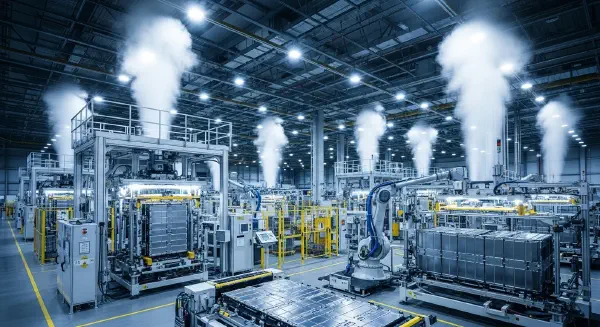
Small Modular Reactors (SMRs) — defined by the Nuclear Energy Agency as reactors with a capacity of approximately 300 MWe or less — represent a different construction theory rather than a different reactor physics. The core economic premise is factory fabrication: if reactor modules can be manufactured in controlled factory environments rather than constructed on-site from custom-engineered components, they benefit from the same manufacturing learning curves that reduced the cost of wind turbines by approximately 70% and solar panels by approximately 90% between 2010 and 2023.
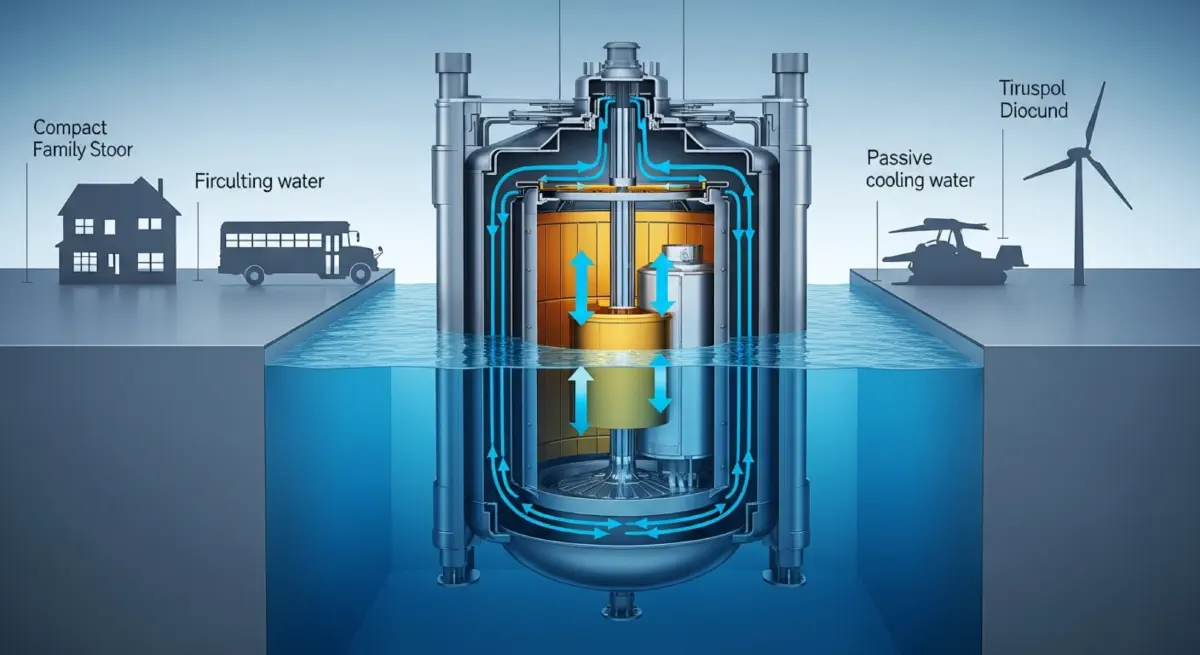
The largest SMR licensing effort in Western markets as of 2024 was NuScale Power's 77 MWe module, which received a Standard Design Approval from the US Nuclear Regulatory Commission in January 2023 — the first Generation III+ SMR design to receive NRC approval. The NuScale design uses passive safety systems — gravity-driven coolant flow and natural convection — that do not require active pump power to maintain cooling. This design feature addresses one of the operational failure modes that contributed to the Fukushima accident, where loss of external power disabled the active cooling systems. The NRC's safety evaluation found that the NuScale design met its safety requirements with a "100-times improvement" in safety margins compared to existing reactors.
The economics of SMR deployment remain unproven. The Utah Associated Municipal Power Systems consortium that had contracted to purchase power from NuScale's Carbon Free Power Project at the Idaho National Laboratory cancelled its subscription in November 2023, citing cost estimates that had escalated from approximately $58/MWh to approximately $89–119/MWh — competitive with offshore wind but not with onshore wind or utility-scale solar in high-insolation regions. NuScale subsequently scaled back its commercial programme. The cancellation is not a verdict on SMR economics in general; it is a verdict on first-of-a-kind commercial deployment costs, which carry engineering novelty and low-series-production premiums that would decline with serial deployment.
The Generation IV landscape#
Beyond the near-term SMR designs, a broader landscape of advanced reactor concepts at varying stages of development carries different risk profiles and fuel cycle characteristics that alter several inputs to the LRACS calculation. The most significant categories from a fuel cycle perspective are:
Molten salt reactors (MSRs) — pioneered at Oak Ridge National Laboratory with the Molten Salt Reactor Experiment of 1965–1969 — use liquid fuel dissolved in molten fluoride or chloride salt rather than solid fuel rods. The fuel's physical properties eliminate the solid-fuel overheating failure mode associated with Chernobyl and Fukushima; the liquid fuel expands and becomes less reactive as temperature rises, providing an inherent negative temperature reactivity coefficient without requiring operator intervention. Terrestrial Energy's Integral Molten Salt Reactor (IMSR-400) and Moltex Energy's Stable Salt Reactor represent current commercial development efforts, both targeting NRC pre-licensing engagement.
Fast neutron reactors — including sodium-cooled fast reactors (like GE-Hitachi's PRISM/BWRX-300 family) and lead-cooled designs — can burn certain categories of spent nuclear fuel as fuel, potentially closing the fuel cycle on long-lived actinides and dramatically reducing the long-term radiotoxicity of the waste stream. The LRACS waste component of fast reactor designs would, if the fuel cycle is closed, be substantially lower than the current LRACS of the open-cycle LWR fleet. This is relevant to the fourth post in this series.
The BWRX-300, GE-Hitachi's 300 MWe boiling water reactor — a simplified evolution of the ESBWR design — received NRC licensing pre-application engagement in 2021 and has been selected by Ontario Power Generation in Canada for the Darlington New Nuclear Project, targeting first operation in the early 2030s. Its construction cost projection, based on a design optimised for simplified construction compared to conventional LWRs, is approximately $3,600–6,000/kW — below the Vogtle actual cost and broadly competitive with offshore wind on a lifecycle cost basis.
The learning rate question#
The central economic bet on SMRs is that factory fabrication will enable a manufacturing learning rate for nuclear components comparable to what the wind and solar industries experienced. The empirical wind turbine learning rate is approximately 12–14% per doubling of cumulative installed capacity; solar panel learning rates have been even steeper at approximately 20–24% per doubling. If SMR modules exhibit a learning rate of only 8% per doubling of cumulative production — a conservative assumption given that they involve considerably more complex manufacturing than wind turbines — they would reach cost parity with offshore wind at approximately 100 GW of cumulative installed capacity, a volume likely achievable between 2040 and 2050 on current development trajectories.
The critical policy question is whether the first 10–20 GW of SMR deployment — expensive by construction, operating at low-volume manufacturing — will receive the same policy support that underwrote the first 10–20 GW of offshore wind deployment in Europe. Wind received feed-in tariffs, contract-for-difference mechanisms, and explicit government procurement commitments that enabled the industry to climb the learning curve at public expense before reaching scale at market cost. Whether nuclear SMRs receive equivalent treatment will largely determine whether the learning rate bet is ever tested at commercial scale.
New reactors, old accounting#
The reactor designs being built and licensed today are not the Chernobyl-era RBMK. The passive safety systems of the AP1000, the negative temperature coefficients of molten salt designs, and the inherent stability characteristics of pool-type liquid metal reactors represent genuine engineering progress on the failure modes of the 1970s-era fleet. The LRACS of these designs is, if anything, lower than the current fleet's LRACS — both because passive safety systems reduce the probability of severe accidents further and because improved fuel efficiency reduces the lifecycle carbon per kWh.
The construction cost problem is real, but it is separable from the physics and the safety. It is a function of institutional capacity, regulatory process continuity, and manufacturing industrialisation — factors that vary by country and by policy choice rather than by the fundamental nature of the technology. South Korea's LRACS for its nuclear fleet, adjusted for construction cost as a component of lifecycle carbon (construction energy is included in the IPCC lifecycle calculations), is effectively identical to France's or the United States', because the construction energy is a small fraction of the lifecycle carbon. The economics vary dramatically; the LRACS does not.
The fourth post in this series addresses the element of nuclear energy's public perception that LRACS does not fully capture: waste. The spent fuel problem — its volume, its management, its long-term radiotoxicity — is real and requires honest accounting. It also requires comparison with the waste streams of the energy sources currently deployed as alternatives.