What happened at 1:23 in the morning#
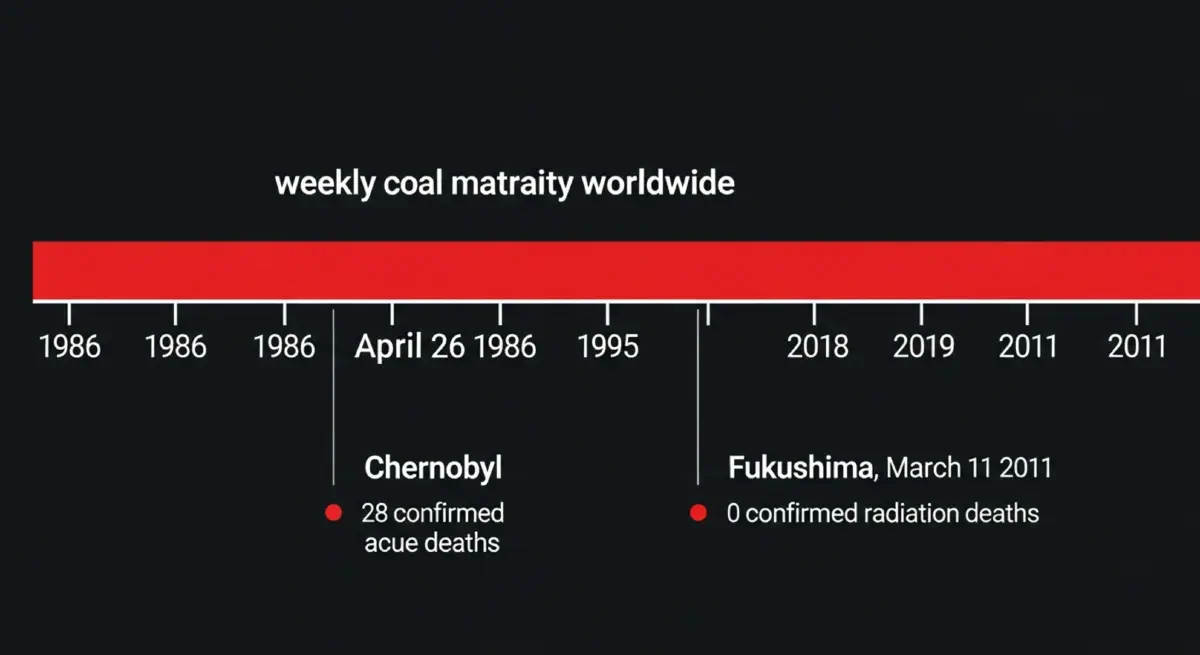
On April 26, 1986, at 1:23:44 am, the operators of Reactor No. 4 at the Chernobyl Nuclear Power Plant in Soviet Ukraine initiated a safety test that violated three separate operational procedures while the reactor was in an unstable low-power state. Within eleven seconds, the power surge peaked at approximately 30,000 MW thermal — ten times the design maximum — and two explosions blew the reactor building apart, launching burning graphite fragments across the surrounding ground and igniting at least thirty fires. The first responders, firefighters from the Chernobyl plant's own brigade and from the city of Pripyat, received acute radiation doses of 1–16 Gy in a working environment they initially did not recognise as radiologically lethal. Twenty-eight of them died from acute radiation syndrome within the first three months.
The Chernobyl accident is the singular reference event in the public imagination of nuclear risk. It represents, in the Slovic dread-risk framework, the maximally visible, involuntary, uncontrollable, catastrophically framed event that defines the fear category. The exclusion zone that remained with restricted access into the 2020s; the abandoned city of Pripyat with its Ferris wheel and collapsing apartment buildings photographed by successive generations of documentary photographers; the HBO dramatisation that attracted 45 million viewers. No other industrial accident in the modern era has received comparable sustained visual and narrative attention.
The UNSCEAR 2008 assessment — the most rigorous internationally peer-reviewed analysis of Chernobyl's health consequences — attributed 28 confirmed acute radiation deaths to the accident, 15 thyroid cancer deaths among evacuees who developed thyroid cancer as children from I-131 exposure and were not treated promptly, and estimated that ultimately approximately 4,000 of the most highly exposed individuals would develop cancer from radiation exposure, of whom perhaps 16 in the Chernobyl liquidators cohort would die from that cancer above background rates. The total attributable mortality from the accident, in UNSCEAR's central assessment, is approximately 60–4,000, with the higher end representing the upper plausible estimate for long-term statistical cancer across all exposure groups.
The arithmetic the comparison requires#
The Lifetime Risk-Adjusted Carbon Score requires a comparison not between single nuclear accidents and a theoretical alternative but between the mortality profiles of entire generation technologies, averaged over their total production histories. The comparison class for Chernobyl is not "what would have happened if no accident had occurred" — it is "what is the mortality per TWh from the entire global nuclear generation history, including Chernobyl, compared to the mortality per TWh from coal, including every mine accident, platform accident, refinery explosion, and, most importantly, every PM2.5-attributable death?"
That comparison produces a specific result. In 1986, the year of Chernobyl, global coal combustion for electricity generation was approximately 3,800 TWh. The WHO-estimated mortality attributable to PM2.5 from coal combustion at that level of generation — using the Sovacool/Our World in Data mortality coefficient of 24.6 deaths/TWh, which itself is a conservative estimate because it is derived from global data including relatively clean coal plants in North America and Europe — was approximately 93,000 deaths in 1986 from coal electricity combustion alone, not including coal used for heating and industry. In the week that Chernobyl's initial reactor explosion killed 28 people, coal power generation killed approximately 1,800.
The LRACS framework does not minimise Chernobyl. It contextualises it.
Three Mile Island: the accident that killed no one#
On March 28, 1979, a coolant system failure at Three Mile Island Unit 2 in Pennsylvania escalated over six days into a partial core meltdown — the most severe accident in the history of US commercial nuclear operations. Approximately 43,000 curies of radioactive krypton gas and 13 curies of radioactive iodine were released to the environment. The Nuclear Regulatory Commission estimated that the maximum radiation dose received by any member of the public within ten miles of the plant was approximately 100 millirem — equivalent to a chest X-ray, and well below the annual background radiation dose at higher elevations such as Denver, Colorado.
The Columbia University School of Public Health conducted a 15-year follow-up study of the population living within ten miles of the plant, comparing cancer incidence against a matched population. The study found no statistically significant increase in cancer rates. The NRC, UNSCEAR, and the WHO have all concluded, consistently across multiple subsequent reviews, that no deaths, cancers, or birth defects can be attributed to the TMI accident with statistical confidence.
The accident cost approximately $975 million in cleanup costs, triggered a decade-long pause in new US nuclear plant construction, and is the second most-cited nuclear accident in public discourse. Its mortality toll is zero. In the month of March 1979, PM2.5 from US coal-fired power plants killed approximately 4,000 people.
Fukushima: the disaster whose deaths came from evacuation#
On March 11, 2011, the Tōhoku earthquake and subsequent tsunami killed approximately 19,000 people along the Japanese Pacific coast and triggered loss of cooling power at Fukushima Daiichi Nuclear Power Plant. Three reactors experienced core meltdowns; hydrogen explosions damaged or destroyed four reactor buildings; approximately 154,000 people were evacuated from a 20-km exclusion zone.
As of the WHO's 2013 health risk assessment, confirmed radiation-related fatalities from the Fukushima accident were zero. The WHO's modelling estimated small increases in lifetime cancer risk for the most highly exposed groups — particularly children in the most contaminated areas of Fukushima Prefecture — but the absolute risk increases were characterised as "small" relative to baseline cancer rates. The 2020 UN Scientific Committee report confirmed: "no observable increases in cancer rates attributable to radiation exposure are anticipated."
The deaths attributable to the Fukushima accident were approximately 2,202, nearly all from the forced evacuation itself. An analysis published in BMJ Open in 2015 documented that the evacuation of approximately 154,000 people — many of them elderly, many with serious pre-existing conditions — under crisis conditions contributed to deaths from stress, hypothermia, disrupted medical care, and the consequences of moving fragile patients. The decision to maintain the exclusion zone for years, rather than implement graded re-entry protocols, extended these evacuation-related harms. The radiological deaths potentially prevented by the evacuation, compared to a modelled scenario of shelter-in-place for most residents, represent a contested calculation that some researchers argue shows the evacuation death toll exceeded the radiation death toll it was designed to prevent.
The German natural experiment#
Germany's response to Fukushima provides the most direct policy-level test of what the LRACS framework predicts. In May 2011, German Chancellor Angela Merkel announced the Energiewende phase-out: all German nuclear capacity would close by December 2022. The decision reversed a 2010 lifetime extension agreement and was implemented without a formal economic or mortality impact assessment. By 2013, seven reactors had closed.
The electricity substitution was not clean. German coal combustion increased approximately 20% in the 2011–2013 period; natural gas imports rose substantially; and Germany's total greenhouse gas emissions from electricity generation increased in the years immediately following the phase-out decision, reversing a previously declining trend.
A 2022 paper by Stephen Jarvis, Olivier Deschênes, and Akshaya Jha, published in the Journal of the European Economic Association, estimated the health and mortality consequences of the German phase-out decision using county-level panel data on air pollution and mortality. Their central estimate was that the phase-out caused approximately 1,100 additional deaths per year in Germany from increased air pollution — at a monetised social cost of approximately $12 billion per year. Over the full phase-out period from 2011 to 2022, this implies approximately 12,000 additional deaths attributable to the nuclear closure decision, plus approximately $132 billion in social mortality costs.
The German nuclear phase-out decision was democratically adopted, publicly supported, and never formally evaluated against these consequences.
The politics of visible versus statistical deaths#
The LRACS comparison demonstrates a consistent and troubling pattern: energy policy decisions that reduce nuclear generation on safety grounds — decisions made in response to the vivid, identified, fear-generating deaths at Chernobyl, TMI, or Fukushima — consistently increase statistical deaths from the fossil fuel generation that replaces nuclear capacity. The visible deaths are counted, investigated, memorialised, and responded to. The statistical deaths are not counted, not attributed, not memorialised, and not responded to.
This is not a flaw in human moral reasoning so much as a consequence of how moral attention works. Identified lives generate stronger moral obligations than statistical lives; this is established in both philosophical theory (the identifiability effect, Schelling 1968) and empirical psychology (the collapse of compassion at scale, Cameron and Payne 2011). The policy implication is that a regulatory and political system that responds proportionally to identified deaths and disproportionately to statistical deaths will systematically make choices that increase total mortality — by retiring the source that generates identified deaths (rare nuclear accidents) in favour of the source that generates statistical deaths (continuous fossil fuel combustion) at a rate that is, per TWh, three hundred times higher.
The next post examines the technology pipeline that may alter the terms of this accounting: small modular reactors, Generation IV designs, and the question of whether the 1950s-derived light-water reactor fleet was the right technology at the wrong scale — and whether newer designs represent a genuinely different risk and economics proposition.