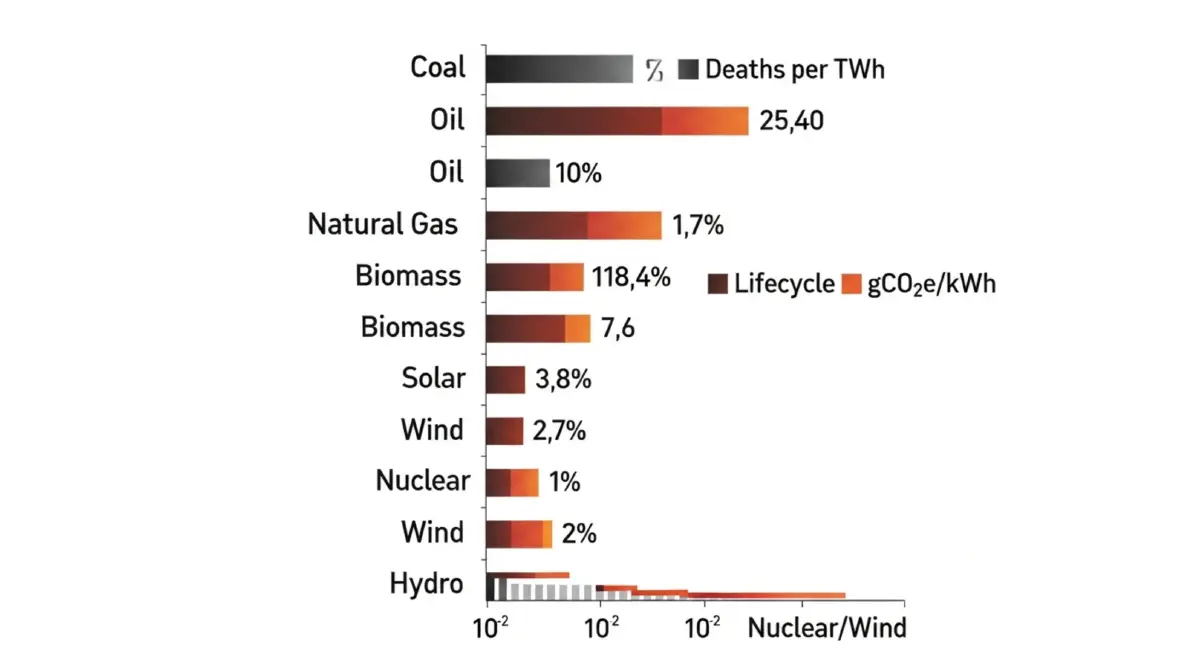
The Lifetime Risk-Adjusted Carbon Score reveals a risk hierarchy that inverts public perception: LRACS = (Lifecycle gCO₂e/kWh × normalised deaths/TWh) composite, indexed to coal = 1.0. Using IPCC (2014) median lifecycle carbon estimates and Our World in Data/Sovacool (2016) mortality data: Coal LRACS = 1.0 (820 gCO₂e/kWh, 24.6 deaths/TWh); Oil = ~0.7 (720 gCO₂e/kWh, 18.4 deaths/TWh); Natural gas = ~0.2 (490 gCO₂e/kWh, 2.8 deaths/TWh); Biomass = ~0.1–0.3 depending on feedstock; Solar = ~0.002 (48 gCO₂e/kWh, 0.44 deaths/TWh); Wind = ~0.001 (11 gCO₂e/kWh, 0.15 deaths/TWh); Nuclear = ~0.001 (12 gCO₂e/kWh, 0.07 deaths/TWh). Nuclear and wind have virtually identical LRACS values — both approximately 1,000× safer per unit energy than coal. Public polling consistently rates nuclear as among the most dangerous energy sources available.
The prevented deaths from nuclear power generation are invisible in energy policy discourse: Hansen and Kharecha (2013) extended their analysis to 2009 and estimated that nuclear power had prevented 1.84 million deaths by displacing coal and natural gas generation. A follow-on analysis estimated that replacing all current global nuclear capacity with gas would cause approximately 420,000 additional deaths per decade. These estimates use the epidemiological methods that are standard in air quality science, applying established dose-response relationships for PM2.5 and CO to the counterfactual generation mix. The prevented deaths are invisible because they are statistical — diffuse, unattributed, distributed across populations exposed to air pollution. Nuclear accident deaths are concentrated in time and space and receive commensurate press coverage.
Germany's nuclear phase-out is a natural experiment in the mortality cost of anti-nuclear policy: Germany shut down its nuclear fleet between 2011 and 2023, replacing the low-carbon baseload with a combination of expanded coal combustion (bridge fuel) and accelerated renewable development. In the transition period, coal represented approximately 30–35% of German electricity generation, compared to approximately 22% before the phase-out. A 2021 paper by Stephen Jarvis, Olivier Deschênes, and Akshaya Jha estimated that Germany's 2010–2011 post-Fukushima nuclear phase-out decision cost approximately 1,100 additional deaths per year from air pollution, at a monetised cost of approximately $12 billion per year. The phase-out decision has never been publicly evaluated against this mortality cost by its political proponents.
Nuclear construction cost escalation in the West is a regulatory and institutional failure, not a technology failure: Nuclear construction costs in South Korea, China, and the UAE — countries that have maintained continuous nuclear construction programmes — remain approximately $2,000–4,000 per kW of installed capacity, within the range of other large-scale baseload generation. In the United States and United Kingdom, recent nuclear projects (Vogtle Units 3 and 4, Hinkley Point C) have incurred costs of $12,000–30,000+ per kW — a 3–10× premium attributable primarily to regulatory discontinuity, loss of skilled construction workforce from the 30-year gap in US nuclear building, first-of-a-kind engineering novelty costs, and financing charges accumulated over extended construction periods. The technology is the same. The institutional capacity is the variable.
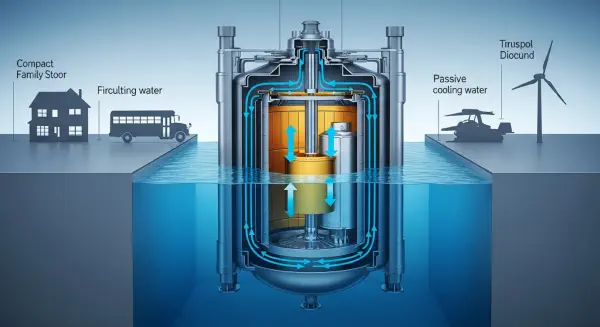
Small modular reactors represent a different cost structure, not a different physics: SMR designs below 300 MWe are designed for factory fabrication, eliminating a substantial fraction of the large-project construction risk that drives cost escalation in conventional nuclear builds. NuScale Power received NRC design certification for its 77 MWe module in 2022; the first commercial SMR deployment at the Idaho National Laboratory was formally cancelled in 2023 citing cost overruns, demonstrating that SMR economics are not yet proven at commercial scale. Rolls-Royce (470 MWe), GE-Hitachi BWRX-300, and Terrestrial Energy's IMSR-400 represent competing concepts at different stages of regulatory approval. The LRACS of near-term SMR designs is expected to be broadly comparable to the existing fleet — the risk profile changes primarily in the direction of construction finance rather than operational safety.