Whose Monsoon Is It?#
In 2009, atmospheric scientist Alan Robock at Rutgers University and colleagues published a paper in Geophysical Research Letters that posed a question no one working on stratospheric aerosol injection had satisfactorily answered.#
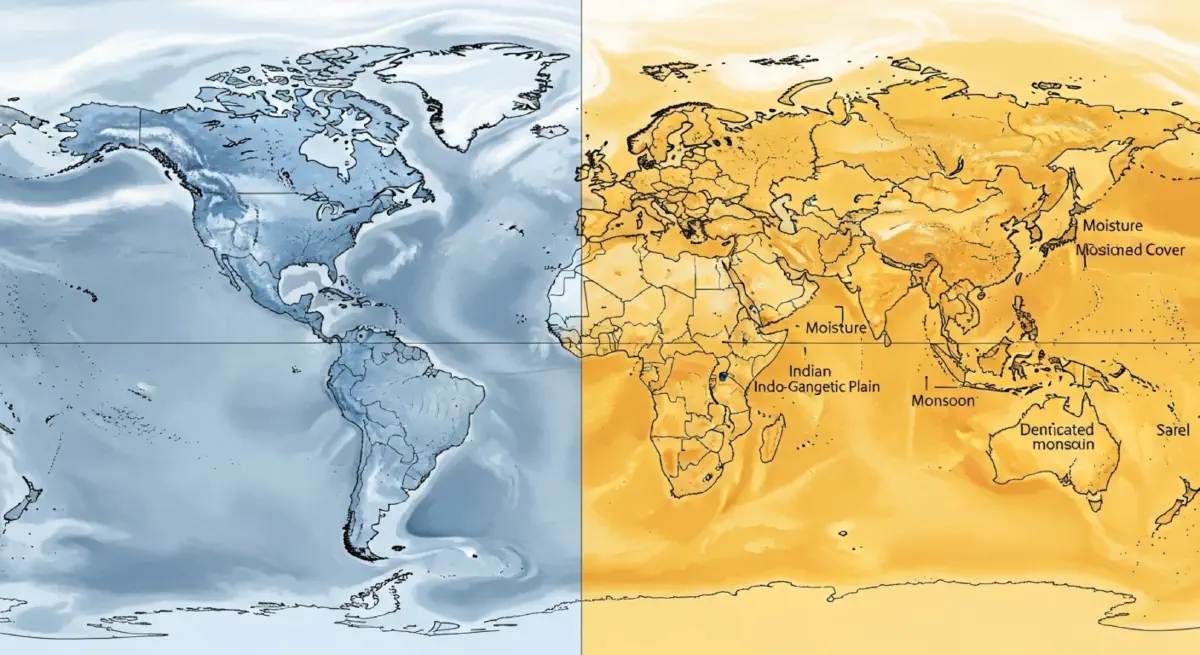
Robock's team ran the GISS ModelE general circulation model with different scenarios of stratospheric sulphate aerosol loading and examined the regional precipitation responses. The results were not ambiguous. In scenarios where aerosols were injected primarily in the northern hemisphere — the hemisphere where most proposed injection infrastructure would logically be located, because it contains most of the countries with the motivation and capability to conduct deployment — the model projected reductions in summer monsoon precipitation across Africa and Asia. The reduction magnitudes varied by scenario but clustered in the range of 5–10% reduction in monsoon rainfall over India and sub-Saharan Africa compared to baseline projections.
Five to ten percent of monsoon rainfall is not a technical rounding error in climate models. The South Asian monsoon delivers approximately 70–90% of India's annual freshwater supply — for a country of 1.4 billion people, approximately 600 million of whom derive their livelihoods from rain-dependent agriculture. The West African monsoon governs the growing season for staple crops across the Sahel, where food security is already structurally compromised by existing rainfall variability. A 5–10% reduction in monsoon precipitation in a region where crop yields are already calibrated to the existing precipitation regime, and where there is no financial or infrastructural margin for adaptation, translates into food production shortfalls measured in millions of tonnes and hunger consequences measured in millions of people.
Robock's paper listed twenty reasons why geoengineering might be risky or undesirable. The monsoon disruption — his second item — was not speculative. It was a mechanistically coherent consequence of the same physics that makes SAI effective as a cooling tool.
The Monsoon Disruption Mechanism: Why Cooling Disrupts Rainfall#
The connection between solar radiation reduction and monsoon weakening is not an incidental side effect of SAI — it is a consequence of the same atmospheric dynamics that drive monsoon circulation in the first place.
Monsoon systems are driven primarily by differential heating between land masses and adjacent ocean surfaces. In the South Asian monsoon, the large land mass of the Indian subcontinent absorbs solar radiation faster than the Indian Ocean during the Northern Hemisphere spring and early summer. This creates a thermal gradient: the land surface becomes significantly warmer than the ocean surface, generating a pressure differential that draws warm, moisture-laden air from the ocean onto the continent. As this moist air ascends over the land, it cools, condenses, and produces the intense seasonal rainfall that characterises the monsoon. The intensity and duration of the monsoon are directly related to the magnitude of the land-sea thermal contrast.
Stratospheric aerosols reduce this thermal contrast. By scattering incoming solar radiation, they reduce the surface heating of both land and ocean. But the land-sea contrast is not reduced uniformly — it depends on the ratio of aerosol optical depth over the land surface to the existing ocean heat capacity regulation of sea surface temperature. The net effect of aerosol loading in general circulation model simulations is a reduction in the land-sea thermal contrast and a corresponding weakening of the pressure gradient that drives monsoon winds. Monsoon onset may be delayed; monsoon intensity may be reduced; total seasonal precipitation may decline.
The African and Asian monsoon systems are particularly sensitive to this mechanism because they are among the strongest monsoon circulations on Earth — driven by the largest land masses positioned at the tropical latitudes where solar forcing is most intense. The same characteristics that make these monsoons powerful agricultural and water supply systems make them particularly responsive to reductions in the solar forcing that drives them.
Northern hemisphere aerosol injection is more disruptive to monsoon circulation than equatorial or southern hemisphere injection because it asymmetrically reduces land surface heating in the northern tropics and subtropics while leaving southern hemisphere sea surface temperatures relatively unchanged, amplifying the reduction in land-sea contrast.
The Regional Winners and Losers Asymmetry#
The ILI calculation looks different depending on where you are standing. The same numerical ratio — cooling forcing achieved per unit disruption risk — that appears acceptable from a global average perspective may be catastrophically negative from a South Asian or sub-Saharan African perspective.
Consider the arithmetic of a hypothetical deployment programme designed by a consortium of northern hemisphere industrialised countries to limit global mean temperature increase to 1.5°C above pre-industrial levels through sustained SAI. The industrialised countries in the consortium have several characteristics in common: they are the primary historical contributors to accumulated atmospheric CO₂; they have the financial and technical capacity to mount and maintain deployment; they are, on average, in more northerly latitudes where warming has been fastest and where the projected damage from continued warming is substantial; and they have agricultural and water supply systems with sufficient infrastructure and market integration to partially adapt to precipitation changes. The countries whose monsoons are disrupted have several characteristics in common as well: they are among the lowest contributors to historical CO₂ accumulation; they lack the technical and financial capacity to participate meaningfully in deployment decisions; they are at latitudes where reduced solar radiation has a larger impact on land-surface heating; and they have agricultural systems with limited adaptive capacity, high dependence on rainfall, and populations with limited financial buffers against crop failure.
This asymmetry is not accidental. It is the geometric consequence of who industrialised, where they industrialised, and where the thermal dynamics that drive monsoons are located. The parties who caused the atmospheric CO₂ accumulation that makes geoengineering seem necessary are not the same parties who would bear the monsoon disruption costs of addressing it via SAI. And the parties who would bear those costs have no formal mechanism to grant or withhold consent.
The governance literature calls this the thermostat problem: if global mean temperature is treated as a single value to be optimised, there is an optimal thermostat setting for the global average. But the temperature and precipitation consequences are not uniformly distributed in space, and different populations have different optimal thermostat settings. A Northern Hemisphere actor deploying SAI to reduce warming at its own latitude may simultaneously be imposing precipitation costs on a population that prefers a warmer but wetter climate over a cooler but drier one. The global mean temperature metric obscures this regional welfare tradeoff entirely.
The Governance Incommensurability Problem#
Solar radiation management geoengineering introduces a governance problem that standard international environmental law frameworks are not designed to handle: the problem of incommensurable welfare impacts across a global forcing mechanism with no neutral baseline.
Standard international environmental frameworks — the Montreal Protocol, the Kyoto Protocol, the Paris Agreement, the Convention on Biological Diversity — address situations where a human activity causes damage relative to a natural baseline from which that activity represents a departure. The legal logic is: do not degrade what would otherwise exist without the harmful activity.
SAI governance faces a different logical structure. The atmosphere as it currently exists is already modified by two centuries of industrial emissions. There is no neutral baseline from which SAI represents a departure, because the baseline from which it might be assessed — pre-industrial atmospheric composition — was departed from by a prior human modification that itself had no legal framework governing it. The warming trajectory that SAI would reduce is itself the consequence of uncompensated modifications to the atmosphere by industrialised countries.
Ricke, Moreno-Cruz, and Caldeira (2013) analysed strategic incentives in climate geoengineering coalitions and found that the distributional conflicts around SAI deployment create game-theoretic dynamics that systematically exclude the parties with the greatest monsoon sensitivity from governance arrangements. A coalition of actors with compatible interests in cooling — primarily northern hemisphere high-emitting countries — could form a deployment coalition and would have no structural incentive to include monsoon-dependent countries whose interests are in conflict with the coalition's preferred forcing level. The legal status of such unilateral or coalition deployment is undefined; the compensation mechanism for affected non-member parties does not exist.
This is not an imagined scenario. Ricke et al.'s analysis of strategic incentives suggests it is the predictable equilibrium outcome of current international institutional arrangements — that the parties who would deploy SAI and the parties who would oppose it have sufficiently incompatible welfare functions that voluntary consensus governance is structurally improbable, and that the parties with the technical and financial capability to deploy have no institutional mechanism constraining them from proceeding.
The Options Under Conditions of Distributional Conflict#
Three governance approaches to the distributional conflict over SAI exist in the current literature, none of which has achieved institutional instantiation.
Compensation regimes: SAI deployment could be conditioned on an international fund that compensates parties who experience monsoon disruption above some threshold. The conceptual structure is analogous to the Loss and Damage mechanism in climate finance — recognising that some parties bear costs from atmospheric conditions they did not cause, and that compensation is owed. The practical challenges are substantial: attribution of specific precipitation anomalies to SAI versus natural variability is a modelling challenge, not a measurement; the institutions that would administer such a fund do not exist; and the fund would need to be capitalised by the same parties who are deploying SAI, creating a conflict of interest in the attribution process.
Consent requirements: SAI deployment could be prohibited without the positive consent of affected parties, analogous to FPIC (Free, Prior, and Informed Consent) requirements for indigenous rights. The Kiruna cancellation demonstrated that consent-based frameworks are viable for blocking research experiments at the local governance level. Scaling consent requirements to global deployment governance requires identifying who constitutes an affected party (all 8 billion people? all sovereign states? all monsoon-dependent agricultural communities?), what procedure generates legitimate consent at that scale, and what institutional body verifies and enforces the consent requirement.
Scientific advisory governance: Some proposals suggest that a scientific advisory body — modelled on the IPCC but with an operational mandate rather than a purely assessment mandate — could establish technical thresholds for deployment levels, injection strategies, and monitoring requirements that limit monsoon disruption to acceptable levels. The challenge is that "acceptable levels" of monsoon disruption cannot be determined by scientific consensus alone; they require value judgements about whose welfare is weighted how much in the optimisation, which is a political question that scientific bodies are not constituted to answer.
The Bilateral Bargaining Trap#
The distributional conflict over SAI can be understood through a bilateral bargaining lens that reveals why standard negotiating frameworks fail to produce governance solutions.
In standard international climate negotiations, all major emitting countries share a common interest in reducing warming, which creates a positive-sum bargaining space: the more countries participate in emissions reduction, the better each participant is off (even accounting for free-rider problems). This structure allows incremental progress — each successive agreement can be marginally better than the previous one while still leaving parties better off than no agreement.
SAI bargaining does not have this structure. A northern hemisphere actor deploying SAI at the level that minimises its own expected damage from continued warming may simultaneously impose monsoon disruption costs on South Asian and sub-Saharan African countries that more than outweigh any benefit those countries receive from reduced warming. The bargaining problem is not positive-sum; it is potentially negative-sum for the most vulnerable parties. Negotiations that aim to find a global optimum require credible side payments from SAI deployers to monsoon-affected parties — but the legal framework for mandating such payments, and the institution that would administer them, do not exist.
The governance gap examined in the next post is not, ultimately, a technical gap. The physics that needs to be governed is well-characterised. The gap is the gap between who controls the atmosphere-modifying capability and who bears the consequences of its exercise — and the absence of any institution with the mandate and authority to bridge it.