The Moral Hazard Machine#
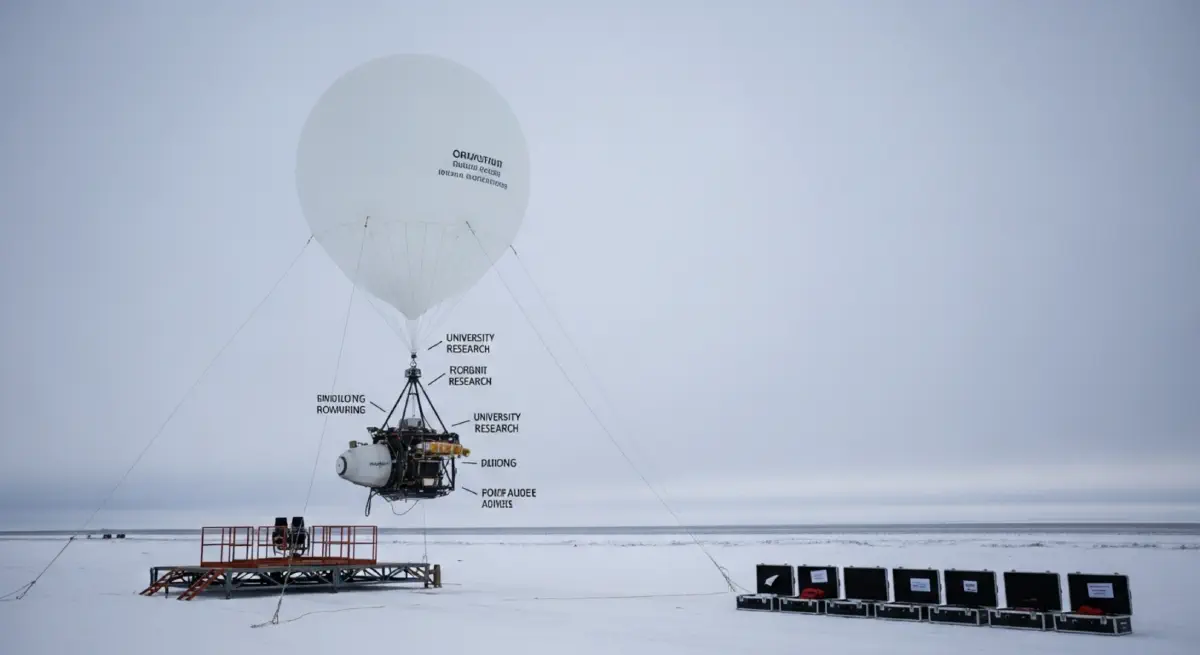
On a clear morning in March 2021, a team of engineers from Harvard University was prepared to launch a balloon from the Esrange Space Center in Kiruna, Sweden — a point approximately 200 kilometres north of the Arctic Circle that Sweden has used for scientific balloon launches since 1966.#
The balloon was not carrying any aerosols. It was not designed to test any injection mechanism. It was a small helium-filled research balloon for the Stratospheric Controlled Perturbation Experiment — SCoPEx — and its purpose in this specific test flight was to ascend to approximately 20 kilometres altitude, verify sensor packages and the gondola's propeller navigation system, and descend. It would not release any materials into the atmosphere. It would not alter the atmosphere in any way detectable by any instrument on Earth. In scientific terms, it was less consequential than thousands of weather balloon launches conducted globally each day.
The Saami Council — the transnational representative body of the Sámi indigenous peoples of Norway, Sweden, Finland, and the Kola Peninsula of Russia — had written to the Swedish Space Corporation, which operates Esrange and had a service agreement with the Harvard team, to register formal opposition to the launch. The Saami Council's letter stated that the research programme "aims to develop technology for SAI," that the Sámi had not been consulted in the development of the research programme, and that indigenous peoples whose territories would be affected by any future atmospheric modification had a right to free, prior, and informed consent under international indigenous rights frameworks. The Swedish Space Corporation suspended its agreement with the Harvard team pending further review. The test balloon was not launched. The SCoPEx programme relocated its planning activities without a confirmed launch site; Kiruna became a permanent entry in the chronology of geoengineering governance.
The cancellation of a balloon that was not going to do anything atmospheric generated more governance commentary than any actual atmospheric modification event since Pinatubo.
The Moral Hazard Argument and Its Architecture#
The moral hazard argument against solar radiation management geoengineering research has a clear logical structure. It proceeds in three steps.
First: research into SAI normalises the idea that SAI is a legitimate policy option. The publication of research results, the conduct of outdoor experiments, and the participation of major scientific institutions in SAI research programmes all signal to policymakers that SAI belongs in the portfolio of responses to climate change alongside mitigation and adaptation.
Second: the availability of SAI as an option in the portfolio changes the political economy of mitigation. If a relatively cheap, rapidly effective intervention exists that can lower surface temperatures without requiring comprehensive emissions reductions, actors who bear costs from mandatory emissions reductions have an incentive to favour the cheap intervention over the costly structural change. Fossil fuel interests benefit from any delay to the energy transition; a credible SAI option provides a delay instrument.
Third: mitigation ambition declines as SAI credibility increases, reducing the probability of achieving the emissions reductions that would eventually make SAI unnecessary.
The moral hazard argument is theoretically coherent. Its empirical status is genuinely contested. The case against SAI research on moral hazard grounds requires not just that the argument is logically valid but that the predicted effect on mitigation ambition is large enough to outweigh the value of having a safety option available if mitigation fails sufficiently.
The counter-argument has equal force: the moral hazard risk of SAI research may be real but small, while the risk of an emergency scenario in which SAI is deployed by a desperate actor without any research base to inform safe deployment is large. The choice is not between a world with SAI research and a world without SAI as a possibility. The physics does not depend on whether research is conducted. The choice is between a world with SAI research and governance development and a world where the same physics is operative but the knowledge and institutional framework for governing it have not been built.
The SCoPEx Governance Vacuum and Its Institutional Significance#
The SCoPEx cancellation is a case study in a governance configuration that produces paralysis: the combination of genuine jurisdictional ambiguity, an unresolved institutional framework, and a well-organised objecting party with moral standing but no formal legal authority over the decision.
The Harvard SAI Programme, led by David Keith and Frank Keutsch, had been planning outdoor experiments since approximately 2017. The outdoor component of SCoPEx was designed to release a small quantity of calcium carbonate particles — or possibly sulphate aerosols — at stratospheric altitude from the gondola of a research balloon, and to measure the resulting aerosol properties, photochemical reactions, and scattering characteristics in-situ. The quantities envisioned were grams to kilograms — orders of magnitude below any threshold of atmospheric significance. No temperature effect was possible; no precipitation effect was calculable; no ozone chemistry was detectable above natural background variation.
The Sámi objection was not factually incorrect about the purpose of the research programme. SCoPEx was indeed part of a research trajectory aimed at understanding whether SAI could be safely and effectively deployed. The Sámi Council was correct that it had not been consulted in the design of the research programme at the time of its first contacts with the Swedish Space Corporation. It was correct that the Sámi, as the indigenous peoples of the Arctic territories where future aerosol injection programmes might plausibly be sited for high-latitude deployment scenarios, had a genuine interest in the governance of such programmes.
What neither party could determine was which institution had the authority to evaluate these competing claims and render a binding decision. The Swedish Space Corporation was not a regulatory body for atmospheric research. The Swedish government had no domestic regulatory framework specifically covering SAI research. No international institution had a mandate that clearly encompassed the governance of small-scale SAI outdoor experiments. The United Nations Environment Programme had no enforcement authority. The IPCC assesses science; it does not authorise experiments.
The governance vacuum that the Kiruna cancellation exposed is not Sweden-specific. It is the global condition. No nation has a comprehensive domestic regulatory framework for SAI research. No international agreement establishes a licensing process or a notification requirement. The ENMOD convention of 1977, which prohibits military use of environmental modification techniques, does not clearly address civilian research; it was designed to prevent weaponisation of weather, not to govern climate interventions. The Convention on Biological Diversity has adopted decisions calling for caution regarding geoengineering but has no enforcement mechanism and no clear scope of coverage.
The Harvard programme subsequently established an independent advisory committee and began a more extensive stakeholder engagement process. It has not successfully identified a launch location for outdoor experiments as of this writing. The research that might reduce the uncertainty in the ILI denominator — field measurements of aerosol behaviour, photochemistry, and precipitation effects — has not been conducted.
The Lock-In Problem and Termination Shock#
The moral hazard literature focuses primarily on the effect of SAI availability on mitigation ambition. A distinct and arguably more serious governance problem concerns what happens after deployment begins: termination shock.
Termination shock refers to the rapid temperature rebound that would follow abrupt discontinuation of a sustained SAI programme. The mechanism is straightforward. If SAI has been deployed for decades at a level that suppresses global mean temperature by, for example, 1.5°C below the trajectory that would otherwise prevail under current CO₂ concentrations, then the atmospheric CO₂ concentration at the time of termination remains at the elevated level it would have reached under the deployment period. The aerosol forcing that was masking the warming associated with that CO₂ concentration disappears within 1–2 years as the stratospheric aerosol burden settles out. The warming suppressed by the aerosol — the full 1.5°C offset — re-emerges at a rate determined by climate sensitivity and the aerosol washout timescale rather than by the gradual pace of CO₂ accumulation.
Parker and Irvine (2018), in a systematic analysis of termination shock risk published in Earth's Future, found that abrupt termination of a deployment that had maintained 1°C of cooling could produce warming rates of approximately 0.3–0.5°C per decade in the years following termination — compared to observed warming of approximately 0.2°C per decade over recent decades. Under some scenarios, particularly if deployment had been sufficiently large to mask 2°C of warming and CO₂ concentrations had been allowed to accumulate toward 550–600 ppm under the assumption of continued deployment, termination could produce warming rates exceeding 0.5°C per decade. This is faster than most terrestrial ecosystems have experienced since the last glacial transition.
Termination shock transforms the governance problem in a specific way: it converts SAI deployment into an indefinite commitment. A country or institution that initiates SAI deployment cannot cease it unilaterally without imposing termination shock costs on the entire planet. This creates a form of planetary lock-in with no precedent in environmental governance. Nuclear arsenals create mutual destruction risks that produce deterrence equilibria; atmospheric carbon creates a commons problem with well-understood collective action structure. SAI deployment creates a dependency relationship in which a single actor's ability to withdraw from the intervention determines the trajectory of global temperature for all parties — and no treaty framework exists that would prevent or compensate for such withdrawal.
The ILI as calculated for an initial deployment decision does not reflect the ILI as recalculated 30 years into a sustained programme, when termination shock has become embedded in the denominator of any contemplated modification to the programme. An intervention that looks leveraged at the initiation phase — high cooling benefit per unit of disruption risk — looks qualitatively different when the denominator includes the civilisation-scale consequences of stopping.
The Empirical Evidence on Moral Hazard Effects#
The empirical study of whether SAI research and availability actually reduces mitigation ambition is a methodological challenge. It cannot be resolved by randomised experiment; the relevant population is the global policy community, the intervention is information about SAI capabilities, and the outcome is national emissions trajectories over decades.
The existing evidence comes primarily from survey-based and experimental studies where subjects are presented with information about geoengineering and asked about their subsequent support for mitigation policies. Results are mixed and context-dependent. Some studies find moderate reductions in stated support for mitigation following information about geoengineering; some find no effect; some find that information about geoengineering risks increases support for mitigation by highlighting the inadequacy of SAI as a standalone solution.
What the empirical literature does not resolve — and cannot resolve with current methods — is the political economy question. The relevant moral hazard mechanism is not primarily individual attitude change; it is institutional and lobbying behaviour. A fossil fuel industry actor facing regulatory pressure does not need survey respondents to reduce their stated mitigation support. It needs a credible technical alternative to the structural changes that regulation would impose, which it can present in policy debates as a reason to defer regulation while research matures. SAI provides this — not as a deployed technology, but as a possibility that is sufficiently credible to require evaluation.
The political economy route to moral hazard does not show up in survey studies of individual attitude change. It operates through the institutional channels of lobbying, expert testimony, and the production of uncertainty in policy forums. The Kiruna cancellation demonstrated that even a balloon test that could not possibly affect the atmosphere was sufficient to mobilise institutional opposition, generate international media coverage, and delay a research programme for years. The political economy of SAI governance operates at the level of institutional legitimacy, not physical effect — and that is precisely where the moral hazard concern has its most direct operational pathway.
The Threshold Question#
The moral hazard dilemma reduces to a threshold question that governance frameworks must answer before SAI can be managed rather than merely argued about: at what point does the risk of not having SAI knowledge exceed the risk of having it?
The Intervention Leverage Index provides part of the analytic structure for that answer. It measures what is gained in cooling forcing against what is risked in hydroclimate disruption. But the governance threshold question requires a second calculation alongside the ILI: what is the expected value of having the knowledge and governance frameworks required for responsible SAI deployment in a scenario where climate change accelerates beyond current trajectory projections? That calculation involves the probability of a genuine climate emergency requiring rapid temperature reduction, the damage costs in such an emergency without an SAI option, the damage costs with an SAI option but without adequate governance frameworks, and the damage costs with an SAI option and adequate governance frameworks.
The argument against research — that moral hazard reduces mitigation ambition enough to make the research net harmful — requires that the moral hazard benefit of delay (in the form of preserved mitigation ambition) exceeds the safety benefit of having knowledge and governance when needed. Under most formal decision analysis frameworks, this comparison favours research, particularly since the physical knowledge of SAI's effectiveness is already publicly available from the volcanological record, meaning research generates governance capacity and risk reduction rather than new capabilities.
The Saami Council's objection at Kiruna was not about the physics. It was about who decides when the research starts, what constraints govern it, and who is compensated when the benefits of cooling efficiency are distributed globally while the costs of disrupted monsoons are distributed regionally. Those are not physics questions. They are governance questions that the Kiruna cancellation made unavoidably concrete. The monsoon distributional problem is where the ledger goes next.