The electric car in the parking lot#
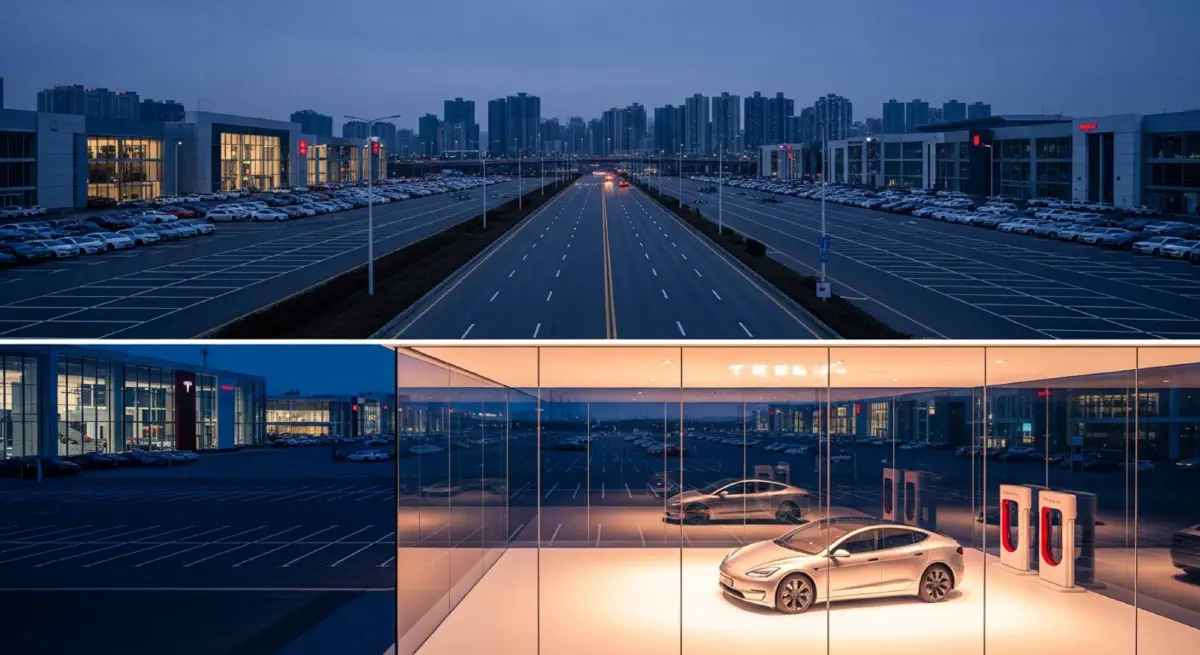
In August 2017, Elon Musk announced that Tesla had built its millionth car. The announcement was made in Fremont, California — a low-density suburb on the eastern edge of the San Francisco Bay Area, surrounded by eight lanes of Interstate 880 and approximately 250 acres of surface parking dedicated to the Fremont Assembly plant. The millionth Tesla drove home that evening on roads built for cars, to a suburb built for cars, in a settlement pattern that will still be built for cars when every vehicle in the state runs on renewable electricity.
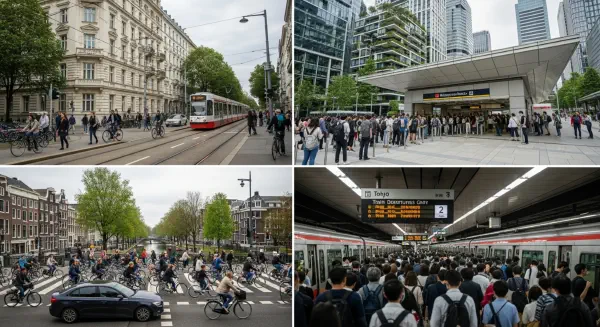
The electric vehicle revolution, as it has been commercially deployed in the United States, is a technology swap within a structural constraint. It replaces the fuel in the tank without altering the spatial distance between the home and everything the car is required to drive to. A Tesla in a Phoenix suburb still drives approximately 15,000–19,000 kilometres per year — the US average — over a spatial pattern of dispersed uses that low-density zoning makes structurally inevitable. An EV in Phoenix has approximately 70–80% lower tailpipe emissions than its petrol counterpart. It still produces roughly 3–4 times the transport-related emissions per capita of a resident of central Amsterdam, whose bicycle covers 4,000 kilometres per year and whose transit pass covers the remainder.
The Urban Carbon Leverage Factor persists across fuel transitions because it is not primarily a fuel problem. It is a spatial problem. The density dividend cannot be collected by changing what cars run on. It can only be collected by changing the distances people are required to travel and the choices available to them for making those trips.
The zoning code as carbon infrastructure#
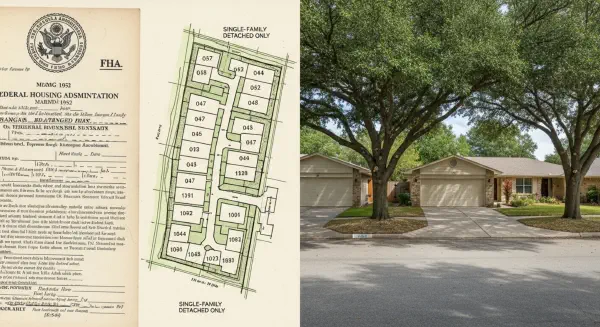
In 2021, California passed Senate Bill 9, which effectively eliminated single-family-only zoning across the entire state. SB 9 allows property owners in R-1 zones to build up to four housing units on any single-family lot and to subdivide lots in most circumstances, without requiring local government discretionary approval. The bill passed after years of advocacy by the YIMBY (Yes In My Backyard) movement — a coalition of housing affordability advocates, urbanists, and climate policy researchers who had reframed single-family zoning not as a benign preference protection but as a policy instrument that maintained both housing unaffordability and structural carbon emissions.
The climate framing of SB 9 was not incidental. A 2020 study by researchers at the University of California Berkeley found that meeting California's climate targets exclusively through vehicle electrification and energy grid decarbonisation, while maintaining the existing single-family suburban settlement pattern, would require 100% EV adoption by 2035, 100% renewable electricity by 2045, and zero direct natural gas use in all buildings — a technology transition scenario that regulators and utilities widely regard as optimistic. Meeting the same targets while incrementally densifying the built environment through zoning reform reduced the required pace of technology transition substantially, because each additional household in a transit-accessible walkable neighbourhood reduces the structural UCLF premium for that household independent of what vehicle they drive or how their power is generated.
The Urban Carbon Leverage Factor is not improved by technology alone. It is improved by changing the spatial structure of urban environments — which requires changing zoning law. Zoning law is entrenched by the political economy of existing homeowners for whom R-1 zoning represents a legally guaranteed form of neighbourhood character protection that also maintains the asset value of their primary investment. That political economy is the principal barrier to collecting the density dividend.
Marchetti's constant and the carbon implication#
Cesare Marchetti, an Italian physicist at the International Institute for Applied Systems Analysis, published a paper in 1994 documenting what has since become known as "Marchetti's Constant": across all historical periods studied, from pedestrian cities of the ancient world to automobile-dependent cities of the twentieth century, the average one-way commute time for urban residents has remained approximately 30 minutes. The technology of movement has changed dramatically — walking at 5 km/h, riding horses at 15 km/h, driving at 50–80 km/h in congested urban conditions — but the time budget has remained constant.
The climate implication of Marchetti's Constant is direct and underappreciated. Higher-speed transport technologies allow a 30-minute travel budget to reach further from a home or workplace — which enables and incentivises land use dispersal. Every increase in transport speed, applied in an unrestricted land use context, generates sprawl to consume the new accessible radius. The Interstate Highway System's 60–80 mph design speed converted a 30-minute commute radius from approximately 20 km (at 40 mph arterial speed) to approximately 40–50 km — roughly tripling the footprint of a viable residential zone around a US employment centre. Zoning had simultaneously prohibited the residential densification of the inner-ring suburbs that would have absorbed the growth within the original radius. The combination was an instruction to build dispersed, and the building industry complied.
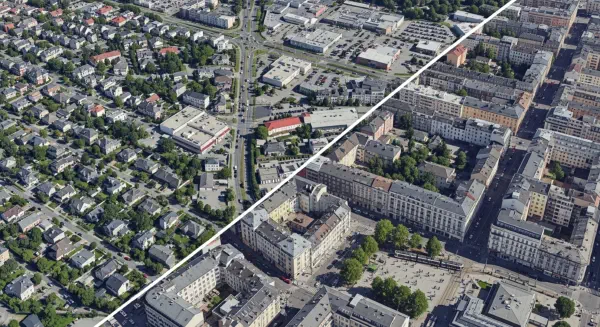
The 15-minute city framework is an inversion of this logic. Carlos Moreno's 2020 proposition — that urban environments should be designed so that all daily-need destinations are reachable within 15 minutes at walkable or cyclable speed — accepts Marchetti's time budget as fixed and reduces the speed constant rather than expanding it. At 5 km/h walking speed, a 15-minute radius is approximately 1.25 km. At that radius, the density required to support walkable retail, school catchments, primary healthcare, and productive employment is approximately 3,000–5,000 housing units/km² — the middle range of European city centres, the bottom range of Tokyo's inner districts, and far above the 200–400 units/km² typical of US R-1 suburban zones.
The YIMBY-climate coalition#
The intersection of housing policy and climate policy is one of the more consequential coalitions to have emerged in US and UK politics in the 2020s. The YIMBY case for zoning reform — articulated initially as an affordability argument — gained substantial climate reinforcement from the Jones and Kammen data, from California's SB 9 process, and from a growing body of carbon accounting literature. Minnesota followed California's zoning reform direction in 2023, eliminating single-family exclusive zoning statewide. Oregon had done so in 2019; New Zealand's Auckland in 2021 produced a natural experiment that researchers at the Motu Economic and Public Policy Research Institute estimated would enable approximately 44,000 additional housing units by 2030 in locations with higher transit access than the units they replaced.
The political geography of zoning reform opposition is instructive. Resistance in every jurisdiction comes primarily from existing homeowners in the affected zones — a constituency that is, on demographic and income grounds, disproportionately influential in local planning processes. US local planning commissions are typically composed predominantly of homeowners over 55, a demographic that both benefits from the property value protection that restrictive zoning provides and is systematically underrepresented in the affordability and climate costs being distributed to younger and lower-income residents priced out of transit-accessible urban cores.
Homeowners' associations, neighbourhood councils, and single-family homeowner lobby organisations have successfully blocked, weakened, or reversed zoning reform initiatives in dozens of US jurisdictions. The political economy is not mysterious: individuals whose primary financial asset is a single-family home in a restricted zone have a direct interest in maintaining the restriction that protects that asset's scarcity premium. The climate externality of that political choice is dispersed across the entire population and future generations. The political incentive is concentrated in the homeowner constituency.
What building for the climate requires#
The density dividend is available. It has been documented with precision, validated across multiple economies, and demonstrated to be policy-achievable in diverse political contexts. What collecting it requires — specifically, implementing zoning reforms, increasing transit investment, de-subsidising parking supply, and correcting the pricing of road use — runs directly against the financial interests of the most politically engaged demographic in most democratic polities.
The argument that individual technology choices can substitute for structural urban reform — the EV-swap narrative — is not only insufficient as a climate strategy. It is politically functional as an alternative to structural reform. If individuals can satisfy their climate obligations by purchasing a different consumer durable within the existing built environment, the political case for the built environment reform that the UCLF data requires never has to be made. The homeowner in the cul-de-sac instals solar panels and leases a Tesla and considers the matter addressed. The structural carbon premium of the cul-de-sac itself continues to accumulate, for the next twenty years of the lease, at 3–5× the emission rate of the apartment building in the transit district that zoning did not permit to be built nearby.
The Urban Carbon Leverage Factor is measured in tonnes. The politics of changing it are measured in votes. The density dividend is not a technological question waiting for a better battery. It is a political question about who pays for the structural reform, who benefits from the structural status quo, and whether the democratic processes of cities built for cars can produce the urban form that a liveable climate requires.