The anomaly on every comparison chart#
Every time researchers compile international per-capita urban carbon footprint comparisons, four cities appear as consistent high-density/low-emission outliers across different climate zones, income levels, and political systems: Vienna, Singapore, Amsterdam, and Tokyo. They have almost nothing culturally in common. Austria is a landlocked Central European social democracy; Singapore is a compact island city-state run as a technocratic one-party state; the Netherlands has the flattest terrain in Europe; Japan has the most complex rail network on Earth. Their carbon profiles converge anyway.
The average Vienna resident generates approximately 5.5 tonnes of CO₂e per year across all categories. The average Singapore resident generates approximately 8–9 tonnes, high by European standards but approximately 40% below the US average despite comparable income. Amsterdam averages approximately 5–6 tonnes. The Tokyo metropolitan resident averages approximately 5.9 tonnes — less than one-quarter of the Houston, Texas resident at comparable purchasing power parity income. The four cities have different geographies, different histories, different governance systems, and different industrial bases. What they share is an urban form that generates a systematically low Urban Carbon Leverage Factor — and the policy instruments that produced that form are, in each case, documentable, specific, and replicable.
Not culture — structure#
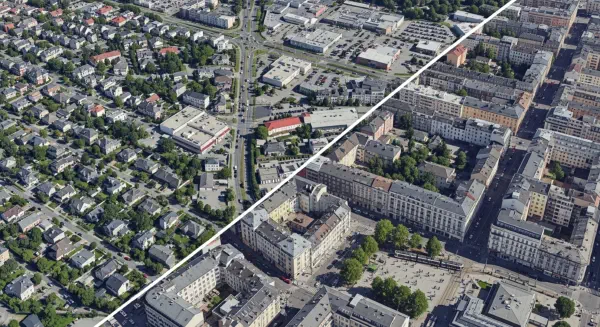
The tempting explanation for low-emission cities is cultural: Europeans cycle because cycling is part of European culture; Singaporeans take transit because they are accustomed to density; Japanese rail commuting reflects Japanese social conformity. This explanation is comforting to the political economy of American suburbia because it implies the low-emission urban form is not available to cities with different cultures. It is also wrong.
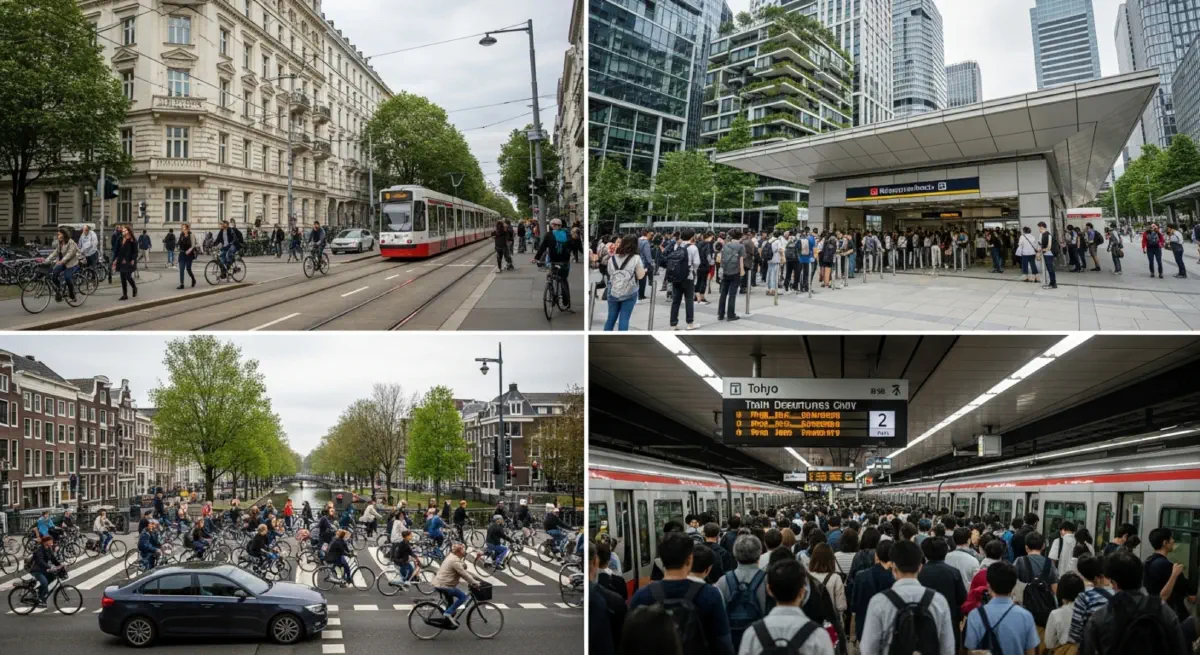
The cultural explanation fails empirically on its own terms: Amsterdam was a car-dominated city in the 1970s. Its modal share for cycling was approximately 10% in 1970 — comparable to many medium-sized American cities. The Dutch government's response to the 1973 OPEC oil embargo, combined with citizen protest movements responding to rising child pedestrian deaths on urban roads, produced a deliberate policy reorientation: dedicated cycle infrastructure investment, intersection redesign prioritising cyclist safety, parking supply restriction in urban centres, and the integration of cycling infrastructure with rail station access. By 2020, cycling accounted for approximately 27% of all trips in Amsterdam and over 60% of commute trips in the city centre. The culture of Amsterdam cycling is the product of approximately forty years of deliberate infrastructure investment and regulatory restriction of alternatives — not the reverse.
The Urban Carbon Leverage Factor in Amsterdam is not the reflection of a pre-existing Dutch cycling culture. It is the measured outcome of a transport policy that removed auto dependence as the default and made cycling and transit the structurally convenient choices. The distinction matters because it eliminates cultural exceptionalism as an explanation and replaces it with a more actionable one: built environment choices and policy instruments determine urban emissions trajectories.
Vienna: the social housing city#
Vienna's low carbon footprint has two primary structural foundations: an exceptionally well-maintained and extensive public transit network, and a social housing system that has prevented the income-sorting land-use pattern that produces the transport poverty of US metropolitan suburbs.
The Wiener Linien operates 5 U-Bahn lines, 28 tramway lines, and over 100 bus routes serving 2.6 million metropolitan residents with headways of 2–5 minutes on major lines during peak hours. The system records approximately 1.3 billion passenger journeys per year — approximately 500 journeys per Vienna resident annually. The transport modal share is approximately 38% public transit, 29% walking and cycling, 27% private car, and 6% other. For comparison, Los Angeles — a city of comparable population density in its inner districts — records approximately 5% transit modal share and 75% private car.
The key structural enabler of Vienna's transit performance is land-use density and mix. Vienna's Gemeindebau — city-owned public housing, home to approximately 62% of Vienna residents either in city-owned stock or heavily subsidised cooperative housing — serves as a density guarantee. The city does not permit the income-driven residential flight to dispersed suburbs that has hollowed out US and UK transit catchments. Mixed-income, mixed-use residential at medium-to-high density (approximately 3,000–8,000 housing units/km² in inner districts) is maintained by direct ownership and regulatory persistence of an urban form that supports the transit system that in turn justifies the land use pattern.
Singapore: the price of driving#
Singapore's low UCLF is achieved by a different mechanism: making private car use expensive rather than making alternatives free. The Electronic Road Pricing (ERP) system — a congestion charge introduced in its current form in 1998, the world's first area-wide electronic road pricing system — applies variable time-of-day charges to road use in the Central Business District and on major arterial roads. Vehicle ownership is controlled by the Certificate of Entitlement (COE) system, which requires purchasers to bid for the right to own a vehicle in a periodic tender; COE prices for a standard sedan have frequently exceeded SGD $75,000–90,000 (approximately USD $56,000–67,000) in recent years, to be paid on top of the vehicle purchase price.
The result is that car ownership in Singapore corresponds approximately to the intersection of genuine functional need and very high income: approximately 11–12 motor vehicles per 100 residents, compared to approximately 80 per 100 in the United States. The transport carbon obligation per capita is commensurately low. Public transit in Singapore serves approximately 7.5 million daily passenger journeys on a network of 6 MRT lines, 4 LRT loops, and 500+ bus routes. The 2019 Land Transport Masterplan targets 75% of peak-hour journeys by public transport.
The Singapore model demonstrates that the UCLF dividend does not require geographical compactness — Singapore is only 733 km² — but does require a willingness to price private automobile use at costs that reflect its spatial demands. The political economy of that pricing is, of course, the reason it has been adopted in Singapore and not in Houston.
Tokyo: frequency as the solution to density#
Tokyo's case is structurally different from Vienna and Singapore because it was not primarily a government-policy achievement. The Tokyo metropolitan rail network — approximately 2,000 km of heavy rail, 400 km of metro, and extensive bus network — was developed largely by private operators, who funded rail construction through integrated real estate development at station catchments. The Tokyu Corporation built and operates rail lines in southwest Tokyo while simultaneously developing the residential properties along those lines, capturing the land value uplift that transit access generates. This model — known in Japan as "eki-shita" or "station-centred" development — produces the transit-oriented development pattern that the US New Urbanism movement has advocated since the 1990s, but achieves it through a combination of property rights, franchise law, and integrated operator business models rather than zoning reform.
Tokyo's transit system achieves average frequencies of approximately 2–5 minutes on major lines during peak hours, with some lines running at 90-second headways. The consequence is that a Tokyo resident with direct access to the rail network has a measured trip time to any major destination in the metropolitan area that competes effectively with private car travel — not because car travel is slow, but because high-frequency, extensive rail coverage makes transit competitive on journey time rather than forcing transit users to accept significantly longer journey durations, as is the case in most US and Australian metropolitan areas.
The UCLF for Tokyo metropolitan residents compared to Osaka or Nagoya — both Japanese cities with lower transit modal shares — runs approximately 1.5–2.0. The UCLF for Tokyo versus Dallas or Phoenix runs approximately 3.0–4.5.
The same story, told four times#
Vienna, Singapore, Amsterdam, and Tokyo reached low-UCLF outcomes through different instruments — social housing policy, vehicle pricing, cycling infrastructure, private rail development — but the structural mechanism is the same in all four cases. Each city made the transit-and-active-travel option structurally convenient through some combination of high-frequency service, land-use density, reduced private vehicle convenience, and economic integration of station access with residential land value. None of them achieved low emissions by asking residents to make high-effort individual sacrifices. They achieved low emissions by building the physical and regulatory conditions under which low-emission behaviours became the path of least resistance.
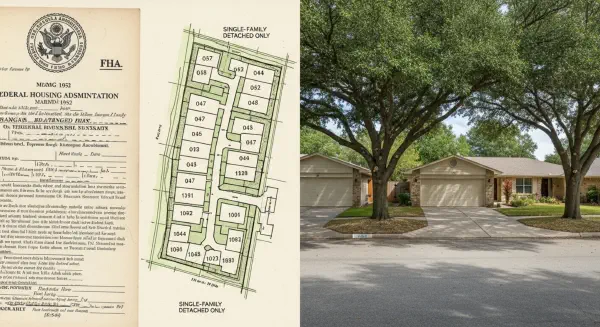
The implication is that the UCLF dividend is not a cultural inheritance. It is an engineering and policy product. Where the product has been built, residents emit less — not because they have chosen to, but because the structural conditions that make high-emission behaviour convenient have been removed. Where it has not been built, residents emit more — not because they have chosen to, but because the structural conditions make the low-emission alternative unavailable, inconvenient, or in many US suburban contexts, literally illegal under current zoning codes.
The fourth post in this series asks why, given this evidence, most cities outside Europe and Asia have not built the density dividend. The answer is not ignorance of the data. It is the political economy of existing homeowners, infrastructure maintenance interests, and the institutional architecture that preserves the suburban form precisely because that form has created a constituency with a direct financial interest in its perpetuation.