The afternoon they decided what a city was#
On June 29, 1956, President Dwight Eisenhower signed the Federal Aid Highway Act into law. The bill authorised $25 billion over thirteen years — approximately $280 billion in 2024 dollars — to construct 66,000 kilometres of Interstate Highway through and between American cities. The system was modelled on the German Autobahn; its ostensible justification was military: the ability to move troops and evacuate populations in the event of nuclear attack. The actual use it generated, within a decade of construction, was the daily commuting of millions of suburban residents into urban employment centres, on roads that the federal government built and the local municipalities that received them were then responsible for maintaining.
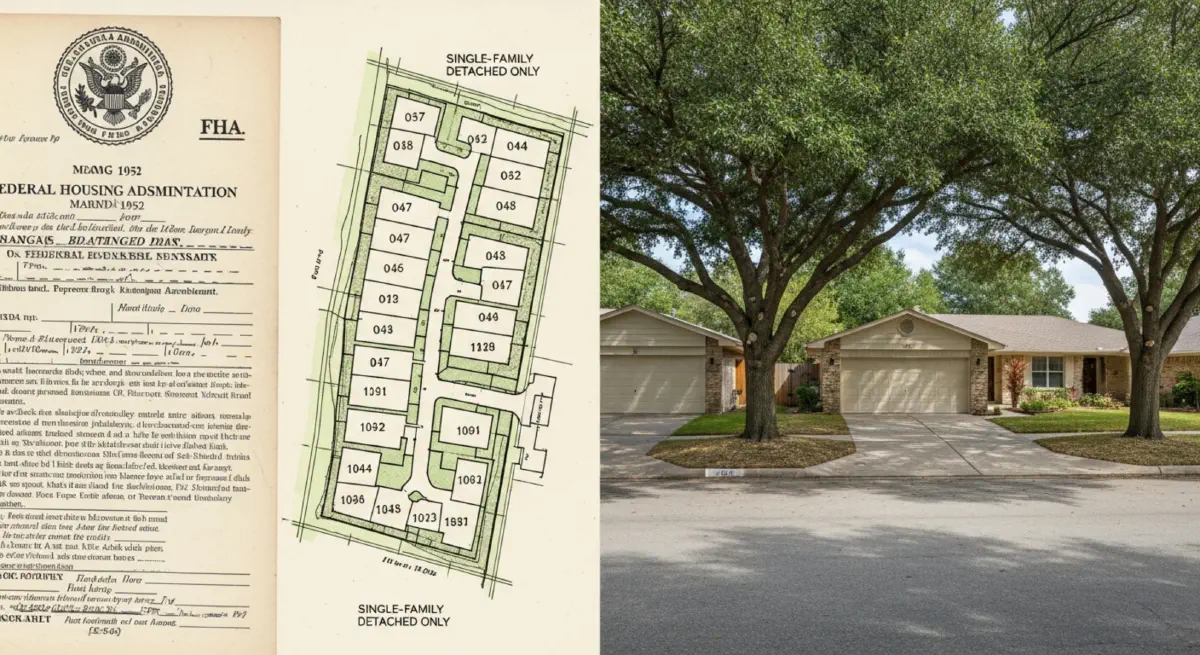
The highway programme did not create American suburbanisation. It accelerated and formalised a dispersal that had been under way since the 1920s. The critical complement was the Federal Housing Administration mortgage guarantee system, which had been operational since 1934 and had, by the late 1940s, refined a set of underwriting standards that effectively disqualified urban neighbourhoods from FHA guarantees. FHA appraisal standards from 1935 through the late 1960s explicitly rated "inharmonious racial groups" as a negative factor in neighbourhood appraisal — a system subsequently known as redlining, which directed federal mortgage support toward white suburban development and away from urban mixed-race or minority neighbourhoods. By 1950, the FHA had guaranteed 3.4 million mortgages; the overwhelming majority were for single-family suburban homes.
The climate consequence was not visible to the architects of American suburban policy in 1956. It is visible now. The settlement pattern that the highway-mortgage-zoning complex constructed between 1945 and 1975 generates a carbon obligation that is still being emitted, is still being expanded at the urban fringe, and cannot be eliminated by electrifying the vehicles that serve it.
A policy machine that built a carbon machine#
The federal highway and housing programmes did not operate in isolation. They operated in combination with a third instrument: zoning law. The 1916 New York City Zoning Resolution, the first comprehensive zoning code in the United States, had established the precedent of legally separating land uses by type. The 1926 US Supreme Court decision in Euclid v. Ambler Realty upheld the constitutionality of use separation, ruling that a city could legally prohibit industrial uses from residential areas. By 1930, most US cities had zoning codes that separated residential from commercial from industrial uses.
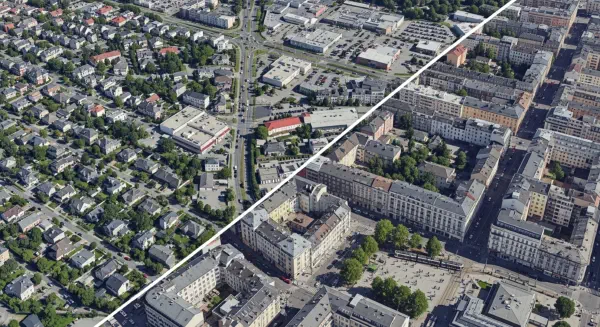
The post-war elaboration of zoning codes went further. The "Euclidean" zoning model — named for the Euclid case — classified residential land into hierarchical categories by density: R-1 (large-lot single-family detached), R-2 (smaller-lot single-family), R-3 (duplexes), R-4 (low-rise multifamily), and so on. The political economy of zoning enforcement — dominated by existing homeowners who valued both the fiscal premium of low-density zoning and the social exclusion it functionally provided — drove most residential zoning in post-war US suburbs decisively toward R-1. By 1970, approximately 75% of residential land in US cities was zoned exclusively for single-family detached housing. By 2020, that figure had changed to approximately 70–75% — remarkably stable despite decades of affordable housing and urbanist advocacy.
The Urban Carbon Leverage Factor in the American metropolitan context is not the result of consumer preferences operating in a free market. It is the result of a policy architecture that made low-density car-dependent development cheaper and easier to finance than any alternative, prohibited the walkable mixed-use alternatives that lower the UCLF by law, and then largely eliminated the transit systems that might have provided low-carbon mobility within the dispersed settlement pattern that had been legally required.
The highway as a carbon delivery system#
The mechanism by which road capacity generates car use — without reducing congestion — was documented systematically from the 1960s onward and named "induced demand" by transport economists. The relationship is empirically robust: new road capacity on congested urban corridors generates additional vehicle trips at a rate of approximately 0.7–1.0 in the long run, meaning that a 10% increase in lane-kilometres generates a 7–10% increase in vehicle kilometres travelled, absorbing the initial capacity gain fully within approximately five to ten years.
The applied implication is that the US Interstate system did not solve the traffic congestion that urban congestion policy identified as its target. It generated the suburban settlement pattern that produced the traffic that required the interstate system to be expanded. Each additional capacity addition generated additional sprawl development around the expanded interchange network, which generated additional vehicle trips, which generated congestion, which generated political pressure for further capacity expansion. The feedback loop is structurally self-reinforcing and has operated continuously since the late 1950s.
By 2020, the US maintained approximately 6.7 million kilometres of public road, or approximately 20 metres of road per person — the highest road density per capita of any major economy. The annual expenditure on road infrastructure maintenance alone exceeds $100 billion at federal and state levels combined. American urban areas allocate approximately 30–50% of their developable land to road and parking infrastructure — a proportion for which there is no equivalent in European, Asian, or Latin American cities of comparable population. That land, and the dispersal pattern it enables, is the physical expression of the UCLF. The highway system did not create American emissions. It built the spatial conditions that make American emissions structurally unavoidable for most of the people living within those conditions.
The transit dismantling and the automobile covenant#
The induced demand story has a complement: the simultaneous dismantling of the electric streetcar and interurban rail networks that had organised pre-war American urban form. Between 1936 and 1950, National City Lines — a holding company financed by General Motors, Firestone Tire, Standard Oil of California, and Mack Trucks — acquired and subsequently converted to bus or discontinued approximately 45 streetcar systems in US cities, including Los Angeles, Baltimore, and Philadelphia. A 1949 federal antitrust conviction documented the coordination, though the sentenced conspirators paid fines of one dollar per company.
The significance of the streetcar dismantling is less about the conspiracy than about what it removed. Electric streetcar lines were the infrastructure around which walkable, transit-oriented urban development had organised since the 1880s. The quarter-mile walkshed around a regular streetcar stop generated the corridor densities at which mixed-use retail, apartment buildings, and walkable street patterns were viable. Their removal did not simply eliminate a transport option — it eliminated the spatial organising template for the urban form that generates low UCLF outcomes.
The post-war American automobile covenant — cheap petrol, subsidised roads, FHA mortgage access for suburban single-family homes, and the legal prohibition of alternative built forms — was not an expression of American individualism or consumer preference. It was a deliberately constructed incentive architecture, built by specific legislation and maintained by specific regulatory instruments. The carbon obligation it generated is equally specific in origin. The question of whether it can be reversed is a question about whether the political economy that built it can be redirected — and that question is the subject of the fourth post in this series.
Counting the carbon debt#
The built environment created by the post-war American experiment is long-lived. The median age of US housing stock is approximately 40 years; the Interstate Highway System has a design life of 50–75 years; the suburban settlement pattern around highway interchanges tends to persist as long as the highway remains operational. This means that the UCLF multiplier embedded in the post-war suburban expansion is not a temporary consequence of energy policy that can be corrected by changing fuel mix. It is a structural feature of where 70–80 million American households now live, woven into building positions, road geometries, and land-use patterns that will persist for decades.
The carbon debt calculation is sobering. If the US housing units built in the suburban expansion of 1945–1975 generate, conservatively, an excess of 5 tonnes CO₂e per household per year relative to an equivalent high-density baseline (a conservative estimate of the UCLF differential at the low end), and there are approximately 30 million such households, the annual excess emission is approximately 150 million tonnes — equivalent to about 3% of total US annual greenhouse gas emissions, attributable entirely to a settlement pattern choice made not by current occupants but by policy makers two generations ago.
A debt that compounds#
The American experiment in automobile-dependent suburbanisation generated an UCLF debt that is being collected every year, from every household in the suburban fringe, independently of the individual choices those households make. Installing a heat pump in a Minnesota ranch house reduces the building energy component. Replacing the family SUV with an electric vehicle reduces the transport component — by approximately 60–80% of its direct combustion emissions. But the structural UCLF premium persists, because the long car trips remain (now electrically powered), the building envelope surface area remains, and the spatial separation of uses that makes alternatives to driving impractical remains.
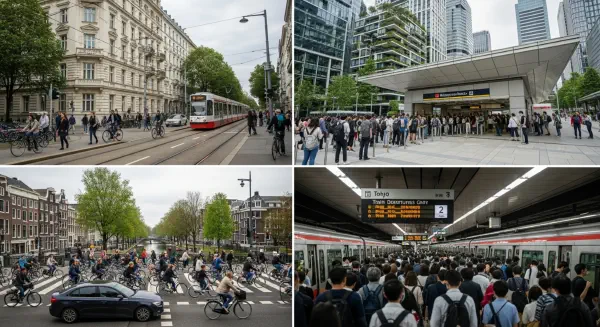
The next post examines four cities that built differently — Vienna, Singapore, Amsterdam, and Tokyo — and asks what structural decisions produced UCLF values 60–70% below the US suburban average at comparable income levels. The answer is not that these cities are culturally more environmentally conscious than American cities. It is that they made different policy decisions about road capacity, land use mixing, transit investment, and parking supply — decisions that are available to be made elsewhere, if the political economy permits.