What a mould and a peach noticed#
In September 1928, Alexander Fleming returned from a two-week holiday to his bacteriology laboratory at St Mary's Hospital in London and found that one of his petri dishes, accidentally contaminated with a fungal spore, had killed the surrounding Staphylococcus bacteria. The mould was Penicillium notatum. The active compound — penicillin — was isolated and stabilised by Howard Florey and Ernst Chain at Oxford in 1939 and 1940 for clinical use. The compound had been present in that mould, doing its biological work as an antibiotic defence against competing bacteria, entirely independent of any human awareness of it or any market signal about its value, for the entirety of the evolutionary history of the Penicillium genus.
The peach in this story is less familiar but equally instructive. In the early 1950s, the pharmaceutical chemist Albert Hofmann (not the LSD discoverer, a different Hofmann) was investigating compounds isolated from a soil bacterium, Streptomyces venezuelae, collected from a Venezuelan field. The compound he was examining was chloramphenicol — the first broad-spectrum antibiotic, effective against typhoid and bacterial meningitis. It had been in that Venezuelan soil, produced by that bacterium as a defence against neighbouring microorganisms, since before humans arrived in South America.
The pattern is consistent across decades of pharmaceutical discovery and across the widest range of organism types in biology. The wild world — its fungi, bacteria, marine invertebrates, plants, and animals — contains compounds whose structures have been refined over hundreds of millions of years of evolutionary competition. Some of those structures are medically useful to humans. Many have not yet been discovered. The extinction rate documented in the previous post is, among its other consequences, a rate of permanent elimination of potential pharmaceutical libraries.
The economy's unpaid research programme#
Natural systems have been running chemistry experiments for approximately 3.7 billion years. Evolution by natural selection tests molecular modifications against the practical problems of cell survival, competition, predation, and reproduction. The resulting molecular diversity — the catalogue of biologically active compounds produced by living organisms — is at once the largest and the least systematically surveyed library of potentially useful chemical structures that exists.
The Ecosystem Dependency Ratio for the pharmaceutical sector is not conceptually different from the EDR for food production or water purification — it is the same calculation, applied to a different service category. The relevant numerator is the economic value of pharmaceutical products that derive from, were developed using, or were inspired by natural compounds. The relevant denominator is the investment in wild species research and habitat protection that maintains the natural library from which discovery is drawn.
A 2020 analysis by Newman and Cragg in the Journal of Natural Products examined the origins of all approved pharmaceutical drugs from 1981 to 2019 — 1,881 approved drugs in total. They found that approximately 33% were natural products or directly derived from natural products. A further 27% were synthetic molecules whose development was informed by the structure of a natural product — compounds that would not have been designed in their specific form without knowledge of the natural compound they were modelling. In the oncology category specifically, approximately 65% of approved cancer drugs over this period were either natural products, natural product derivatives, or natural product-inspired synthetic compounds.
The compound library being destroyed#
The classes of organism that have contributed most significantly to pharmaceutical discovery are not evenly distributed across the tree of life. Several groups are disproportionately represented in the known pharmaceutical literature:
Bacteria, particularly actinomycetes (soil-dwelling bacteria of the Streptomyces family), have contributed more antibiotic compounds than any other group — streptomycin, tetracycline, erythromycin, rifamycin, vancomycin, and the entirety of several antibiotic classes. The diversity of soil actinomycetes is estimated in the millions of species; fewer than 10,000 have been cultured under laboratory conditions. Each species represents a potentially unique biochemical repertoire.
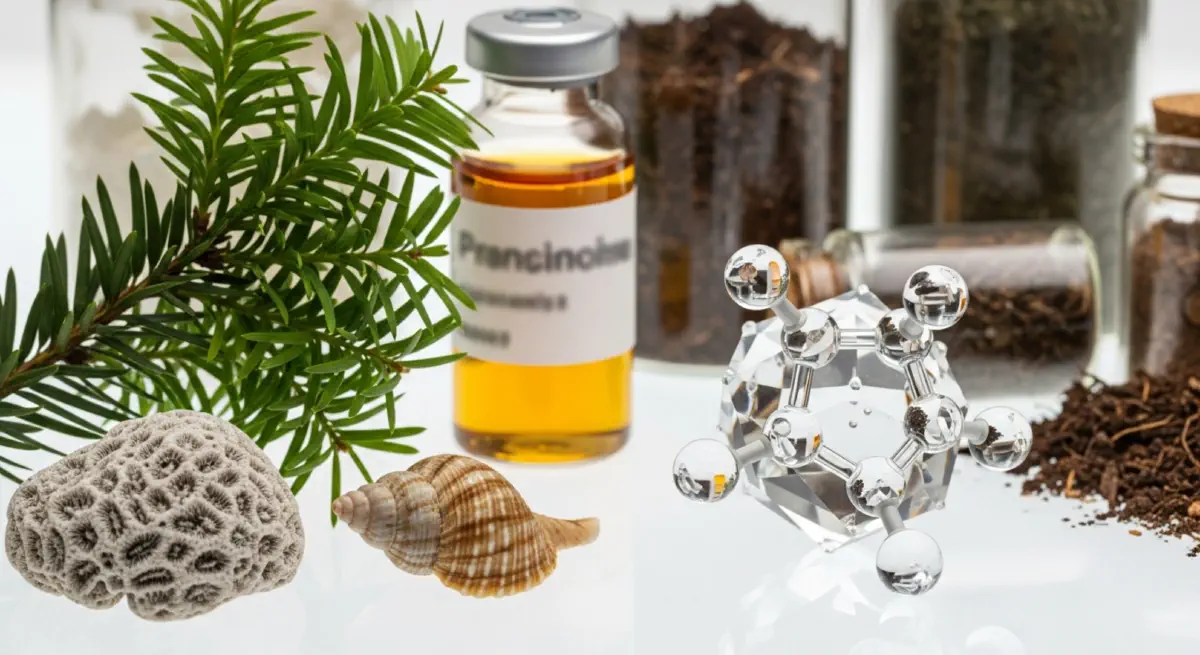
Marine invertebrates — particularly sponges, tunicates (sea squirts), and soft corals — represent one of the most chemically diverse groups studied for pharmaceutical activity. The sea squirt Ecteinascidia turbinata provided aplidine and trabectedin, both approved cancer therapies. The cone snail Conus magus provided ziconotide, a severe chronic pain treatment (the only non-opioid systemic painkiller for intractable pain). Sponges collected in the Caribbean Ocean provided cytarabine and vidarabine, two of the earliest antiviral drugs and precursors to the antiretroviral compound development that produced AZT and subsequent HIV treatments.
Plants, with their exceptionally diverse secondary metabolite chemistry — evolved as defences against herbivores, pathogens, and light stress — provided taxol (paclitaxel, from the Pacific yew Taxus brevifolia, the most important cancer treatment developed since the 1990s), vincristine and vinblastine (from the Madagascar periwinkle Catharanthus roseus, both foundational cancer chemotherapy drugs), quinine (malaria treatment, from the Andean Cinchona tree), morphine and aspirin (from opium poppy and willow bark respectively), digoxin (heart failure treatment, from foxglove), artemisinin (malaria treatment, from Artemisia annua, 2015 Nobel Prize in Medicine), and cyclosporine (organ transplant immunosuppressant, from a Norwegian soil fungus).
The compounds found in these organisms are not simple structures. Taxol, whose total synthesis by Holton and Nicolaou was achieved in 1994 at enormous cost after decades of effort, requires 37 or 40 synthetic steps respectively from simpler starting materials. The Pacific yew produces it biosynthetically as a secondary metabolite. The compound could not have been designed by a rational organic chemistry programme — it was too structurally complex, too counterintuitive, too dependent on the specific evolutionary solution that Taxus brevifolia evolved to a problem humans did not know it had.
Antibiotic resistance and the discovery pipeline#
The practical urgency of the pharmaceutical inventory argument is amplified by the trajectory of antibiotic resistance. The WHO's 2019 Global Antimicrobial Resistance and Use Surveillance System documented that approximately 700,000 deaths per year were attributable to drug-resistant infections globally; the UN General Assembly's inter-agency coordination group projected that, without new antibiotic development, resistant infections could cause approximately 10 million deaths per year by 2050 — exceeding current cancer mortality.
The commercial pipeline for novel antibiotics has been collapsing for decades. Approximately 18 new antibiotics were approved in the US between 2000 and 2010; fewer than 6 were approved in the following decade. The market failure is structural: antibiotic treatment courses are short (days to weeks), resistance surveillance limits market lifetime, and the most valuable use of a new antibiotic in antimicrobial resistance terms — reserving it for resistant infections only — minimises the commercial sales volumes on which pharmaceutical revenue depends. The commercial return on antibiotic development does not justify the investment required.
The natural compound library — particularly the unexplored diversity of deep-sea organisms, soil microbiomes, tropical forest species, and marine sediment bacteria — represents the most significant known source of structural diversity for novel antibiotic discovery. The ESKAPE pathogens (the six bacteria genera responsible for most hospital antibiotic resistance mortality) have, in the genomic experience of soil actinomycetes, been encountering and being inhibited by multiple chemical strategies for billions of years. The search for those strategies in the natural compound library is currently being conducted in an ecological context where the library itself is being destroyed approximately 1,000 times faster than background rates.
What we don't know we're losing#
The pharmaceutical argument for biodiversity is sometimes framed as an "option value" argument: we should preserve species because they might prove useful. This framing is accurate but understates the case. The compounds already identified — taxol, cyclosporine, artemisinin, ziconotide, trabectedin — represent discoveries made from a tiny fraction of the described species and an infinitesimal fraction of the undescribed species in ecosystems we have partially explored. The compounds not yet found, from species not yet described, in ecosystems not yet sampled, are not theoretical possibilities — they are, based on the established pattern of bioprospecting across the organisms studied so far, statistically certain to exist in large numbers.
The Ecosystem Dependency Ratio in the pharmaceutical domain has a future-value dimension that makes the conventional static valuation an understatement. The service being provided by biological diversity is not only the compounds already known — it is the entire undiscovered pharmacological space that the diversity contains, about which we currently know almost nothing. Each extinction permanently removes a portion of that space. Unlike the loss of a manufacturing facility, a data file, or even a crop variety (which can sometimes be reconstructed from existing seed stocks), the loss of the evolved biochemical repertoire of an extinct species is total and irreversible.
The next post examines the policy architecture being assembled in response to the Ecosystem Dependency Ratio's alarming numerator/denominator gap: the Kunming-Montreal Global Biodiversity Framework, debt-for-nature swaps, natural capital accounting, and the question of whether the finance being mobilised is anywhere near sufficient to the task it is supposed to address.