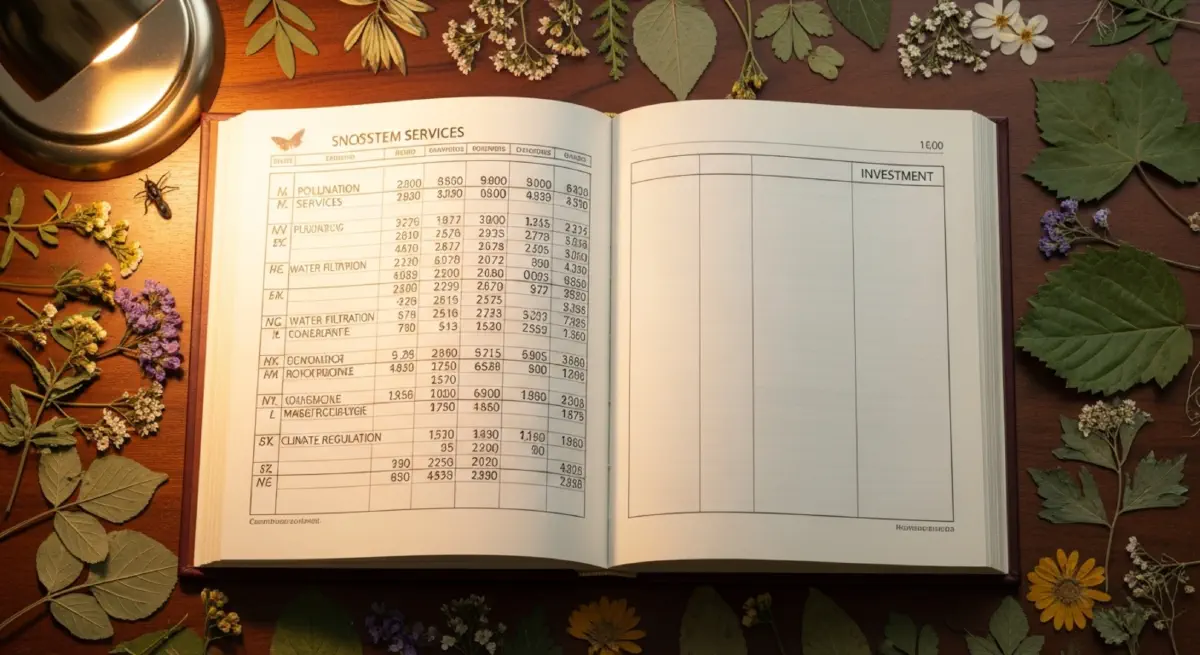
The Ecosystem Dependency Ratio reveals a leverage structure with no parallel in conventional finance: EDR = Estimated GDP value dependent on biodiversity-supplied ecosystem services ÷ Annual public + private investment in biodiversity protection. Using Costanza et al.'s 2014 revised ecosystem service valuation of $125–145 trillion globally and World Bank/OECD estimates of total biodiversity finance at approximately $100–130 billion/yr: EDR ≈ 1,000–1,300. Every dollar invested in biodiversity protection underpins approximately $1,000–1,300 of ecosystem-dependent economic output. No publicly traded corporation with this leverage ratio and a clearly deteriorating underlying asset base would find it difficult to attract creditor attention.
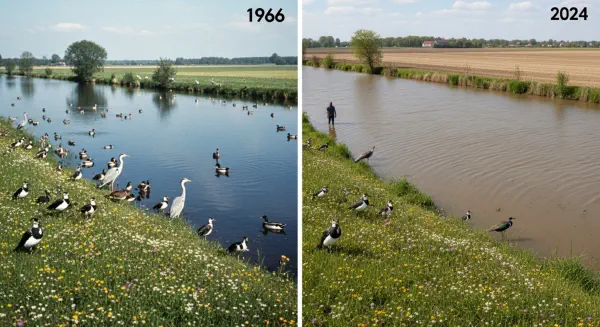
The IPBES 2019 assessment established a species loss baseline of unprecedented alarm: Of the estimated 8 million animal and plant species on Earth, approximately 1 million are threatened with extinction under current land use and exploitation trajectories. The average abundance of native species in terrestrial environments has fallen by approximately 20% from 1900 baseline levels. Freshwater species populations have declined in average abundance by approximately 84% since 1970. The primary drivers — in order of impact — are land use change, direct exploitation (fishing, hunting), climate change, pollution, and invasive species. The extinction rate is estimated at 100–1,000 times the background rate that prevailed over the 90 million years prior to the emergence of Homo sapiens.
Pollination services alone represent a food security dependency worth $235–577 billion/yr: Approximately 75% of food crop types depend at least partially on insect pollination; crops fully dependent on animal pollination represent approximately 35% of global food production volume. The IPBES Pollinator Assessment (2016) estimated the economic value of pollination services to food production at approximately $235–577 billion per year. Global invertebrate biomass has declined catastrophically in well-studied regions — a 28-year UK study published in Science found a 76% decline in total flying insect biomass at monitored sites. The research base is geographically limited but directionally consistent across the studies that exist.
Biodiversity loss and climate change are co-drivers with amplifying interactions: Climate change is currently the third-ranked driver of biodiversity loss. By 2050, under high-warming scenarios, it is projected to become the primary driver. Species range shifts under climate warming are occurring approximately ten times faster than the pace at which species adapted to previous climate transitions in the Holocene. Ecosystems under thermal stress — particularly coral reefs, montane forests, and Arctic tundra — are declining so rapidly that the biodiversity and carbon storage functions are failing simultaneously. This interaction means that climate mitigation which preserves biodiversity also protects carbon sinks, and biodiversity protection that maintains intact forests and wetlands simultaneously provides approximately 30% of the cost-effective near-term emissions reductions available globally.
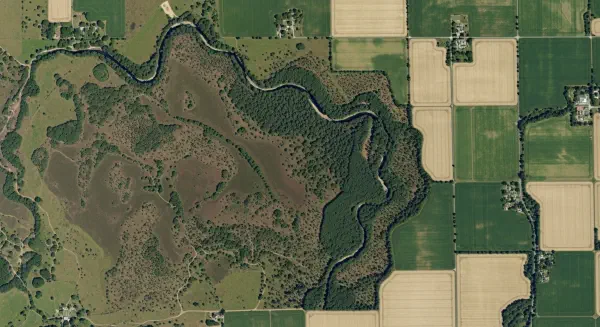
The Kunming-Montreal Global Biodiversity Framework commits 30×30 — and what happens next matters enormously: The December 2022 Kunming-Montreal GBF established the "30×30" commitment: protecting 30% of the world's land and ocean areas by 2030. As of 2022, approximately 17% of land and 8% of ocean were under some form of protected area designation. Reaching 30×30 requires designating and effectively managing an additional area approximately equal to the landmass of the United States. Effective management requires approximately $140–175 billion/yr in protected area finance; the current investment level is approximately $20–25 billion/yr. Without the finance to close this gap, 30×30 designations risk becoming "paper parks" — protected on maps but inadequately managed on the ground.
Costanza, R., de Groot, R., Sutton, P., van der Ploeg, S., Anderson, S.J., Kubiszewski, I., ... & Turner, R.K. (2014). Changes in the global value of ecosystem services. Global Environmental Change, 26, 152–158.
IPBES. (2019). Global assessment report on biodiversity and ecosystem services of the Intergovernmental Science-Policy Platform on Biodiversity and Ecosystem Services. E.S. Brondízio et al. (Eds). IPBES Secretariat.
WWF. (2022). Living Planet Report 2022: Building a nature-positive society. WWF.
IPBES. (2016). The assessment report of the Intergovernmental Science-Policy Platform on Biodiversity and Ecosystem Services on pollinators, pollination and food production. IPBES Secretariat.
Hallmann, C.A., Sorg, M., Jongejans, E., Siepel, H., Hofland, N., Schwan, H., ... & de Kroon, H. (2017). More than 75 percent decline over 27 years in total flying insect biomass in protected areas. PLoS ONE, 12(10), e0185809.
Newman, D.J., & Cragg, G.M. (2020). Natural products as sources of new drugs over the nearly four decades from 01/1981 to 09/2019. Journal of Natural Products, 83(3), 770–803.
TEEB (The Economics of Ecosystems and Biodiversity). (2010). The economics of ecosystems and biodiversity: Mainstreaming the economics of nature. UNEP.
Morales-Hidalgo, D., Oswalt, S.N., & Somanathan, E. (2015). Status and trends in global primary forest, protected areas, and areas of forest designated for conservation of biodiversity from the Global Forest Resources Assessment 2015. Forest Ecology and Management, 352, 68–77.
CBD. (2022). Kunming-Montreal Global Biodiversity Framework. Convention on Biological Diversity.
Waldron, A., Adams, V., Allan, J., Arnell, A., Asner, G., Atkinson, S., ... & Watson, J. (2020). Protecting 30% of the planet for nature: Costs, benefits and economic implications. Campaign for Nature.
Maxwell, S.L., Fuller, R.A., Brooks, T.M., & Watson, J.E.M. (2016). Biodiversity: The ravages of guns, nets and bulldozers. Nature, 536(7615), 143–145.
Dasgupta, P. (2021). The economics of biodiversity: The Dasgupta Review. HM Treasury.
Miller, K.G., Browning, J.V., Schmelz, W.J., Wright, J.D., Mountain, G.S., & Edwards, L.E. (2020). Cenozoic sea-level and cryospheric evolution from deep-sea geochemical and continental margin records. Science Advances, 6(20).
Ceballos, G., Ehrlich, P.R., Barnosky, A.D., García, A., Pringle, R.M., & Palmer, T.M. (2015). Accelerated modern human–induced species losses: Entering the sixth mass extinction. Science Advances, 1(5), e1400253.
Gibbard, S., Caldeira, K., Bala, G., Phillips, T.J., & Wickett, M. (2005). Climate effects of global land cover change. Geophysical Research Letters, 32(23).
Audits the Kunming-Montreal 30×30 framework, TEEB offsets, and debt-for-nature swaps against the financing gap, demonstrating that the governance architecture exists but investment remains orders of magnitude below what closing the Ecosystem Dependency Ratio would require.
Quantifies the pharmaceutical economy's dependence on wild species compounds — the hidden health-sector dimension of the Ecosystem Dependency Ratio that no healthcare cost accounting currently reflects.
Applies the Ecosystem Dependency Ratio to documented species loss rates, showing that the IPBES-tracked decline of 1 million species is occurring while biodiversity investment remains orders of magnitude below the dependency it is supposed to finance.
Traces the contested Costanza ecosystem service valuation and establishes the Ecosystem Dependency Ratio showing that the global economy extracts 340–1,300× more value from nature than it invests in its protection.