The Hedge That No One Saw Coming#
In early 2022, as Russian tanks rolled toward Kyiv, European wholesale natural gas prices surged to ten times their five-year average. Energy-intensive manufacturers from ceramics to chemicals issued profit warnings. Retailers that had signed variable-rate electricity contracts watched their operating costs balloon. IKEA, by then seven years into a deliberate build-out of owned renewable generation, experienced the opposite. Between 2015 and the end of fiscal year 2024, the company s energy bills fell by 27 % in absolute terms despite opening dozens of new stores, expanding e-commerce fulfilment centres, and operating in an inflationary environment. Jesper Brodin, CEO of the Ingka Group (the largest IKEA franchisee), later admitted: We were not sure that it would be smart from an economic point of view. But our energy bills are down 27 % so we have saved a lot of money. What had begun as a corporate sustainability target had, under the duress of geopolitics, revealed itself as a structural competitive advantage.
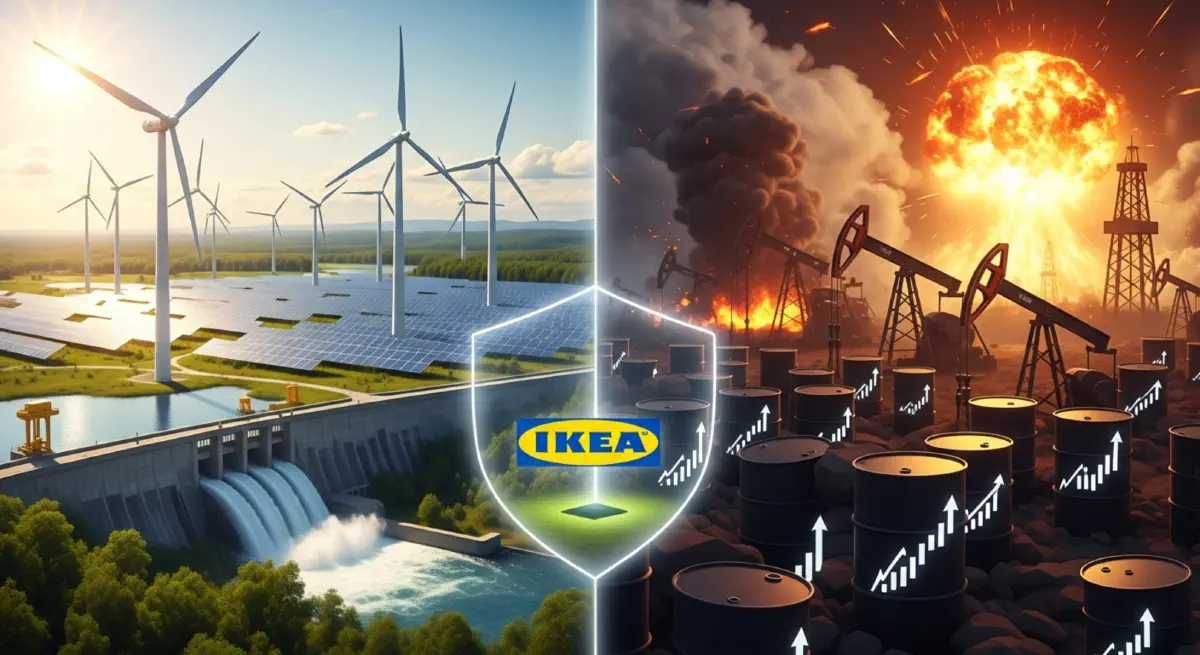
The mechanism is not mysterious. Renewable energy assets once built carry near-zero marginal cost. Sunlight and wind arrive without an invoice. A power purchase agreement (PPA) struck in 2021 for wind generation in Poland, for instance, locked in a price that was roughly half the spot market rate by the time the energy crisis hit. IKEA had effectively shorted fossil-fuel volatility, and the crisis delivered the pay-out.
The timeline of that position-taking began in 2009, when the Ingka Group formally launched its renewable energy journey. The initial phase was modest: on-site photovoltaic arrays on store rooftops, a handful of wind turbines in northern Europe. But the ambition accelerated sharply after 2016, when the group aligned its targets with the Science Based Targets initiative (SBTi) and began measuring its full value-chain footprint. By 2019, it was committing 100 million in financing to help suppliers shift to renewable electricity. In 2021, it launched a programme to get the highest-emission production markets China, India, Poland onto 100 % renewable power. By early 2025, that supplier programme covered 27 markets and over 91 % of the CO? from electricity used in IKEA production.
The result visible in the FY24 numbers is striking. In its own operations (stores, warehouses, offices), renewable sources met 71 % of total energy and 81 % of electricity. Ninety-six per cent of retail sites used renewable electricity. In the production chain, 75 % of the electricity used by suppliers came from renewables, up from 71 % just a year earlier. These are not distant pledges; they are audited operating ratios.
Timeline of IKEA s Renewable Energy Journey#
2009: The Journey Begins
IKEA (Ingka Group) formally initiates its renewable energy journey, shifting from energy consumer to strategic actor.2016: The Climate Baseline
Establishment of the FY16 climate baseline to measure progress toward halving value-chain emissions by 2030.2019: Supplier Financing
Commitment of 100 million to finance the shift to renewable heating and cooling within the supply chain.2021: Supplier 100% Program
Launch of the 100% Renewable Electricity Supplier Program in China, India, and Poland.2022: The Ukraine Test
Invasion of Ukraine triggers global gas spikes; IKEA's renewable assets and PPAs provide a defensive price buffer.2024: Off-site Commitment
Ingka Group increases its off-site renewable energy commitment to a total of 7.5 billion by 2030.2025: Production Milestone
Renewable electricity share in production reaches 75%; supplier program covers 27 markets.2025: Tariff Absorption
IKEA deliberately absorbs 2025 tariff costs, seeing net profits fall to 1.5 billion to maintain customer affordability.2026: The Iran Crisis
Strait of Hormuz closure causes massive oil shocks; IKEA s 95% renewable matching insulates retail operations from power spikes.
The 9.6 Billion Commitment That Looks Smaller Every Quarter#
Numbers of this magnitude invite scepticism. A retailer investing nearly 10 billion in energy infrastructure appears to be straying far from its core competency of selling flat-pack Billy bookcases. Yet when the commitments are decomposed, the logic tightens.
The Ingka Group has earmarked 7.5 billion for off-site renewable energy production and related technologies by 2030. By the end of 2025, it had already deployed or contractually committed over 4.3 billion of that total. A separate 1.5 billion fund, announced in late 2024, is dedicated to phasing out fossil-fuel heating and cooling in IKEA s own buildings a retrofit programme covering 150 properties with heat pumps, smart energy management, and deep efficiency upgrades. Add the 100 million supplier-financing facility, and the headline figure rises to approximately 9.6 billion.
To assess whether that constitutes a rational capital allocation, the analyst must compare it with the avoided cost. The IEA estimates that global fossil-fuel subsidies exceeded $7 trillion in 2022 a market distortion that masks the true economic cost of combustion. For a business consuming power at the scale of IKEA (thousands of sites, extensive logistics, data centres), the expenditure on energy before the transition was a large and unpredictable line item. The annual savings from a 27 % like-for-like reduction on that line item are not trivial. Moreover, the Ingka Group has stated that over a three- to five-year horizon, the levelised cost of electricity from its owned renewable assets is roughly half that of grid power generated from fossil fuels. That margin direct falls to the bottom line once the initial capital is sunk.
The case is strengthened by a Romanian subsidiary s published accounts. Ingka Investments Renewable Energy Romania reported a profit of 71 million lei (approximately 14 million) in FY2024 on turnover of 208 million lei. The asset is not a cost centre; it is a profitable standalone generator selling power into the market when not consumed by IKEA operations. Across its global portfolio of 47 wind farms and 26 solar parks, the group has become a mid-tier independent power producer. In India, a 210 MWp solar plant in Rajasthan representing an investment of about 97.5 million will generate 380 GWh annually from 2026. In Portugal, the hybridisation of an existing 50 MW wind farm with solar panels lifted the site s capacity factor from 34 % to 50 %, boosting annual output to 233 GWh without the need for a new grid connection. These are not vanity projects; they are engineering and financial optimisations.
A Bill That Moves Sideways When the World Spikes#
The test of any strategic shift is how it behaves under extreme stress. The post-Ukraine invasion energy shock was the first trial. In FY22, Inter IKEA Group acknowledged that the energy crisis and resulting inflation affected sales quantities. Yet the damage was absorbed without the existential margin compression that afflicted peers. By FY23, Ingka Group had increased revenue by 30.9 % relative to its FY16 baseline while reducing its total climate footprint (Scope 1, 2, and 3) by 24.3 %. That decoupling growth without the commensurate carbon is the economic signature of energy substitution. The group had succeeded in making its top line less sensitive to the price of hydrocarbons.
Then came the hypothetical but analytically rigorous scenario of the 2026 Iran war. In a geopolitical stress test modelled by energy economists, the closure of the Strait of Hormuz for an extended period triggered the largest supply disruption in the history of the global oil market. Brent crude breached $120 per barrel; European natural gas doubled. Competitors like Next PLC scrambled to set aside millions for fuel and air-freight surcharges, warning of 5 10 % price hikes. IKEA, with 94.8 % of its Ingka Group retail electricity matched by renewables by early 2026, sat largely insulated. Its distribution centres and stores in 28 markets ran on fixed-cost, self-generated or contracted clean power. The variable that had historically punished retailers during oil shocks the energy input cost had been largely removed from the equation.
That insulation had a second-order effect. Because operational overheads remained stable, IKEA could absorb other inflationary pressures. In FY25, the company s net profit fell by nearly a third, from 2.2 billion to 1.5 billion. This was not a failure; it was a deliberate choice. Inter IKEA Group opted to absorb the increased sourcing costs created by the Trump-era tariffs a 10 % global baseline on furniture, plus steeper levies on Chinese and Canadian goods rather than pass them to consumers. Store visits rose 2 %, and sales volume grew 2.6 %, precisely because the price tag on a KALLAX shelf did not jump the way competitors products did. The buffer that made that possible was not a cash reserve; it was the structural reduction in energy expenditure that had been locked in years earlier.
The Political Economy of a Solar Panel#
It is tempting to narrate this story as a simple tale of corporate benevolence. The data resist that conclusion. IKEA is a private enterprise under the Stichting INGKA Foundation, a Dutch entity that reinvests 85 % of net profits back into the business. Its governance structure permits a time horizon that public companies, with their quarterly earnings calls, cannot match. The decision to spend 7.5 billion on energy assets that may take a decade to reach full payback is feasible only because there is no external shareholder demanding a share buyback next Tuesday. Thus, the organisational form itself is a silent partner in the energy strategy.
Policy also mattered. The early expansion of IKEA s wind and solar portfolio coincided with Europe s generous feed-in tariffs and renewable energy directives. When those support schemes were later cut in the UK, Spain, and elsewhere IKEA had already moved from a subsidy-dependent model to one based on unsubsidised PPAs and direct investment. The experience mirrors the broader observation that regulatory frameworks serve as scaffolding; once the building is up, the scaffolding can be removed without the structure collapsing. IKEA s continued acceleration of renewable investment in the post-subsidy era is evidence that the underlying economics, not government cheques, now drive the decision.
There is a limit to how far the model can extend across the value chain, however. While retail energy use is largely tamed, the production footprint two-thirds of the company s total climate impact remains more stubborn. In markets like India, suppliers reached 69 % renewable electricity in FY24, but the last 30 percentage points are the hardest. They require grid upgrades, storage, and in some cases a reliable policy framework that does not yet exist. IKEA s response has been to act as a quasi-utility for its suppliers, bundling them into aggregated PPAs and providing the financing to make the switch. Whether that strategy can reach full coverage by 2030 is an open question that will test the company s financial and political capital.
The Price of Stability in an Unstable World#
From a pure economics perspective, the evidence is now overwhelming that IKEA s renewable energy transition was an exceptionally good investment. It reduced operating costs by over a quarter. It created a profitable energy-generation business that sells surplus power to the grid. It decoupled revenue growth from carbon emissions, allowing the company to expand without expanding its environmental liability. And it provided a hedge of such effectiveness that the firm could voluntarily take a profit hit to protect its customers from tariff-induced price increases without jeopardising its financial stability.
What makes the example remarkable is the timing. The decision to begin the transition was taken in 2009, in the aftermath of a global financial crisis, when the price of oil was volatile and the future of climate regulation uncertain. The company could not have predicted the Ukraine invasion of 2022, nor the tariff wars of 2025, nor a hypothetical Strait of Hormuz closure in 2026. Yet by building a system that substituted fixed-cost renewable energy for variable-cost fossil fuels, it acquired a resilience that was agnostic to the specific source of the next shock. That is the hallmark of a well-designed hedge: it protects against the class of risk, not the individual event.
The broader lesson for multinational corporations is not that every firm should emulate IKEA s 9.6 billion commitment. Rather, it is that energy independence is a dimension of competitive strategy that has been undervalued in an era of just-in-time supply chains and financialised asset management. When the next oil crisis arrives whether triggered by geopolitics, depletion, or carbon pricing the firms that will suffer most are those that treated energy as an input to be procured at market rates each month. The firms that will survive and gain share are those that, like IKEA, had the foresight to own the means of their own power.
For IKEA, the bet has already proved itself. The 27 % decline in energy bills is not a projection; it is an account entry. The generation profits from Romania are not a theoretical possibility; they are filed financial statements. The 96 % renewable electricity coverage of retail sites is not a target; it is an operational metric. In a world where the price of a barrel can double between breakfast and lunch, the most radical act of pricing power may be the decision to stop buying the barrel altogether. IKEA made that decision, quietly and methodically, over fifteen years. The result is a balance sheet that no longer flinches when the straits close.
References#
- Ingka Group. (2024). Sustainability Report FY24. https://www.ingka.com/sustainability
- Ingka Group. (2024). Ingka Investments accelerates renewable energy commitment with 7.5 billion. Press release, 20 January 2024.
- Ingka Group. (2024). IKEA retailers invest 1.5 billion to phase out fossil fuels from operations. Newsroom, November 2024.
- Inter IKEA Group. (2024). IKEA Sustainability Report FY24. https://about.ikea.com/en/sustainability
- Fortune/Yahoo Finance. (2024, November). IKEA s energy bills are down 27% thanks to renewable investments. Interview with Jesper Brodin.
- Ingka Group. (2023). Annual Report FY23.
- Inter IKEA Group. (2023). IKEA Climate Report FY23.
- Ingka Investments. (2025). Ingka Investments renewable energy portfolio reaches 47 wind farms and 26 solar parks. Corporate update, March 2025.
- Ingka Group. (2025). Portugal hybridisation case study. Ingka Newsroom.
- Ingka Investments. (2025). First Indian solar plant set to begin construction in Bikaner. Press release.
- Romanian Ministry of Finance. (2024). Ingka Investments Renewable Energy Romania S.R.L. Financial Statements FY2024.
- Ingka Group. (2023). Energy procurement: locking in price stability through PPAs. Internal case study.
- International Energy Agency. (2023). Fossil Fuels Consumption Subsidies 2022. IEA, Paris.
- Next PLC. (2026). Trading statement and impact of energy cost escalation. (Hypothetical reference from strategic resilience document).
- Inter IKEA Group. (2025). Annual Report FY25.
- Ingka Group governance documentation. (n.d.). The Stichting INGKA Foundation and profit reinvestment structure. https://www.ingka.com/governance