The Resource Question#
We’ve established that decarbonizing Austria requires roughly 166 TWh of carbon-free electricity. But how much renewable energy can Austria actually produce within its borders?
This question requires careful analysis. There are many ways to define “potential”:
- Theoretical potential: How much energy is physically available (e.g., total solar radiation)
- Technical potential: What fraction can be captured with current technology
- Economic potential: What can be deployed cost-effectively
- Reduced Technical Potential (RTP): What can realistically be built given all constraints
The RTP is the most useful metric for planning purposes. It accounts for:
- Land use restrictions
- Environmental protection
- Social acceptance
- Grid integration constraints
- Technical limitations
Hydropower: The Mature Technology#
Austria is blessed with excellent hydropower resources. The Alps provide both elevation (for storage) and precipitation. Currently:
- Installed capacity: ~14.5 GW
- Annual generation: ~43 TWh
- Capacity factor: ~34%
Remaining Potential#
Austria has already developed most of its economic large hydro sites. The remaining RTP is estimated at:
| Category | Additional Potential |
|---|---|
| Large hydro (new sites) | 2-3 TWh |
| Small hydro (< 10 MW) | 4-6 TWh |
| Upgrade existing plants | 5-8 TWh |
| Total additional | 11-17 TWh |
Total hydro RTP: approximately 56 TWh/year
Pumped storage capacity of about 3 GW (soon expanding to 5+ GW) provides crucial grid balancing services but does not add net generation.
Wind Power: Room to Grow#
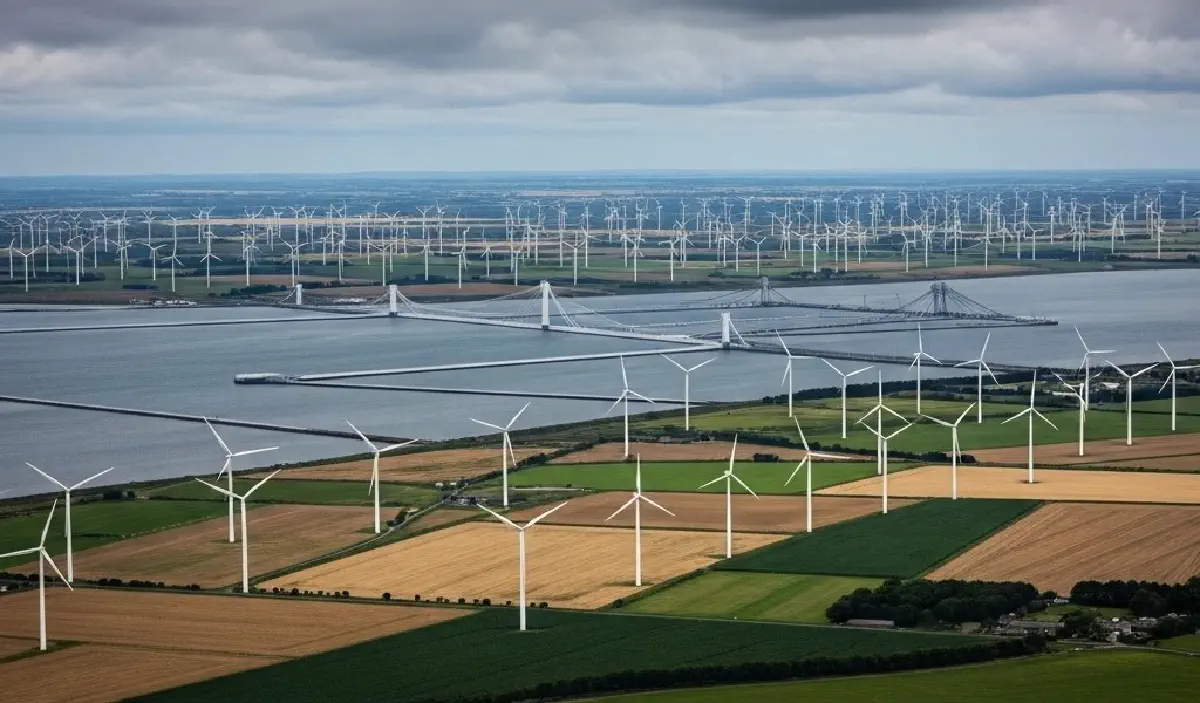
Wind power in Austria has grown rapidly but remains modest compared to northern European countries. The Alpine topography creates challenges but also opportunities.
Current status:
- Installed capacity: ~3.5 GW
- Annual generation: ~7-8 TWh
- Capacity factor: ~25-28%
Wind Resource Assessment#
Austria’s wind resources are concentrated in:
- Eastern lowlands (Burgenland, Lower Austria, Vienna)
- Alpine ridges and passes
- Pannonian Basin
The RTP for wind power depends heavily on:
- Minimum distance from settlements (typically 750-1000m)
- Protected areas (nature reserves, bird corridors)
- Aviation restrictions
- Visual impact considerations
Estimated wind RTP: 42 TWh/year (requiring ~15-18 GW installed capacity)
This represents significant growth potential—roughly 5× current generation.
Photovoltaics: The Sleeping Giant#
Solar PV has the largest untapped potential of any renewable source in Austria. Despite good solar resources (900-1300 kWh/m²/year), PV deployment has been slow compared to Germany or Italy.
Current status:
- Installed capacity: ~4 GW
- Annual generation: ~5 TWh
- Capacity factor: ~11-12%
PV Resource Assessment#
Available surfaces for PV include:
- Rooftops: ~250 km² of suitable roof area
- Facades: ~100 km² (south-facing walls)
- Agricultural land: Limited by food production needs
- Industrial/commercial sites: Parking lots, warehouses
- Alpine infrastructure: Dams, reservoirs, ski areas
Assuming conservative coverage ratios:
| Category | Area (km²) | Potential (TWh/year) |
|---|---|---|
| Rooftops | 200 | 24-30 |
| Facades | 50 | 4-6 |
| Open space/agri | 100 | 15-20 |
| Other | 50 | 6-8 |
| Total | 400 | ~57 TWh |
Estimated PV RTP: 57 TWh/year (requiring ~50-55 GW installed capacity)
Biomass and Other Sources#
Other renewable sources contribute modestly:
| Source | Current (TWh) | RTP (TWh) |
|---|---|---|
| Biomass (solid) | ~4 | ~6 |
| Biogas | ~0.5 | ~2 |
| Geothermal | ~0 | ~1-2 |
| Waste-to-energy | ~1 | ~2 |
Biomass potential is limited by sustainable forestry yields and competing uses (material, heating).
The Total Austrian RTP#
Summing all sources:
| Source | RTP (TWh/year) |
|---|---|
| Hydropower | 56 |
| Wind | 42 |
| Photovoltaics | 57 |
| Biomass/Other | 10 |
| Total | ~165 TWh |
This is remarkably close to our earlier estimate of 166 TWh required for full decarbonization.
Austria can, in principle, generate enough renewable electricity to fully decarbonize—but only if it exploits nearly all of its RTP.
The Intermittency Challenge#
The composition of this renewable portfolio creates challenges:
- Hydro: Reliable, flexible, dispatchable
- Wind: Variable, somewhat predictable, produces more in winter
- Solar: Variable, highly predictable, produces more in summer
At high penetrations, periods of both surplus and deficit will occur regularly. Storage, demand flexibility, and interconnections with neighboring countries are essential.
Infrastructure Requirements#
Achieving the full RTP would require:
- Wind capacity: 15-18 GW (vs. current 3.5 GW)
- PV capacity: 50-55 GW (vs. current 4 GW)
- Grid upgrades: Substantial transmission expansion
- Storage: Multiple GW of battery and pumped hydro
- Hydrogen infrastructure: For long-term storage and industrial use
The total investment required is estimated at €100-150 billion over 20-30 years.
Beyond Austria#
Austria cannot be an energy island. Even with full RTP deployment, seasonal variations and peak demand will require:
- Imports: From solar-rich southern Europe in winter
- Exports: Surplus summer solar power
- Transit: North-south electricity flows through Austria
European grid integration is not optional—it is essential for a renewable energy system.
In the next installment, we take a closer look at solar PV—the technology with the largest untapped potential and the greatest need for supporting infrastructure.
Resource assessments based on Austrian Energy Agency studies and Environment Agency Austria (UBA)