The Thermal Sector: A Hidden Giant#
Heating and cooling buildings accounts for approximately 27.2% of final energy consumption in industrialized nations. In Austria, this amounts to roughly 300 PJ annually—most of it provided by natural gas, oil, and biomass.
Unlike transport, where complete decarbonization requires entirely new vehicle technologies, the thermal sector can be addressed through a combination of demand reduction and efficiency improvement.
The Physics of Building Heat Loss#
Heat loss from buildings follows well-understood physics:
$$Q = U \times A \times \Delta T \times t$$
Where:
- $Q$ = Heat energy lost (J)
- $U$ = U-value (thermal transmittance, W/m²K)
- $A$ = Surface area (m²)
- $\Delta T$ = Temperature difference (K)
- $t$ = Time (s)
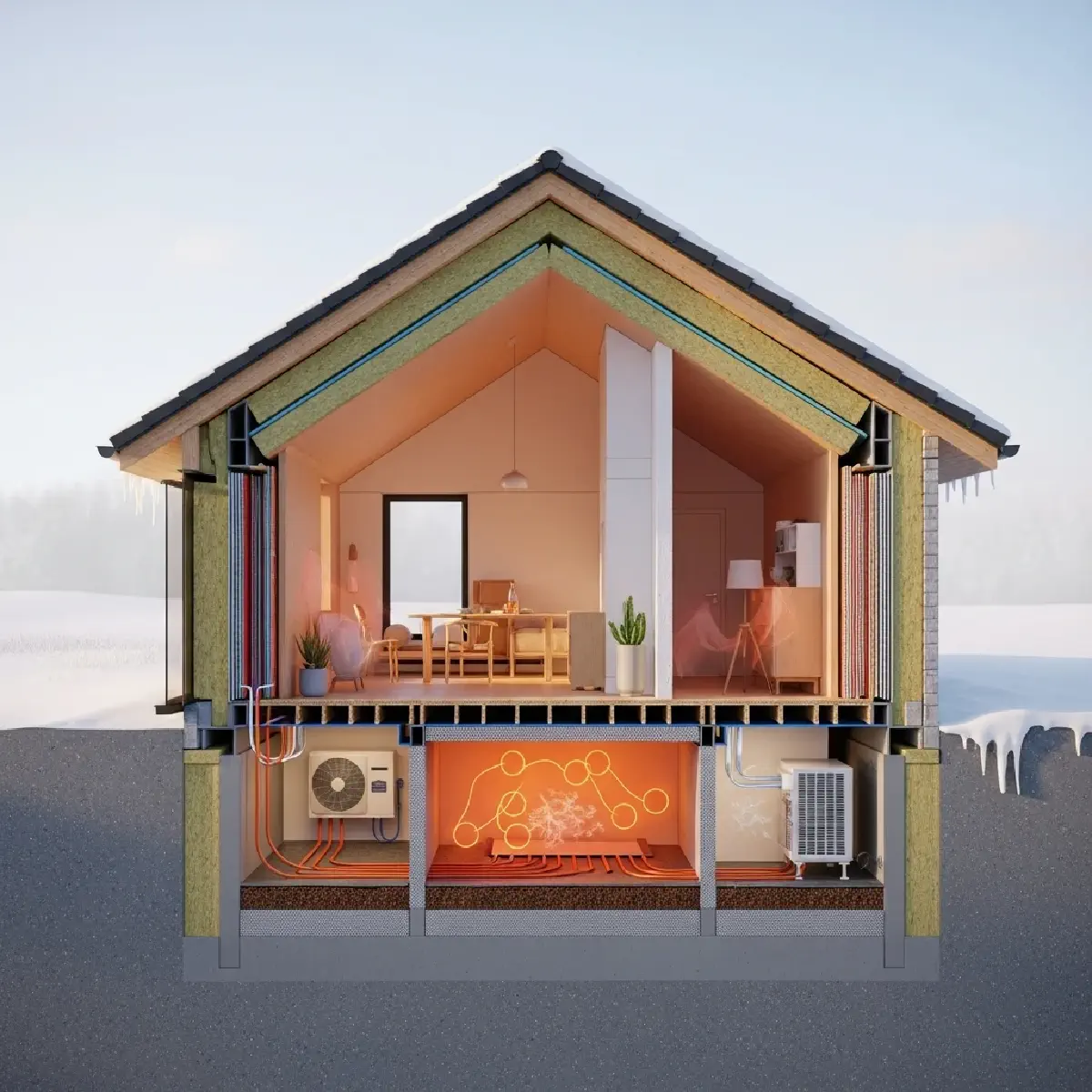
The key insight is that heat loss is proportional to the U-value of the building envelope. Reducing the U-value through insulation directly reduces heating demand.
The Insulation Revolution#
Modern building standards in Austria and the EU require U-values that would have been considered extraordinary just decades ago:
| Building Element | Old Standard (1970s) | Current Standard | Passive House |
|---|---|---|---|
| Walls | 1.0-1.5 W/m²K | 0.20-0.35 W/m²K | < 0.15 W/m²K |
| Roof | 0.8-1.2 W/m²K | 0.15-0.25 W/m²K | < 0.10 W/m²K |
| Windows | 2.8-3.5 W/m²K | 1.0-1.4 W/m²K | < 0.80 W/m²K |
| Floor | 0.8-1.0 W/m²K | 0.25-0.40 W/m²K | < 0.15 W/m²K |
A building meeting Passive House standards requires only 15 kWh/m² per year for heating—compared to 200-300 kWh/m² for buildings from the 1960s-70s.
Heat Pumps: Multiplying Efficiency#
Heat pumps don’t generate heat; they move it from outside to inside. This allows them to deliver more thermal energy than the electrical energy they consume.
The efficiency metric is the Coefficient of Performance (COP):
$$COP = \frac{Q_{delivered}}{W_{input}}$$
Modern heat pumps achieve:
- Air-source heat pumps: COP 2.5-4.0
- Ground-source heat pumps: COP 3.5-5.0
- Water-source heat pumps: COP 4.0-5.5
A COP of 4 means the heat pump delivers 4 kWh of heat for every 1 kWh of electricity consumed.
Comparison with Other Heating Systems#
| Technology | Efficiency/COP | 100 kWh Heat Requires |
|---|---|---|
| Electric resistance | 1.0 | 100 kWh electricity |
| Gas boiler | 0.90 | 111 kWh gas |
| Oil boiler | 0.85 | 118 kWh oil |
| Air-source heat pump | 3.5 | 29 kWh electricity |
| Ground-source heat pump | 4.5 | 22 kWh electricity |
Heat pumps are by far the most efficient way to heat buildings—if the electricity is available.
Solar Thermal Potential#
Solar thermal collectors directly capture the sun’s energy as heat. In central European climates:
- Flat plate collectors: 300-500 kWh/m²/year
- Evacuated tube collectors: 400-600 kWh/m²/year
- Concentrated collectors: 800-1200 kWh/m²/year (requires direct sunlight)
Austria’s total solar thermal potential, assuming reasonable rooftop and open-space deployment, is estimated at approximately 118 TWh per year. This alone could cover a significant fraction of heating demand.
However, solar thermal faces a fundamental problem: seasonal mismatch. Heat is needed most in winter when solar radiation is lowest. Long-term (seasonal) heat storage is technically possible but expensive.
District Heating#
District heating networks distribute heat from centralized sources to multiple buildings. This enables:
- Utilization of waste heat from power plants and industry
- Large-scale heat pumps with better efficiency
- Easier integration of renewable heat sources
- Decoupling of heat generation from individual buildings
In Denmark and Sweden, district heating supplies over 50% of space heating. Austria’s district heating share is approximately 25% and growing.
The Renovation Challenge#
Austria has approximately 2.2 million residential buildings. Of these:
- ~800,000 were built before 1960
- ~600,000 were built between 1960-1980
- Most have poor insulation by modern standards
Renovating the entire building stock to modern standards would:
- Cost tens of billions of euros
- Take decades at realistic renovation rates
- Reduce heating energy demand by 50-70%
The renovation rate in Austria is currently about 1-2% per year. At this pace, it would take 50-100 years to renovate the entire stock. Accelerating renovation is one of the most effective climate policies available.
Hydrogen for Heating?#
Using hydrogen for space heating is technically feasible but energetically wasteful:
- Generate electricity (e.g., from solar/wind)
- Electrolyze water to produce hydrogen (70% efficiency)
- Distribute hydrogen (90-95% efficiency)
- Burn hydrogen in a boiler (85-95% efficiency)
Overall efficiency: ~55-63%
Compare to a heat pump:
- Generate electricity
- Run heat pump (COP = 3.5)
Overall efficiency: 350% (more heat delivered than electricity consumed)
For most building heating applications, direct use of electricity via heat pumps is far superior to hydrogen. Hydrogen should be reserved for applications where direct electrification is impractical.
The Path Forward#
The thermal sector offers perhaps the most cost-effective decarbonization opportunities:
- Aggressive insulation standards for new buildings
- Incentives for deep renovation of existing buildings
- Mass deployment of heat pumps to replace oil and gas boilers
- Expansion of district heating where population density permits
- Solar thermal for domestic hot water and summer heating
With these measures, Austria’s heating energy demand could be reduced by 50-70% while eliminating most fossil fuel use in the sector.
In the next installment, we examine the supply side: how much renewable energy can Austria actually produce within its borders?
Building data from Statistics Austria and the Austrian Energy Agency