The Velocity Tax#
For products that move, such as vehicles, aircraft, and mobile machinery, the “use phase” of the material life-cycle accounts for the vast majority of total energy consumption. In the case of a family car, the energy consumed during operation represents more than 80% of its life-cycle burden. In civil aircraft, this figure exceeds 90%.
In these systems, every unit of mass added to the structure necessitates a corresponding increase in fuel to overcome inertia and air resistance. The environmental audit of such products reveals that the energy invested in material production—while significant—is often an order of magnitude smaller than the energy consumed during its operational life. Consequently, the most effective ecological strategy for mobile systems is the radical minimization of mass.
Lightweighting, however, presents a material conflict. Materials with high specific stiffness and strength, such as aluminum alloys and carbon-fiber-reinforced polymers (CFRP), often require significantly more energy to produce than the steel or cast iron they replace. The designer must determine if the fuel saved over the life of the product justifies the initial energy debt of refinement.
The Weight of Momentum#
The engineering requirements for lightweight design are mathematically rigorous. Performance is not governed by a single property but by combinations of density, modulus, and strength. These combinations are expressed as material indices, providing a quantitative metric for ranking candidates by their mechanical efficiency.
Momentum and the Mass Index#
Minimizing the mass of a structural component requires identifying the governing constraints. For a tie-rod carrying a tensile load, the mass is minimized by maximizing the specific strength, $\sigma_f/\rho$. For a beam or column loaded in bending, the index changes to $E^{1/2}/\rho$ for stiffness or $\sigma_f^{2/3}/\rho$ for strength.
The material property charts assist in this selection. For a light, stiff beam, candidates are those lying furthest in the direction of the index $E^{1/2}/\rho$. Aluminum alloys ($E \approx 70$ GPa or $10.1 \times 10^6$ psi; $\rho \approx 2700$ kg/m³ or 0.098 lb/in³) and magnesium alloys ($E \approx 45$ GPa or $6.5 \times 10^6$ psi; $\rho \approx 1740$ kg/m³ or 0.063 lb/in³) emerge as more efficient than steel ($E \approx 210$ GPa or $30.5 \times 10^6$ psi; $\rho \approx 7850$ kg/m³ or 0.284 lb/in³).
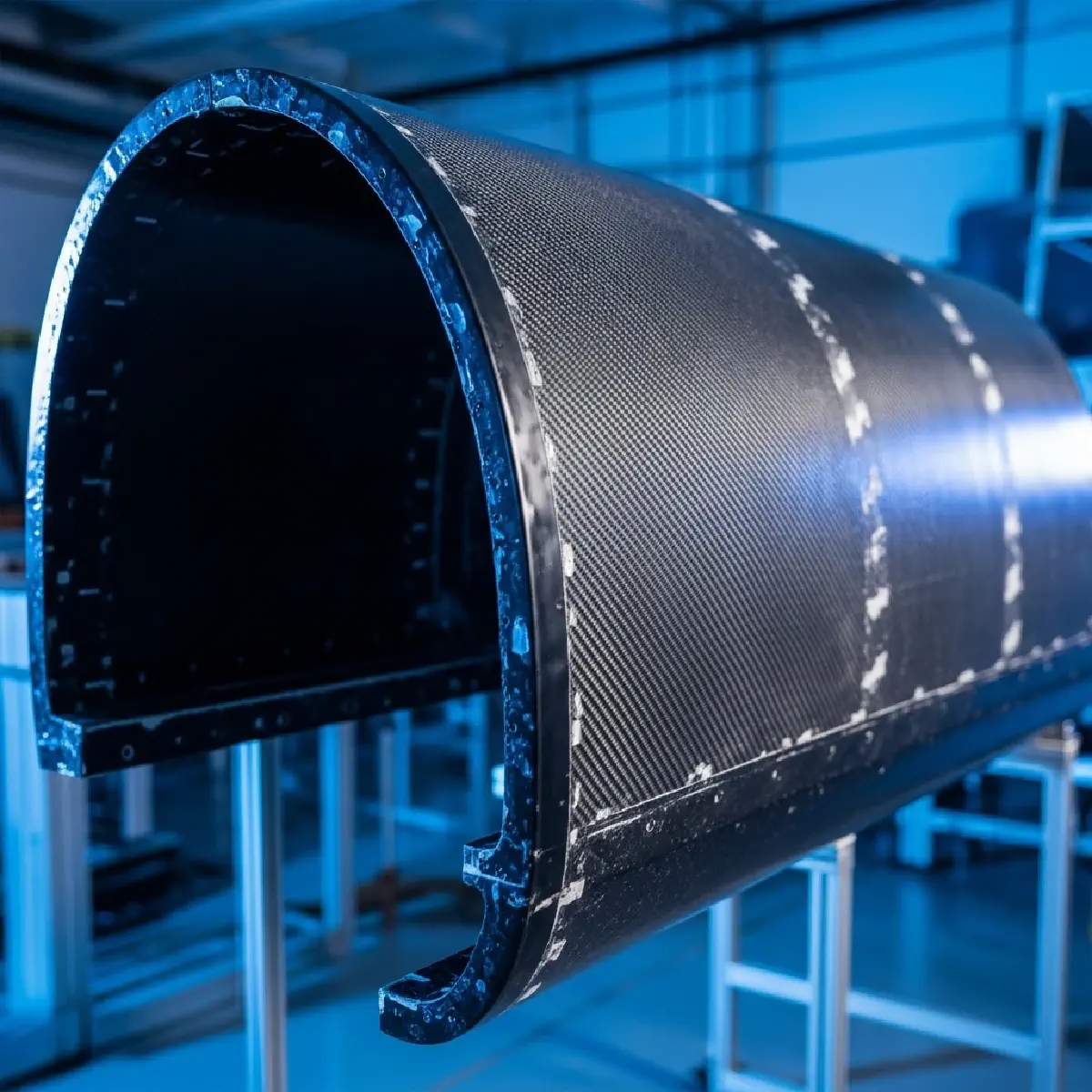
Composites extend these boundaries further. A carbon-fiber-reinforced polymer (CFRP) provides a modulus comparable to steel but at one-fifth of the density. By using these materials, designers can reduce the mass of a civil airliner structure by 30%, which directly translates into reduced carbon emissions during every flight hour.
The Paradox of Premium Materials#
The environmental benefit of lightweight materials depends on the intensity of the product’s use. This is quantified using exchange constants, $\alpha$, which measure the value of weight reduction over the life of the vehicle. For a family car, $\alpha$ is typically $1 to $2 per kg ($0.45 to $0.90 per lb), reflecting fuel savings over a 150,000 km (93,000 mile) life.
For a commercial truck, the utility of weight saving increases to $5 to $20 per kg ($2.27 to $9.07 per lb) because every kilogram of structural weight saved allows an extra kilogram of revenue-generating payload. In this context, replacing steel components with more energy-intensive aluminum becomes ecologically and economically viable.
In aerospace, the exchange constant reaches $100 to $500 per kg ($45 to $227 per lb) for civil aviation and up to $10,000 per kg ($4,535 per lb) for space launch vehicles. At these extremes, the energy cost of producing high-performance materials like titanium or advanced composites is negligible compared to the massive energy savings achieved through weight reduction during the use phase.
The Aerospace Exchange#
Case studies in aerospace design highlight the dominance of the use phase. The structural frame of a Boeing 787 is approximately 80% composite by volume. While the embodied energy of carbon fiber is high (259 to 286 MJ/kg or 111,000 to 123,000 BTU/lb), the reduction in fuel burn over its 20-year service life offsets this production penalty within the first few months of operation.
The same logic does not apply to static structures like highway crash barriers. For a static barrier, there is no use-phase energy consumption. The environmental audit focuses entirely on the production and manufacture phases. In this case, choosing high-embodied-energy materials like aluminum or CFRP would be an ecological error. The optimal choice for a static barrier is carbon steel or wood, which maximize the energy absorbed per unit of production energy.
Design for the environment must therefore distinguish between mobile and static systems. For mobile systems, the objective is the maximization of the material index $M = \sigma_f^{2/3}/\rho$. For static systems, the objective is the maximization of $M = \sigma_f^{2/3}/(H_p\rho)$. This distinction ensures that high-embodied-energy materials are reserved for applications where they provide the greatest life-cycle return.
Designing for the Long Traverse#
Efficiency in the use phase also involves thermal and electrical management. In refrigeration systems, the wall panels must provide maximum thermal resistance. The choice of a hybrid sandwich panel, combining stiff face sheets with a low-density foam core, allows for a thin wall with high flexural stiffness and exceptional insulation.
Minimizing energy loss in electrical systems requires materials with high conductivity. However, strengthening these materials to support structural loads—as in high-speed motor windings—often increases their electrical resistivity. Designers must use strengthening mechanisms like precipitation hardening, which provide significant strength gains with minimal impact on electron flow.
The use phase represents the greatest opportunity for energy conservation in the modern world. By utilizing material indices to optimize for mass and efficiency, engineers can mitigate the entropy of transport and thermal systems. The hidden debt of material production is not a barrier to sustainability, but a capital investment that must be spent wisely to yield operational dividends.