The Geological Ledger#
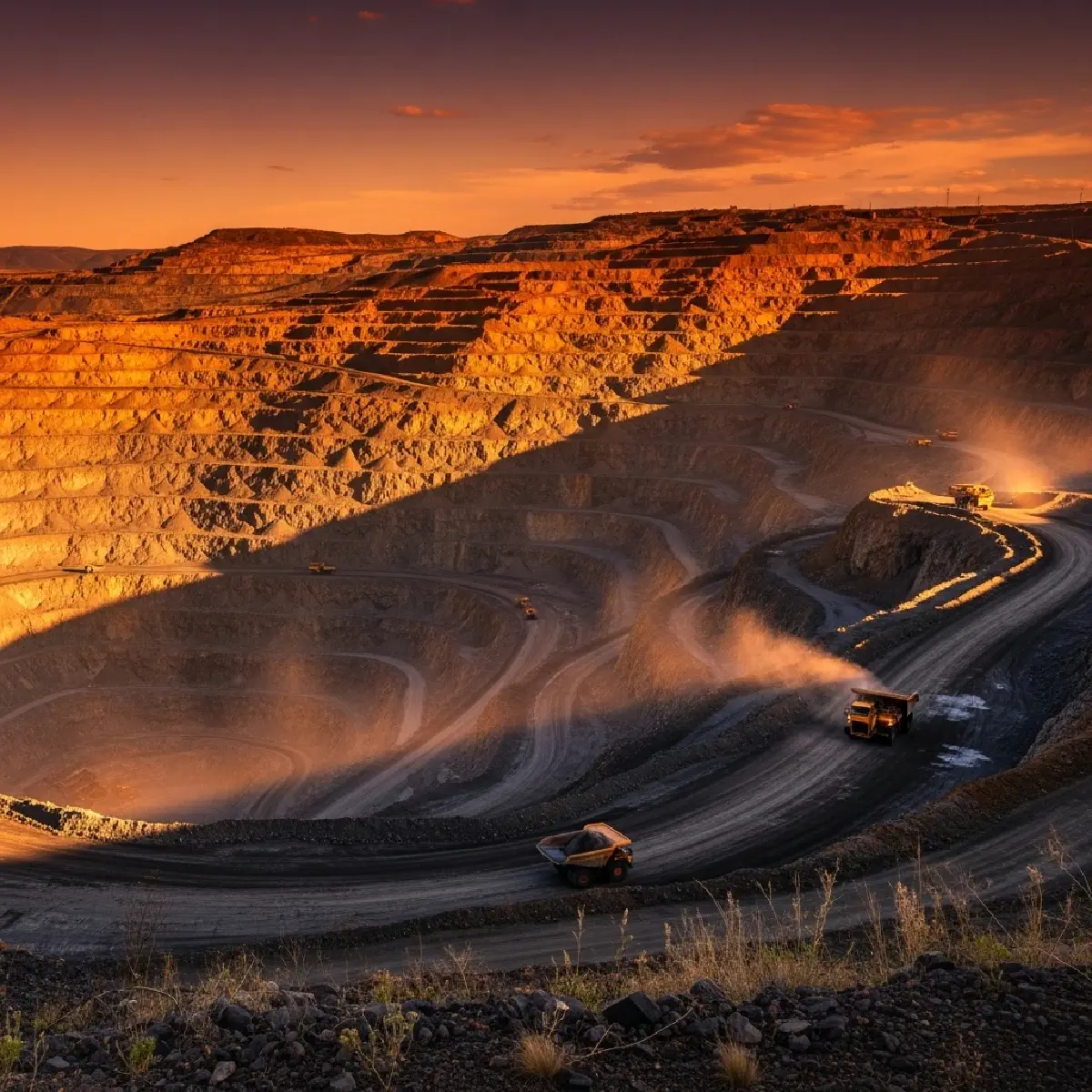
The current industrial trajectory operates at a global growth rate of 3% per year. If this acceleration continues, the human population will mine, process, and dispose of more material in the next 25 years than in the entire history of the species. This exponential consumption occurs within a system where the environment has a finite capacity to absorb gaseous, liquid, and solid waste.
Every manufactured object carries a metabolic history of energy consumption and byproduct generation. While much of the public discourse focuses on the visible energy used during a product’s operation, the energy required to extract, refine, and synthesize the material itself often dictates the environmental footprint. This tension between material volume and ecological impact necessitates a rigorous evaluation of the early phases of the material life-cycle.
Sustainability is defined as meeting present needs without compromising the ability of future generations to meet theirs. To achieve this, a reduction in material and energy flows by a factor of four is considered a conservative minimum. The audit of these flows begins with the measurement of embodied energy, the total fossil-fuel energy consumed to produce 1.0 kg (2.2 lbs) of a specific material.
The Carbon Debt of Refinement#
The selection of a material is a commitment to a specific ecological cost. Embodied energy varies by orders of magnitude across different material families, driven by the thermodynamic difficulty of separating elements from their ores or feedstocks. This data-driven analysis must replace intuition when assessing the total environmental burden of a product.
The Anatomy of Extraction#
The embodied energy of a material is the sum of the primary energy used during mining and refinement, as well as the intrinsic energy contained within the material itself. For polymers derived from oil, the energy in the raw feedstock is a significant component of the total. For metals, the majority of the energy is consumed in the chemical reduction of ores to elemental form.
Typical embodied energy values illustrate the vast disparities in production costs. Primary aluminum requires 200 to 220 MJ/kg (86,000 to 94,600 BTU/lb), while plain carbon steel requires 29 to 35 MJ/kg (12,500 to 15,000 BTU/lb). Cement and concrete represent the lower end of the spectrum, with concrete requiring only 1.0 to 1.3 MJ/kg (430 to 560 BTU/lb).
These energy inputs correlate with the generation of gaseous emissions, most notably carbon dioxide (CO2). For every 1.0 kg (2.2 lbs) of virgin aluminum produced using fossil fuels, approximately 9.0 kg (19.8 lbs) of CO2 is released into the atmosphere. Nitrogen oxides (NOx) and sulfur oxides (SOx) follow similar production patterns, with aluminum generating 72 to 79 g/kg (1.1 to 1.3 oz/lb) and 120 to 140 g/kg (1.9 to 2.2 oz/lb), respectively.
Economic Parity vs. Ecological Reality#
The market price of a material is rarely a perfect reflection of its environmental cost. In sectors where material costs account for 50% or more of the total product price, such as civil construction, economic drivers favor low-embodied-energy materials like concrete and steel. However, in high-technology sectors, material costs may represent less than 1% of the price, leading designers to ignore production energy in favor of mechanical performance.
The disparity between material cost per kg and environmental impact per kg creates a conflict in design optimization. High-performance ceramics like silicon carbide offer exceptional properties but require substantial energy for synthesis and processing. Without a systemic mechanism for accounting for the “hidden debt” of production, industry continues to prioritize the immediate financial ledger over the geological one.
Technological change often accelerates this consumption by introducing new functionalities that lead to premature obsolescence. Electronic devices, for instance, are frequently discarded while their components are still operational, resulting in the waste of the high-embodied-energy materials used in their microcircuits. This cycle of planned obsolescence represents a systemic failure to leverage the energy already invested in refined matter.
The Tally of the Disposable Vessel#
Fluid containers serve as a case study for products where the material production phase dominates the life-cycle energy. For a 440 ml (14.9 fl oz) aluminum can, the material production consumes significantly more energy than the forming process. The can weighs 20 g (0.7 oz) and has an embodied energy of 210 MJ/kg (90,300 BTU/lb), resulting in 9.0 MJ (8,530 BTU) per liter of capacity.
Comparing this to a steel can of the same volume reveals the impact of material choice. The steel can weighs 45 g (1.6 oz) and has an embodied energy of 32 MJ/kg (13,760 BTU/lb). Despite its higher mass, the steel vessel consumes only 2.4 MJ (2,275 BTU) per liter of capacity, representing a nearly fourfold reduction in energy burden.
Glass bottles provide a different trade-off. A 750 ml (25.4 fl oz) soda glass bottle weighs 325 g (11.5 oz) but has a low embodied energy of 15.5 MJ/kg (6,665 BTU/lb). This results in an energy burden of 8.2 MJ (7,770 BTU) per liter, which is higher than steel or plastic. The high mass of the glass bottle makes it less efficient per unit of function unless reuse cycles are high.
Scaling the Sustainable Summit#
Selection based on embodied energy must be tied to functional requirements. For a beam of specified stiffness, the relevant index to maximize is $E^{1/2}/(H_p\rho)$, where $E$ is Young’s modulus, $H_p$ is embodied energy, and $\rho$ is density. This index quantifies the mechanical benefit derived from each unit of energy invested during the material’s birth.
Commodity polymers, often perceived as ecologically detrimental due to their petroleum origins, perform efficiently in these functional comparisons. Per unit of function in bending, many polymers carry a lower energy penalty than primary aluminum or titanium. This efficiency derives from their low density and the relatively simple processing required to mold them into complex forms.
The ultimate goal is the decoupling of growth from resource consumption. Achieving this requires a transition from the linear “take-make-waste” model to a circular methodology. The first step is the audit: recognizing that every material choice is a withdrawal from a finite ecological reserve.