The Supermarket Scientist#
In a Norwegian lab, a researcher named L scans supermarket shelves looking for biodegradable leaching reagents. He considers using tannic acid from trees or even citric acid—if you can eat it, it might be a greener way to recover lithium. This search for “green chemistry” represents a hope to close the battery loop without toxic side effects. However, the reality of industrial scaling often demands faster, cheaper, and more aggressive chemicals. The “closed loop” is a powerful sociotechnical imaginary, but it frequently hides “open ends”.
The Thermodynamic Reality Check#
The thesis of this post is that lithium circularity is a material impossibility within current industrial frameworks due to entropic loss. Every chemical separation requires energy, water, and additive chemicals that themselves generate waste. Thus, the “closed loop” often acts as a “vicious cycle” that legitimizes increased consumption rather than reducing mining.
The Anatomy of a Leaky Loop#
Explaining the System: The Chemistry of Separation#
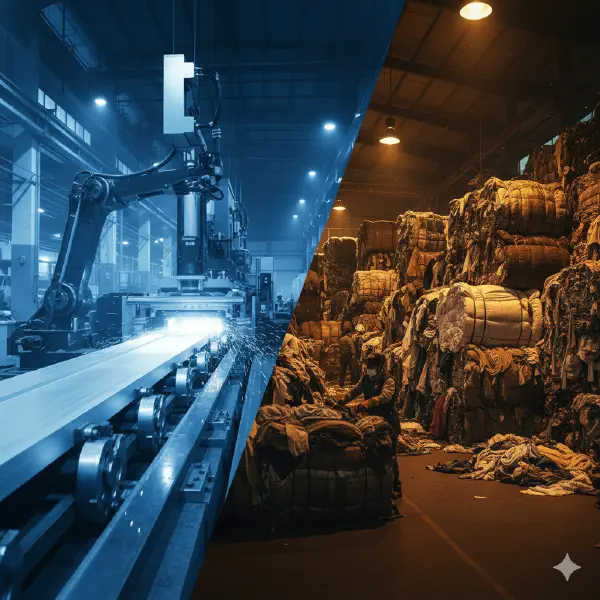
To recover lithium, scientists use hydrometallurgy—a water-and-acid-based method considered more sustainable than high-heat smelting. In the lab, “black mass” is mixed with concentrated sulfuric acid to create a “slurry”. The acid separates the target metal from the impurities, but it also creates “hazardous waste”. Even “green” methods face resistance: higher black mass ratios for efficiency often lead to lower-quality recovered lithium. Pure lithium (99.9%) is the industry target, but achieving this purity requires constant material additions.
Complicating Factors: The Rebound Effect#
Sustainability improvements often trigger the “rebound effect,” where efficiency leads to increased total consumption. If batteries are seen as “recyclable,” they may be treated as disposable resources rather than durable goods. In Norway, many EV owners replace vehicles before they reach the end of their life, fueling a “hot market” for bigger, more luxurious models. This “trap of consumerism” means that even with 100% recycling, the skyrocketing demand for new batteries would still require primary mining.
Tracing the Consequences: The Ash of the Entropocene#
The consequences of entropic thinking are visible in places like Tocopilla, Chile. For decades, this energy hub burned coal to power copper mines, leaving behind mountains of toxic ash that can never be “unburned”. This is the “Entropocene”—an era marked by the acceleration of material and psychosocial erosion. In the lithium loop, every 1,600 cubic meters (56,500 cubic feet) of lithium shipped is paid for by massive water evaporation in a desert. We are mopping the floor with the tap wide open because we ignore the energy required to “close” the loop.
The National Illusion#
A closed loop makes little sense if it is limited by national borders. Norway’s “green shift” is funded by the “oil fund,” which accumulates profits from fossil fuel exports burned elsewhere. While Norwegian air becomes cleaner through EVs, the planetary atmosphere continues to absorb the emissions from those exported fuels. Truly green chemistry must account for the “more-than-chemical” separations of energy and waste. The loop is only as strong as its weakest connection.