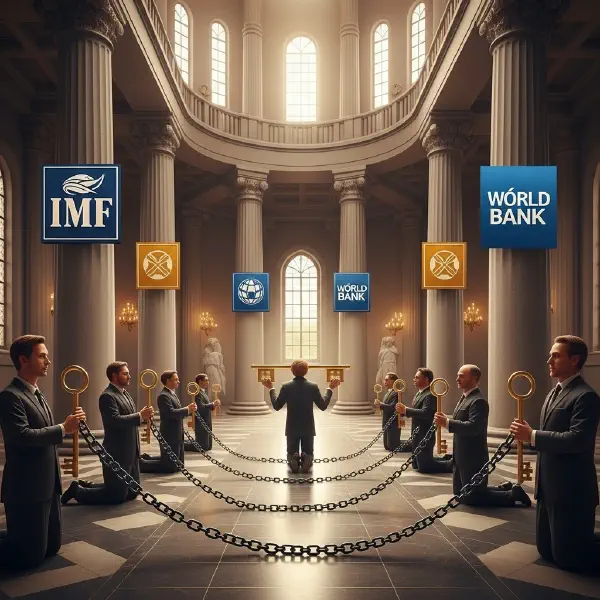
The Money Moving Syndrome and the Institutional Drive for Disbursement Over Development#
Among professionals familiar with the international development sector, the obsession of donor agencies with spending allocated funds—spending quickly, and spending ever increasing amounts—is a pervasive and continuous feature. This phenomenon, often dubbed the Money Moving Syndrome (MMS), overshadows all other goals and ultimately serves as the primary starting point for analyzing the pathologies of the aid industry. David Sims argues that this compulsion to move the money (MMS) is so profound that it leads to perverse incentives and structural failures, often pushing the entire development effort to the “absurd point where the donor has a greater need for giving the aid than the recipient has for taking it”.
This post explores the origins and devastating consequences of the imperative to spend, examining how donor institutional insecurity, the tyranny of the budget cycle, and the near-impossibility of suspending failed projects combine to ensure that the foreign aid machine never ceases, regardless of its effectiveness.
The Core Pathology: Institutional Insecurity and the ‘Spend It or Lose It’ Rule#
The development industry’s fundamental drive to spend is rooted in deep institutional insecurity. Donor organizations operate in an unending fight played out in Western capitals between aid champions and aid skeptics who question the continued flow of funds. To survive this scrutiny and justify their massive existence, these agencies feel a constant need to protect their budget streams.
This dynamic results in the cardinal rule of the donor world: ‘spend it or lose it’. If funds earmarked for a country’s international development budget are not spent or at least committed within a certain budget cycle, it becomes difficult to justify asking for the same level of funding, or greater largesse, in subsequent years. An agency that leaves funds uncommitted or has programs that are embarrassingly stillborn failures faces the immense pressure on its management to move the money.
The obsession to spend what has been allocated is focused and intense. Donor staff, especially those in the field, feel strong pressure to disburse money, particularly towards the end of the budget year. This pressure is heightened for donor countries with bold commitments, such as Sweden, which pledged to raise its aid allocation to one percent of GNP, thereby creating internal fear that uncommitted resources would not be re-budgeted in following years.
The sheer volume of unallocated and unspent funds often creates an “embarrassing overhang” in donor budgets, which is perceived as money “still up for grabs” in the current and future budget cycles. Decisions on how to manage these substantial allocated funds are made at the “stratospheric levels of donor management” and are embedded in horizon plans, annual budgets, and country programs. Internal policy papers, sectoral reviews, and workshops are used within the donor’s “bubble” to influence these funding streams.
Perverse Incentives: Rewarding Disbursement Over Results#
The imperative to spend generates pervasive perverse incentives throughout the industry:
Promotion Is Tied to Disbursement: Paul Collier famously stated that in the development industry, people “get promoted by disbursing money, not withholding it”. This career incentive structure rewards quantity over quality.
No Reward for Caution or Cost-Saving: It is unknown for a development agency or its divisions to be rewarded for not spending an allocated budget or for saving funds for a more useful future purpose. A staffer who simply says “no” to a fiasco-in-the-making or shoots down a dubious project concept is likely to be politely encouraged toward early retirement or shuffled into an obscure administrative position.
Tying Pay to Loan Generation: Former World Bank President Jim Yong Kim attacked the entrenched spending incentives, deploring how the pay of World Bank economists is tied to the number of loans they “churn out”.
This environment means that donor management prioritizes moving money quickly and showing “early results,” as noted by an OECD monograph aimed at addressing these issues. However, the proposed solutions, such as implementing a Management for Development Results (MfDR) system, are often seen as pure “dissimulation” or attempts to replace spending targets with vague outcome and impact targets.
The Structural Cost of Control and Speed#
The obsession with spending fast is constantly compromised by a countervailing obsession with control. Donors maintain control through several structural mechanisms, ensuring that funds are disbursed but only through processes that are sanitized and controlled by the donor, not the recipient.
Short-Leash and Time-Bound Money: Despite rhetoric promoting development ‘partnerships’ and recipient ‘ownership,’ grants and loans are strictly time-bound and kept on a “very short leash”. Funds are “dribbled out through byzantine bureaucratic dances” using detailed sequencing and complex conditionalities that must be ’triggered’. Even simple payments usually require a coveted ’no objection’ from the donor agency, often necessitating dozens of signatures if managed by a partner agency, leaving little space for efficient execution of the project. Mechanisms for independent management and multi-year retention of allocations are virtually non-existent, apart from tiny ventures or specialized programs like the USA’s Millennium Challenge Account.
Hollow Artifacts of Performance: Because the industry’s success is defined by spending earmarked funds on time, “whole structures have been built up to pretend that there are other ways to gauge performance”. This involves emphasizing outcomes, measuring results, worrying about effectiveness and value for money (VFM), and evaluating impact. Sims contends that these metrics are “very much hollow artifacts that convey only a semblance of dynamic change”. The VFM agenda, for example, risks forcing foreign aid agencies into “irrelevance and subterfuge,” compelling them to choose low-risk projects that satisfy political demands but rarely lead to sustainable development.
The Procurement-Process Trap: Nearly all aid industry expenditures (ninety-some percent) flow through competitive procurement processes, generating intense competition for these financial slices. Procurement is designed to generate competitive markets but has resulted in a “little-known world of bureaucratic rules, regulations, and oversight”. The process requires consulting companies to devote a significant portion—often more than half—of their staff and management efforts merely to tracking announcements, negotiating consortia, and assembling teams to navigate the lengthy steps, which include expressions of interest (EOIs) and requests for proposals (RFPs). This administrative burden is intrinsic and makes a “joke out of anything like real ‘ownership’ on the recipient side”.
The Unwillingness to Halt a Fiasco#
The momentum created by the imperative to spend means that turning off the aid spigot is generally “not part of the game”. Aid programs are only suspended in rare cases, typically due to egregious moral or human rights reasons, or “outrageous and rampant corruption,” and even these suspensions are usually temporary and tempered.
Pulling the plug on a project that is technically failing, woefully off the implementation timetable, or causing serious negative policy repercussions is something donors “practically never do”. Once a project is under serious preparation or implementation, a “steamroller momentum” pushes it forward.
A classic historical example demonstrating this resistance is the Arun III Hydropower Project in Nepal in the early 1990s.
The World Bank conceived the project, which was “unprecedented in the country’s history” in scale.
It was hugely expensive, costing more than Nepal’s annual budget, and threatened to condemn the country to decades of loan repayment.
Despite multiple, loud criticisms over a period of three years regarding environmental, technical, and social problems, the Bank’s senior management “persisted in stonewalling on Arun III,” risking it becoming the “Dien Bien Phu of infrastructure projects”.
The project was only canceled in 1995 through the personal intervention of James Wolfensohn after he became World Bank President.
This reluctance to say no stems directly from the incentive structure: no donor staffer is rewarded for withholding money or halting a dubious project; instead, they face professional risk.
The Overdrive Effect: Budgets That Must Be Forced Out#
When a donor country dramatically increases its budget for political or other reasons, the imperative to spend shifts into “overdrive,” often with negative consequences.
A prime historical example is the USAID Mission to Egypt following the Camp David Peace Accords in 1977–1979. The mission was suddenly tasked with expanding its program to a massive one billion dollars in grant aid a year, making it the largest economic assistance program in the world for over a decade. This sudden influx of money led to a frantic “scramble to identify projects and to process them,” requiring USAID to construct an extensive bureaucracy in Cairo and deploy “an army of American contractors, subcontractors, and consultants”. The consequence of this rapid spending was that the Egyptian government was allowed to “avoid difficult reforms, continue business as usual,” while enjoying American-financed projects.
Similarly, the British government’s 2004 decision to raise its aid budget to the purely arbitrary level of 0.7% of GDP was criticized for yielding “waste, missed opportunities,” and dubious VFM when the goal was achieved in 2013.
The imperative to spend thus dictates the need for constant growth, encapsulated by the internal drive to find new ways to move the money. As is known in corporate management, organizations that expand and proliferate their activities also create more positions at upper management levels, leading to more opportunities for career growth and increased power for managers. This drive manifests as the donor core competency of “product development,” which seeks out new paths and sectors to justify disbursement.
The Result: The Instinct to ‘Carry On Carrying On’#
The collective effect of institutional insecurity, perverse incentives, and the need to control funds ensures the survival of the development ecosystem, overriding any serious reflection on genuine effectiveness.
The development community is locked into a self-referential “processism” that prioritizes formulaic processes, procurement systems, and sanitized public images over real development work. This institutional trait leads to what Nigela Wrong called a “powerful urge… to keep the show on the road”. Donors create a habit where “supposedly temporary projects develop a momentum and logic of their own,” and the larger the sums involved, the harder it is to concede failure.
The “inclination to carry on carrying on means donors shrink from walking away,” even when results are disappointing. This self-perpetuation is reinforced by constantly repeating the argument that global issues are becoming more complex and new challenges are always rising, justifying colossal “mission creep” and ensuring a prosperous future for development players. The ultimate conclusion of the analysis of MMS is that the development industry, unlike a normal corporate entity, is defined by the declaration: ‘I spend therefore I exist’.
The imperative to spend acts like a massive, constantly running river. It is not concerned with where the water goes, or how deeply it irrigates the land, but merely with the velocity and volume of its own flow. Any attempts to build a small dam or divert the flow for sensible, localized use are instantly threatened by the tremendous, necessary pressure of the water behind it, which must continue rushing forward to justify the river’s existence.