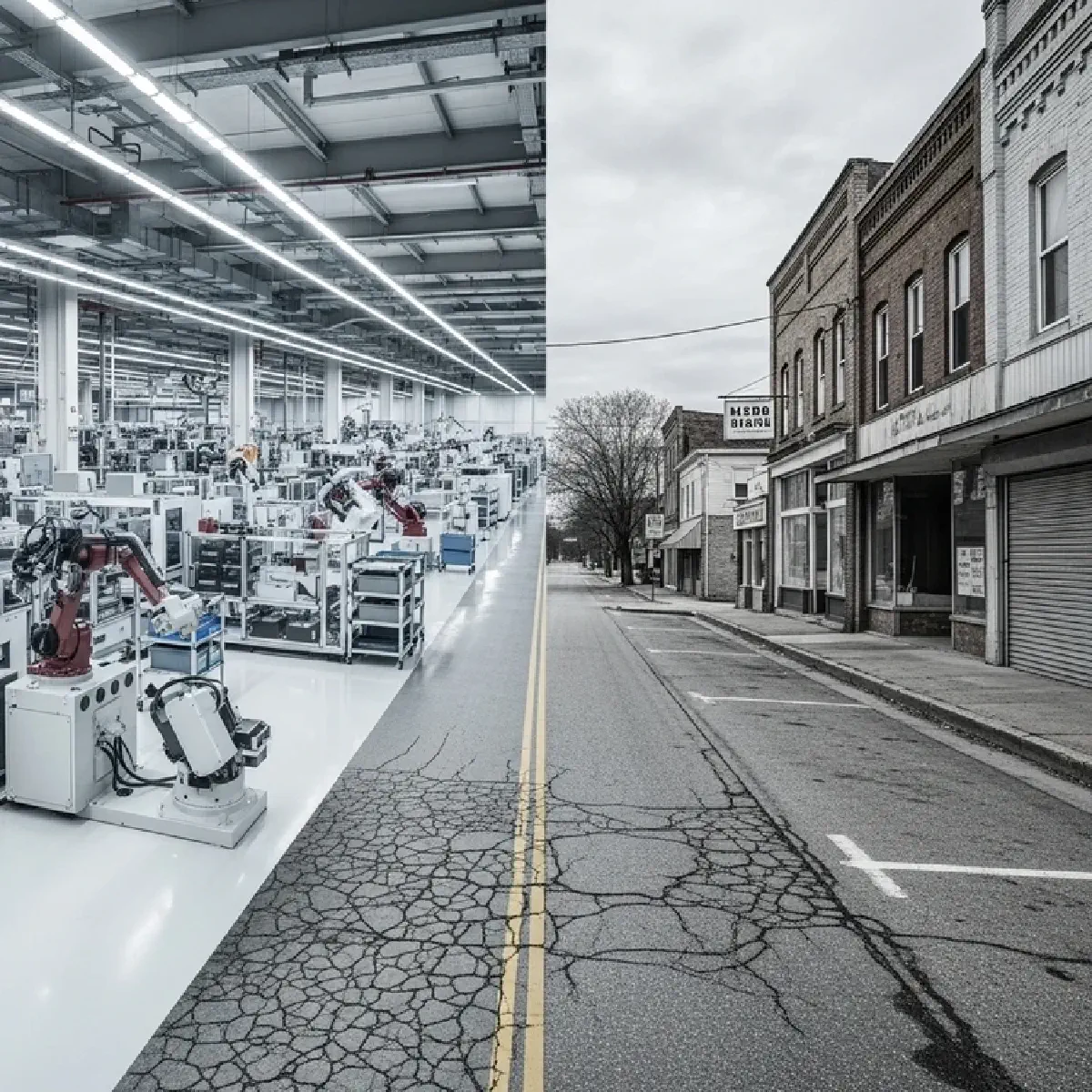
Beneath the macro-concentrations of minerals, patents, capital, and geopolitics lies the most human dimension: who benefits and who bears the cost. The rallying cry for a “just transition” acknowledges that shifting from a brown to a green economy will create winners and losers. The evidence so far suggests that the forces of concentration are stacking the deck, threatening to bake profound new inequalities into the foundation of our sustainable future.
This inequality manifests spatially and socially. On one hand, gleaming “gigafactories” for batteries and “Silicon Valleys” for climate tech are creating clusters of high-skilled, high-wage jobs in specific regions. On the other, communities whose identities and economies were built around fossil fuels—coal towns, oil-refining regions—face economic desertification without a clear pathway forward. The transition risks becoming a story of spatially concentrated prosperity and spatially concentrated despair.
The divide is also global. The technologies and subsidies accelerating the transition in the Global North are often prohibitively expensive for the Global South, which still needs to expand energy access for hundreds of millions. The same lithium needed for electric vehicles in Europe is also needed for grid storage in Africa, setting up a competition where the wealthier consumer will win. The green revolution, unless consciously designed otherwise, threatens to exacerbate the very global inequities it purports to solve.
The Two Maps of Employment#
The labor market impact of the transition is not a simple story of net job gains. While clean energy jobs are growing, they are not appearing in the same places, nor do they demand the same skills, as the fossil fuel jobs they replace. A study by the Brookings Institution found that in the United States, the top 10% of counties in terms of clean energy jobs account for nearly 50% of all such employment. These are typically metropolitan areas with strong tech and manufacturing bases.
Conversely, fossil fuel jobs are often in rural or peripheral regions. A coal miner in West Virginia or an oil worker in the Canadian prairies cannot easily commute to a battery plant in Tennessee or a solar panel facility in Ontario. This spatial mismatch creates “stranded communities” alongside “stranded assets.” Without massive, targeted investment in retraining, infrastructure, and economic diversification, these regions will experience concentrated decline, fueling social unrest and political polarization.
The Green Premium and the Energy Poor#
The cost of decarbonization creates a “green premium.” Electric vehicles, heat pumps, and home retrofits require significant upfront capital. While they often pay back over time through lower operating costs, the initial investment is a barrier for low- and middle-income households. In the Global North, this risks creating a two-tiered energy system: the wealthy in efficient, electrified homes with EVs, and the poor in less efficient housing reliant on volatile fossil fuel prices.
In the Global South, the challenge is more acute. Over 700 million people still lack access to electricity. For them, the priority is any reliable, affordable energy—a need that can conflict with the Global North’s imperative to decarbonize. Pressure to forgo fossil fuel development, without equivalent financial and technological support for clean alternatives, can be seen as a new form of climate imperialism, concentrating the right to develop in nations that already industrialized on fossil fuels.
The Burden of Extraction#
The human and environmental cost of mineral extraction is itself unequally distributed. The DRC supplies the cobalt that makes EVs possible, yet vast swathes of its population live in poverty, and artisanal mining is rife with hazards. Chile’s lithium extraction consumes vast amounts of water in the already arid Atacama Desert, threatening indigenous communities and ecosystems.
This follows a familiar colonial pattern: raw materials are extracted from the periphery, often with high local social and environmental costs, to fuel consumption and technological advancement in the core. The green transition, unless rigorously governed by new standards of equity and environmental justice, risks perpetuating this exploitative dynamic under a green banner.
Designing for Distribution#
A just transition is not an automatic byproduct of market forces; it must be intentionally architected. This requires policies that explicitly counter the tendencies of concentration. Community ownership models for renewable projects, like those in Denmark and Scotland, can keep benefits local. “Place-based” industrial policies can direct investment to transitioning regions, not just the most competitive ones.
Globally, it demands fulfilling and surpassing the $100 billion climate finance pledge, with a focus on grants (not loans) for adaptation and clean energy access. It requires reforming intellectual property regimes to facilitate technology transfer and supporting circular economy models that reduce primary mineral demand. Justice must be engineered into the system, not hoped for as a trickle-down effect.
The Moral Core of the Machine#
The concentration of the green revolution is not a technical bug; it is a design challenge with profound moral implications. We are building the infrastructure for the next century. Will it reinforce old hierarchies and create new ones, or will it be a vehicle for greater equity and resilience?
The final, and most important, concentration we must confront is the concentration of political will. The forces of capital, technology, and geopolitics are coalescing into powerful, self-reinforcing patterns. Redirecting them toward a more distributed, equitable outcome will require an equally concentrated and sustained effort—a collective insistence that the future be not only clean, but fair. The quality of our transition will be judged not by our reduction in parts per million of CO2 alone, but by the justice woven into its very fabric.