Adaptive Futures: Part 4—Building in Multiple Time Horizons: Temporal Design for Uncertain Futures#
The Cathedral That Took Six Centuries#
Construction began on Cologne Cathedral in 1248. When work halted in 1473, the building stood incomplete—a choir and one tower finished, the rest skeletal. For 350 years, the cathedral remained frozen in time, its original purpose seemingly forgotten. Then in 1842, construction resumed using rediscovered medieval plans. The cathedral was finally completed in 1880, 632 years after breaking ground. What’s remarkable isn’t just the timescale but the continuity of purpose across centuries. The 19th-century builders weren’t constructing something new; they were fulfilling a vision conceived in the 13th century for a future they couldn’t possibly imagine.
This cathedral represents what we might call temporal design—architecture conceived across multiple human lifetimes, built for futures the architects knew they wouldn’t see. Most modern construction operates on radically different timescales: buildings designed for 30-year mortgages, infrastructure for 50-year lifespans, products for planned obsolescence. This mismatch between our short-term design horizons and long-term challenges (climate change, sea level rise, resource depletion) creates what sustainability scholar Thomas Princen calls “the tyranny of the present”—design decisions made for immediate needs compromising future possibilities.
Temporal design offers an alternative: designing systems that accommodate multiple possible futures, that can adapt as conditions change, that serve purposes beyond what their creators can foresee. This isn’t about predicting the future—an impossible task—but about creating what architect Stewart Brand calls “shearing layers”: systems where different components change at different rates, allowing adaptation without complete replacement. In an age of accelerating change and deep uncertainty, temporal design may be our most important resilience strategy.
The Timescale Mismatch#
Modern design operates on timescales fundamentally mismatched with both natural systems and human civilization:
Financial timescales: Most investments require returns within 3-10 years. This drives design decisions favoring low upfront cost over long-term durability.
Political cycles: Infrastructure funding follows 2-6 year election cycles, discouraging projects with benefits beyond politicians’ terms.
Technological obsolescence: Digital systems become obsolete in 3-5 years, physical products in 5-15 years, yet buildings last 50-100 years.
Climate timescales: Carbon dioxide persists in atmosphere for centuries, sea level rise continues for millennia, yet most climate planning looks only to 2100.
Cultural continuity: Indigenous knowledge systems maintain wisdom across hundreds of generations, while modern education often neglects lessons more than a generation old.
This mismatch creates what resilience scholar Brian Walker calls “the pathology of natural resource management”: managing systems on timescales too short for their dynamics. Fisheries collapse because quotas are set annually while fish populations fluctuate decennially. Forests are managed on 20-year harvest cycles while ecosystems operate on century scales. Climate policy aims for 2050 targets while carbon cycles operate over millennia.
Temporal design addresses this by aligning design decisions with appropriate timescales. The “long now” perspective—thinking in centuries rather than years—changes what we value and how we build.
Shearing Layers: Architecture for Change#
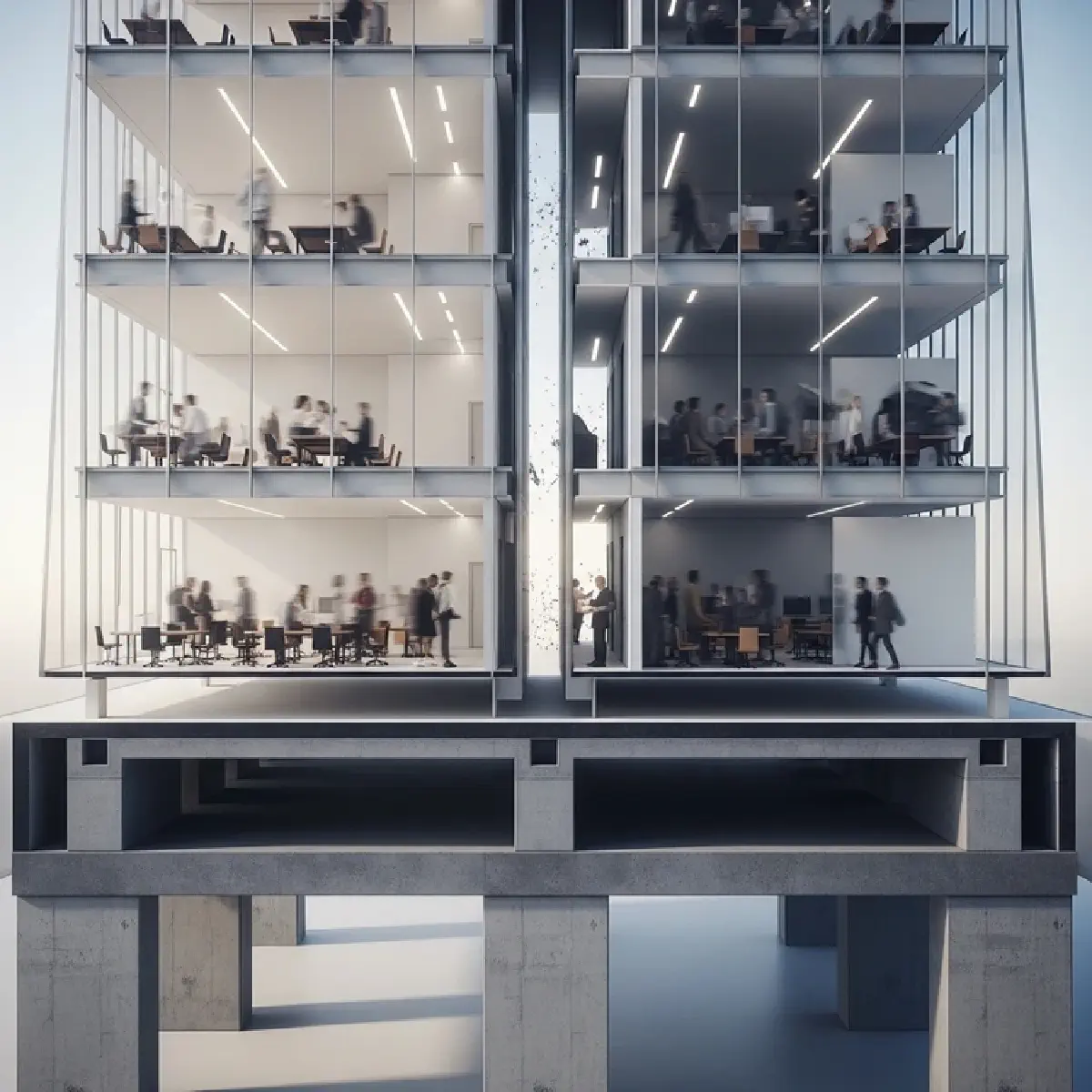
Architect Frank Duffy proposed that buildings consist of “shearing layers” that change at different rates:
- Site (eternal) – The geographical location
- Structure (30-300 years) – Foundation and load-bearing elements
- Skin (20 years) – Exterior surfaces
- Services (7-15 years) – Plumbing, electrical, HVAC
- Space plan (3-5 years) – Interior walls and layouts
- Stuff (days-months) – Furniture and objects
Good temporal design recognizes these different rates and creates interfaces allowing layers to change independently. The Farnsworth House by Mies van der Rohe exemplifies poor temporal design: its skin and structure are integrated, so replacing windows requires structural work. The Centre Pompidou in Paris exemplifies good temporal design: its structure, skin, and services are separated, allowing each to be upgraded independently.
This principle extends beyond architecture. In software engineering, the concept of “separation of concerns” creates similar shearing layers: data storage, business logic, and user interface can evolve independently. In urban design, the “spine and blocks” approach separates permanent infrastructure (streets, utilities) from changeable buildings.
The Dutch approach to flood infrastructure applies shearing layers thinking. Dikes (structure layer) are built for 50-year horizons while warning systems (services layer) are upgraded every 5-10 years and evacuation plans (space plan layer) are revised annually. This allows the system to adapt to changing climate predictions without complete reconstruction.
Designing for Multiple Futures#
Since we cannot predict the future, temporal design creates systems that can accommodate multiple possible futures. Scenario planning, developed by Royal Dutch Shell in the 1970s, offers a methodology. Instead of predicting one future, Shell developed multiple plausible scenarios and tested strategies against each. This allowed the company to navigate the 1973 oil crisis more effectively than competitors who planned for a single expected future.
Applied to design, scenario planning means creating systems flexible enough to work under different conditions. The Bullitt Center in Seattle, billed as the world’s greenest commercial building, incorporates this thinking. Its design accommodates multiple possible futures:
- If grid electricity becomes cleaner, the building can draw more from the grid
- If water becomes scarcer, rainwater harvesting systems can expand
- If heating needs change, radiant floor systems can adapt
- If workspaces evolve, open floor plans allow reconfiguration
More fundamentally, the building is designed for disassembly. Unlike conventional buildings where materials are permanently bonded, the Bullitt Center uses bolted connections allowing components to be replaced or recycled. This creates what circular economy advocates call a “technical nutrient”—a building that can be reconfigured rather than demolished.
The Time Value of Durability#
Modern economics heavily discounts the future. A standard 5% discount rate means $100 in 20 years is worth only $38 today. This systematically undervalues long-term benefits like durability, resilience, and sustainability.
Temporal design requires different valuation methods. The concept of “whole-life costing” accounts for not just initial construction but maintenance, operation, and eventual disposal over a building’s entire life. Studies show that while green buildings often have 2-5% higher upfront costs, they have 20-30% lower operating costs over their lifespan.
More radically, some advocate for “intergenerational accounting” that gives equal weight to future generations. The Māori concept of “kaitiakitanga” (guardianship) requires considering impacts seven generations forward. This changes design decisions dramatically: a bridge designed for 100 years rather than 50 may cost more initially but serves multiple generations.
The Ise Jingu shrine in Japan embodies this intergenerational thinking. The shrine has been rebuilt every 20 years for over 1,300 years using the same techniques and materials. This practice maintains traditional skills, allows gradual improvement, and creates what anthropologist David Lowenthal calls “the past as a renewable resource”—not frozen in time but continuously renewed.
Slow Knowledge vs. Fast Innovation#
Modern culture valorizes innovation and disruption. But resilience often depends on what ecologist David Orr calls “slow knowledge”—wisdom accumulated through long observation and experience. Indigenous fire management practices in Australia developed over 60,000 years represent slow knowledge. Modern prescribed burning programs are rediscovering this wisdom after catastrophic wildfires revealed the limitations of fire suppression.
Temporal design balances fast innovation with slow knowledge. The Passivhaus standard for ultra-efficient buildings combines centuries-old principles (thick walls, orientation to sun) with modern materials and engineering. The result isn’t high-tech for its own sake but appropriate technology for long-term performance.
Education systems exemplify the tension between fast and slow. Modern education often emphasizes current skills over timeless wisdom. Finland’s education reforms intentionally emphasize slow knowledge: critical thinking, collaboration, creativity—skills that remain valuable regardless of technological change. This represents temporal design in education: preparing students for multiple possible futures rather than training them for specific predicted jobs.
Case Study: The Growing Building#
The “Brock Environmental Center” in Virginia Beach takes temporal design to its logical conclusion. The building is designed to adapt to sea level rise through several strategies:
Elevated structure: Built on pilings allowing storm surges to pass underneath
Relocatable components: Critical systems can be moved to higher floors as water rises
Material adaptability: Uses materials that can be disassembled and reused elsewhere
Ecosystem integration: Designed to become part of a wetland ecosystem as waters rise
Most radically, the building has a planned decommissioning strategy. When the site eventually becomes uninhabitable due to sea level rise, the building can be disassembled and its materials used elsewhere. This accepts impermanence as a design parameter rather than pretending buildings last forever.
This approach represents what landscape architect Kristina Hill calls “design for retreat”—accepting that some places will become uninhabitable and designing graceful exit strategies rather than futile defenses. In an era of climate change, temporal design must include not just how systems are built but how they’re unbuilt.
The Politics of Long Time Horizons#
Temporal design faces political challenges. Democratic systems struggle with long time horizons because voters prioritize immediate concerns. The Roman Republic appointed “dictators” during emergencies—temporary rulers with extraordinary powers. Some scholars suggest modern democracies need similar mechanisms for long-term challenges: institutions with mandates extending beyond election cycles.
Several models exist:
Future generations commissioners: Hungary established a Parliamentary Commissioner for Future Generations in 2008. Wales created a Future Generations Commissioner in 2015 with legal authority to challenge policies harmful to long-term wellbeing.
Intergenerational trusts: The Alaska Permanent Fund distributes oil revenue to citizens while preserving principal for future generations. Norway’s Sovereign Wealth Fund similarly preserves oil wealth for future Norwegians.
Long-term research institutions: The Long Now Foundation (founded 1996) builds projects like the 10,000 Year Clock designed to tick for millennia, encouraging long-term thinking.
Legal frameworks: Some countries give nature legal standing, allowing lawsuits on behalf of ecosystems. New Zealand granted the Whanganui River legal personhood in 2017, creating guardians to protect it for future generations.
These institutional innovations create what political scientist Dennis Thompson calls “temporal representation”—giving future generations a voice in current decisions.
The Cathedral’s Lesson#
Cologne Cathedral teaches several temporal design lessons:
Continuity of purpose: The 19th-century builders honored the 13th-century vision while using 19th-century technology. They balanced respect for the past with adaptation to the present.
Incremental progress: Work proceeded as resources allowed over centuries. The building wasn’t completed quickly but correctly.
Adaptive reuse: During its incomplete centuries, the cathedral served various purposes while awaiting completion.
Cultural memory: The original plans were preserved for 350 years, maintaining the vision across generations.
Modern design can learn from this cathedral not as a model of efficiency but as a model of temporal thinking. We don’t need to build everything to last centuries, but we need to design with appropriate time horizons: some systems for immediate needs, some for decades, some for centuries.
Temporal design recognizes that different systems operate on different clocks. Financial systems tick in quarters, ecological systems in seasons and centuries, cultural systems in generations, geological systems in millennia. Good design aligns decisions with appropriate clocks rather than forcing everything onto the shortest timescale.
In an age of accelerating change, the most resilient systems may be those that change at multiple speeds simultaneously—fast adaptation where needed, slow preservation where valuable. The cathedral that took six centuries to build reminds us that some things worth building are worth building across generations, that some visions outlive their creators, and that designing for futures we won’t see may be the most important work we do. As we face challenges that unfold over decades and centuries, we need not just better designs but designs that understand time—not as an enemy to be defeated by permanence or an opportunity to be seized by disposability, but as a dimension to be inhabited with wisdom, humility, and care for those who will come after us.