The Ant That Doesn’t Know It’s Building a Cathedral#
In Paris’s Jardin des Plantes, weaver ants construct nests defying individual comprehension. Each ant grips a larva secreting silk, moving it between leaves. No ant has a blueprint. No foreman directs. Yet through simple rules—pull leaves together when close enough, add silk when leaves touch—the colony produces intricate, waterproof structures housing thousands. The architect isn’t an individual ant but what entomologist E.O. Wilson calls “the superorganism”—distributed intelligence building without centralized control.
This emergence of complex order from simple rules represents biology’s profound design principle. From snowflakes forming through molecular attraction to embryos developing through chemical gradients, complexity emerges not from top-down instruction but bottom-up interaction. Human design has historically relied on centralized control: architects draw blueprints, managers create charts, engineers specify tolerances. This achieves precision but struggles with adaptability.
The divergence matters as human systems grow complex. The 2008 financial crisis revealed how interconnected markets could generate emergent crashes no regulator anticipated. The Internet’s growth demonstrated how protocols could coordinate global exchange. This installment examines how biological self-assembly could inform human systems more adaptive and innovative.
The Grammar of Growth#
In 1968, mathematician John Conway created the “Game of Life”—a cellular automaton with three rules governing cells based on neighbor counts. From these emerged gliders, oscillators, and self-replicating patterns. Conway demonstrated complexity theorist Stephen Wolfram’s “computational irreducibility”: the only way to know what emerges is to run the simulation—you cannot predict outcome from rules alone.
Biological systems operate on similar principles. Bird flocks maintain cohesion through three rules observed by computer scientist Craig Reynolds: separation (avoid crowding), alignment (steer toward average heading), cohesion (move toward average position). From these emerges fluid motion of starling murmurations. Fish schools follow similar rules, as do pedestrian crowds—all achieving complex coordination without central direction.
Human organizations typically reject simple rules for complex regulations. The U.S. tax code exceeds 70,000 pages. Corporate handbooks run hundreds of pages. Yet management scholar Kathleen Eisenhardt finds high-performing companies in fast-changing environments often operate with fewer, simpler rules. Netflix’s culture deck distilled management to principles like “freedom and responsibility” rather than detailed policies.
The challenge lies in identifying which simple rules generate desired complexity. In design, architect Christopher Alexander’s “pattern language” attempted this: 253 patterns that, combined, generate humane environments without prescriptive blueprints. In software, agile development uses simple rules (“deliver working software frequently”) that self-organize teams. These recognize you cannot specify every detail of complex systems—only establish conditions for successful emergence.
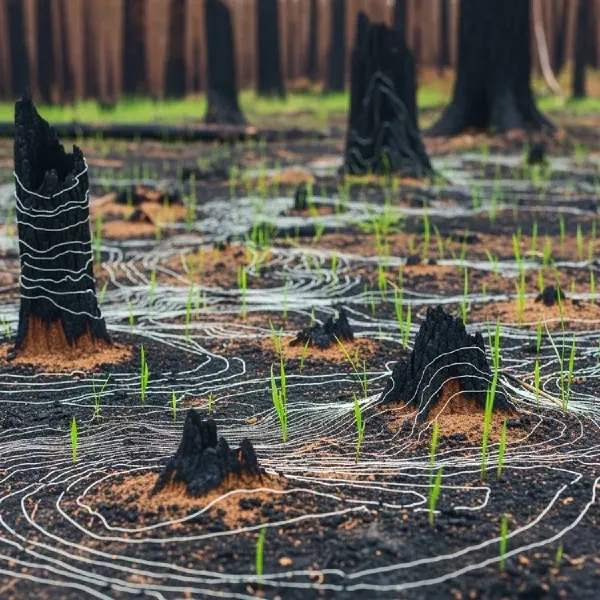
Termite mounds reveal another emergent mechanism: stigmergy. Biologist Pierre-Paul Grassé first described this in 1959: individuals modify environment, and modifications influence subsequent behavior. A termite deposits mud pellet with pheromones. Scent attracts others to deposit nearby. Gradually, pillars form, then arches, then complex chambers. The blueprint exists in environment itself, constantly updated through collective action.
Human systems increasingly use digital stigmergy. Wikipedia articles improve through incremental edits guiding subsequent editors. Open-source software evolves through code commits others extend. Google’s PageRank treats links as votes determining page importance. Each coordinates distributed contributions without central control by making past work visible and building upon it.
Physical stigmergy appears in urban environments. “Desire paths” worn across lawns show where people actually walk, often more efficient than designed sidewalks. These informal paths eventually get paved, formalizing emergent intelligence. Tokyo’s subway map emerged from station locations determined by passenger flow rather than geometric planning. Like ant trails optimizing through pheromone accumulation, these systems improve through use rather than planning.
The Intelligence of Swarms#
Honeybee swarms demonstrate remarkable collective decision-making. When colony needs new home, scout bees search, then perform waggle dances indicating location quality. More vigorous dances attract more scouts to check promising sites. Through positive feedback, colony converges on best option without any bee comparing all alternatives. Biologist Thomas Seeley calls this “swarm intelligence”—collective ability solving problems beyond individual capability.
Human organizations typically rely on hierarchical decision-making: information flows up, decisions flow down. This creates bottlenecks, distortion, and slow response. Some adopt swarm-like approaches. Valve Software’s flat structure allows employees to choose projects based on interest, forming temporary teams dissolving when work completes. The handbook states: “Nobody ‘reports to’ anybody else.” Projects emerge organically like bee scouts converging.
Digital platforms enable new swarm intelligence. GitHub coordinates millions through forking, merging, and pull requests—distributed version control allowing parallel experimentation with convergence. Foldit gamifies protein folding, allowing players to solve structures stumping supercomputers. These don’t direct work but create conditions for effective self-organization.
The insight: swarms work best for problems with multiple possible solutions where parallel exploration pays. For routine tasks with known solutions, hierarchies may be more efficient. But for innovation and complex problem-solving, distributed intelligence outperforms centralized control—a lesson biology learned through evolutionary competition.
Swarms achieve resilience through systems theorist Yaneer Bar-Yam’s “functional redundancy.” If one bee dies, others perform its role. If part of ant trail destroyed, ants find alternatives. No single point of failure because capacity distributed across similar elements. This contrasts engineered systems eliminating redundancy for efficiency, creating vulnerability.
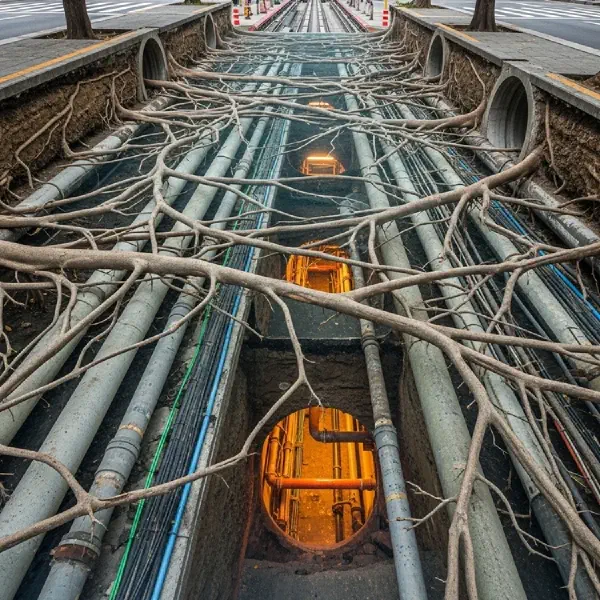
Human infrastructure adopts swarm-like redundancy. The Internet’s original design distributed routing across multiple paths so damage to any node wouldn’t collapse network. Mesh networks create distributed connectivity. Microgrids allow neighborhoods operating independently if main grid fails. Each sacrifices some efficiency for greater resilience—like biological systems maintaining excess capacity.
Ant colonies scale from dozens to millions without restructuring. Same simple rules—follow pheromone trails, respond to local encounters—work at all scales because based on local interactions rather than global coordination. This scalability through decentralization contrasts human organizations adding management layers as they grow, creating bureaucracy and delays.
Digital networks demonstrate similar scalability. Bitcoin processes transactions without central authority through blockchain consensus. The World Wide Web grew from one page to over 1.7 billion without central planning. These scale because based on protocols (rules for interaction) rather than control structures.
Some companies maintain startup-like agility at scale through decentralized models. Haier’s “rendanheyi” replaces hierarchical departments self-organizing micro-enterprises responding directly customer needs. Model sacrifices some economies scale faster adaptation. Similarly, Spotify’s “squad” organizes missions rather functions, squads autonomy achieving objectives. These prioritize responsiveness over efficiency.
Designing for Emergence#
Gardeners don’t build plants; they create conditions—soil, water, sunlight—allowing plants to grow themselves. Emergent design follows similar logic: create conditions for desired outcomes rather than specifying outcomes directly. Barcelona superblocks illustrate this. Rather than designing complete street transformations, city closes certain blocks to through traffic, then lets residents adapt new spaces. Some become playgrounds, others cafés, others gardens—uses emerge from local needs rather than planning.
This conditions-based approach requires humility about prediction. Complex systems often produce unintended consequences—positive and negative. New York’s High Line park sparked gentrification displacing communities it meant to serve. Designers focused on physical structure without considering economic interactions. Emergent design acknowledges second-order effects by creating adaptable frameworks rather than fixed solutions.
Urban planning uses “strategic urbanism”—lightweight, temporary interventions testing possibilities before permanent investment. Parklets, pop-up bike lanes, tactical urbanism allow communities experimenting with public space uses. Like biological evolution’s trial and error, these test many variations quickly and cheaply, scaling what works and discarding what doesn’t.
In product design, platforms enable emergence. Apple’s App Store provides tools and distribution but doesn’t dictate what apps get created. The results—over 1.8 million apps addressing countless needs—could never have been centrally planned. Similarly, Arduino’s open-source hardware enables makers creating everything from art to scientific instruments. These succeed by empowering others rather than controlling outcomes.
Biological self-regulation depends on feedback loops: predator-prey cycles maintain balance, body temperature maintains homeostasis, plant growth responds to light. These create stability through continuous adjustment rather than fixed states.
Human designers can intentionally create loops. Dutch “self-explaining roads” use design elements (narrow lanes, brick surfaces, trees close to road) naturally slowing drivers without speed bumps. The system works through perception rather than enforcement—drivers feel they should go slow rather than being told. Like biological systems where structure influences behavior, road design creates its own regulation.
Digital systems excel at feedback loop design. Amazon’s recommendation creates positive loop: purchases influence recommendations influencing future purchases. While commercially effective, such loops create “filter bubbles” narrowing perspectives. Deliberate design can create balancing loops instead. The “Pol.is” platform for public discourse uses machine learning identifying consensus across diverse opinions, creating feedback broadening rather than narrowing.
The key is designing feedback leading to desired emergent properties. In organizations, “balanced scorecards” measuring multiple dimensions (financial, customer, internal, learning) prevent over-optimization on single metrics. In cities, “15-minute city” planning creates feedback between proximity and livability. These aren’t control mechanisms but conditioning mechanisms—like chemical gradients guiding embryonic development without determining exact cellular outcomes.
The weaver ant doesn’t know it’s building cathedral. It responds to local stimuli: leaf here, silk there, larva in jaws. Yet from simple responses emerges architectural marvel. Human designers might learn to sometimes step back—to create conditions rather than outcomes, design rules rather than blueprints, trust emergence rather than control. For in space between intention and emergence lies not chaos but different order—one building itself, adapting itself, achieving wisdom no single designer could blueprint.