
Key Takeaways
- Anisotropic Superiority: Wood's directional strength properties outperform homogeneous man-made materials in structural applications.
- Energy Management: Wood's ability to absorb and dissipate shock through deformation provides superior resilience compared to brittle alloys.
- Multi-Functional Design: A single piece of wood can simultaneously function as a beam, post, and spring due to its cellular architecture.
- Biological Optimization: Growth conditions and moisture content allow engineers to fine-tune wood's mechanical properties for specific applications.
- Engineering Blueprint: Nature's materials science offers innovative solutions for modern structural and automotive design challenges.
The Paradox of the Shattered Wheel#
In 1914, Samuel J. Record peer through a microscope at a small block of western hemlock, capturing a photomicrograph that revealed a complex world of early and late wood growth. To the naked eye, wood appears as a simple, solid material, yet at thirty-five times magnification, it reveals itself as a fibrous system of radial rays and tangential vertical beads. This structural complexity is not merely an aesthetic quirk of nature; it is the fundamental reason wood possesses mechanical properties that often baffle engineers accustomed to the predictable homogeneity of steel or iron. In the early 20th century, laboratory engineers conducted > [!NOTE]
80,000 tests to understand wood’s superior shock resistance to understand why a simple buggy spoke could withstand shocks that would shatter cast iron.
They observed that when a long column of wood is compressed endwise, it does not merely crush; it bends, creating a combination of stresses that engage the entire length of the fiber. This sidewise bending, or flexure, is a sophisticated response to external pressure that homogeneous man-made materials cannot replicate. Wood is an organic product of infinite variation in detail and design, allowing it to adapt to external forces in ways that rigid substances cannot. This inherent variability is not a defect but the cornerstone of its mechanical fitness.
By investigating the transition from horse-drawn carriages to early automotive structures, we uncover a material science lesson hidden in the forest. The buggy spoke paradox reveals that a material’s ultimate strength is often less important than its ability to manage energy. As we convert our understanding into modern technical units, the biological blueprint of wood emerges as a high-performance system perfectly suited for the kinetic demands of structural and automotive design.
The Thesis of Anisotropic Superiority#
Wood’s structural and automotive superiority stems from its anisotropic cellular architecture, which provides a strength-to-weight ratio and shock-absorption capacity that homogeneous man-made materials struggle to replicate. This biological blueprint allows wood to serve as a beam, a post, and a spring simultaneously, utilizing a directional intelligence that optimizes performance under compound stresses. By regulating growth conditions and moisture content, engineers can optimize these mechanical properties, proving that wood is a living technology rather than a passive raw material.
The Micro-Architecture of Stress and Density#
Wood is fundamentally a system of thick-walled cells and air-filled cavities that function as a biological scaffolding. The strength of any given piece is found in these cell walls, not the cavities themselves. Because the actual wood substance is denser than water—possessing a relative density of approximately 1.55—the “lightness” of wood is actually a result of its sophisticated void-to-void geometry. This means a cubic meter of pure wood substance weighs > [!NOTE]
1,550 kg density of pure wood substance, yet a cubic meter of red spruce weighs only 410 kilograms because of its air-filled cells.
This cellular arrangement allows wood to balance stiffness and elasticity with a precision that synthetic processes often fail to achieve. The modulus of elasticity, a measure of stiffness, reaches values near > [!NOTE]
12,197 MPa modulus of elasticity for pignut hickory for species like pignut hickory. While steel possesses a much higher modulus of 206,842 MPa, wood’s lower density allows it to provide a scaffolding that is exceptionally efficient at resisting bending. Every stress applied to a wooden member produces a corresponding strain, a relationship governed by Hooke’s Law.
Within the elastic limit, wood stores potential energy that can be released upon the removal of stress, a property known as resilience. This energy storage is a hallmark of wood’s fitness for structural use, where it acts as a dynamic participant in a building’s equilibrium rather than a passive weight. The transition from early wood to late wood within a single growth ring further refines this system. Late wood cells are thick-walled and dense, providing the primary structural support, while early wood cells are more open-textured, allowing for fluid transport.
Anisotropy and the Kinetic Performance of Automotive Components#
Unlike man-made alloys that exhibit similar properties in all directions, wood is anisotropic, meaning its strength depends entirely on the direction of the grain. It exhibits its greatest strength in tension parallel to the grain, where it requires 220.6 MPa of pull to tear the fibers of a pignut hickory block. In contrast, that same block will crush endwise at only 58.6 MPa, revealing a tensile-to-compressive ratio of nearly 4-to-1. This directional intelligence is critical for automotive components like buggy spokes and wagon tongues.
Resistance to impact or shock is perhaps the most important mechanical property of wood in automotive use. This is measured by the work done on a piece at the instant the velocity of a striking body is removed. Wood handles these sudden jars through local deformation and the inertia of its own particles, acting as a biological shock absorber. In impact tests, where a 22.7-kilogram hammer is dropped from increasing heights, wood demonstrates a capacity for resilience that prevents the clean, sudden fractures typical of brittle materials.
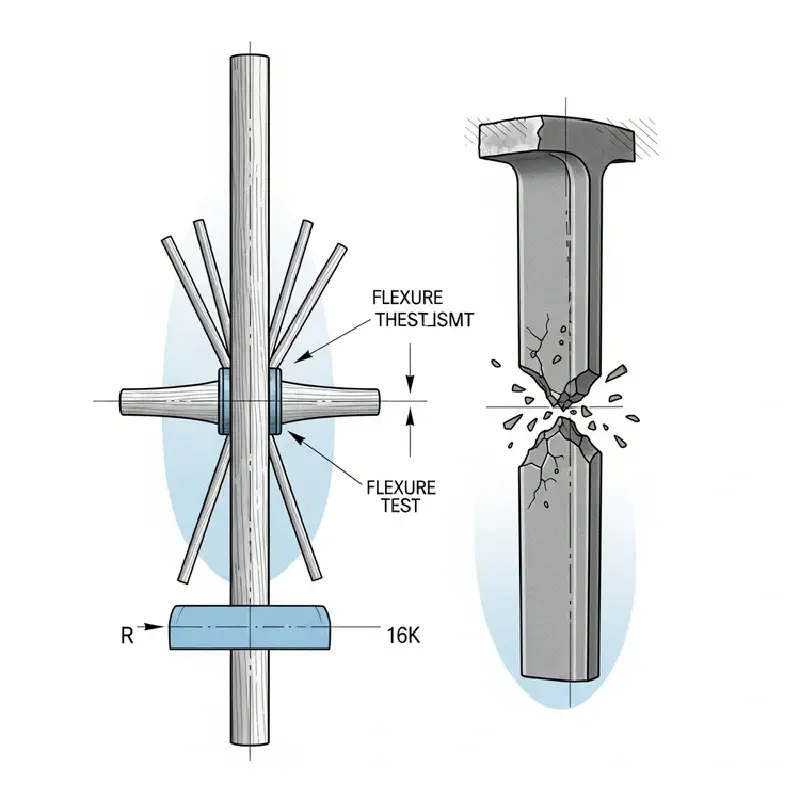
Furthermore, wood possesses a property of plasticity—increased by moisture and heat—that allows it to be steamed and bent into complex shapes. Steaming wood at 138 kilopascals (kPa) for several hours makes it incredibly pliable, allowing it to be molded into carriage shafts and wheel rims without destroying its internal cohesion. While a man-made beam might snap when its rigid limits are reached, a tough wooden beam fails gradually through “splintering tension,” providing visual and audible warning before total collapse.
The Cascade of Systemic Resilience in Large Structures#
The application of wood in large structural timbers introduces complex shearing stresses that must be managed to prevent failure. The weight carried by a beam tends to shear it off at right angles to the axis, but there is also a longitudinal shear tending to move the fibers past each other. This horizontal shear is maximum at the neutral plane and is often the primary cause of failure in large, air-seasoned beams. For instance, tests on green Douglas fir beams measuring 203 mm by 406 mm revealed that many fail by horizontal shear at approximately 1.85 MPa.
As wood seasons, its relationship with moisture dictates its structural integrity. Drying below the “fiber-saturation point”—the stage where free water in cell cavities is gone but cell walls remain saturated—triggers a dramatic increase in strength. A completely dry spruce block can support a permanent load four times greater than a green block of the same size. However, irregular drying can lead to “case-hardening,” where the outer shell dries faster than the interior, causing internal “honey-combing” cracks that weaken the member.
To account for these biological variables, engineers apply a factor of safety between 6 and 10 for timber structures. This means that only 10% to 16% of the material’s ultimate strength is utilized in practice to ensure human safety. This conservative approach acknowledges that wood is a “living” structural element that responds to environmental humidity, a feature absent in rigid man-made alloys. By using S-shaped steel clamps to control season checking, engineers can maintain the cohesion of large timbers, extending the life of bridges and trestles for decades.