Key Takeaways
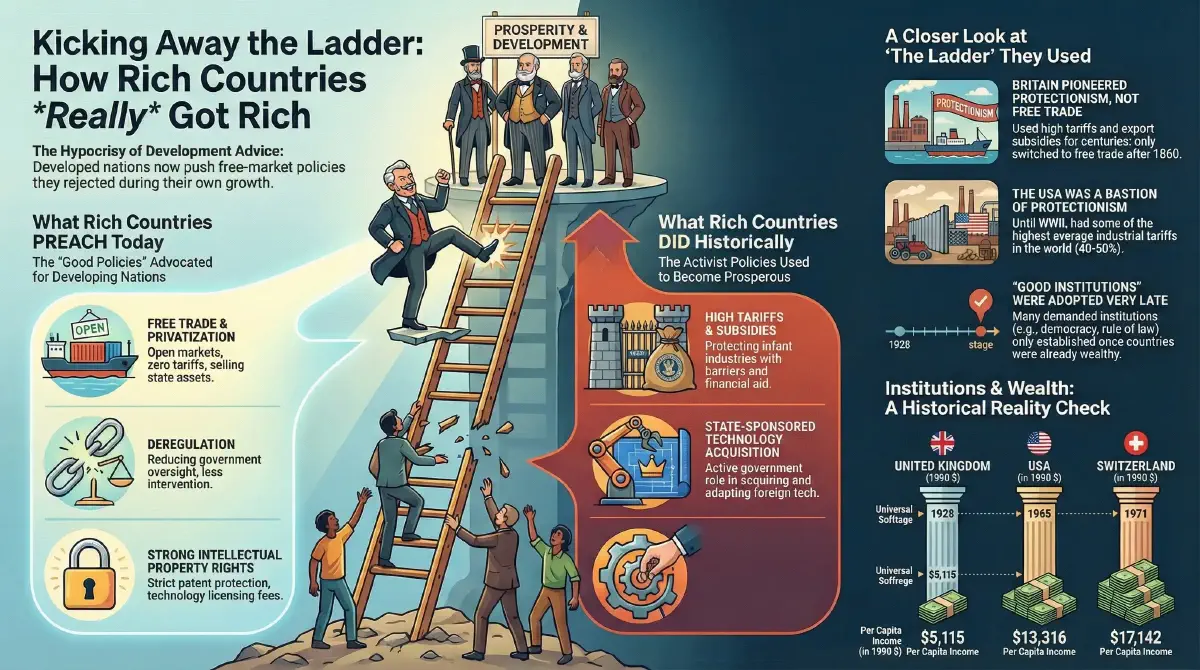
- Protectionism Over Free Trade: Rich nations achieved industrial dominance through high tariffs and protectionist policies, not the free trade they advocate today.
- State-Led Development: Successful industrialization required active state intervention, including subsidies, infrastructure, and technology transfer.
- Institutions Follow Wealth: Good governance and property rights evolved as a result of economic progress, not as prerequisites.
- Intellectual Property Violations: Early developers routinely ignored or violated IPR to acquire technology, only enforcing it once they became leaders.
- Reclaiming Policy Space: Developing nations should learn from historical strategies rather than following ahistorical advice.
The Prosperity Paradox: A Tale of Two Histories#
In the modern discourse on economic development, a powerful consensus prevails. Developing nations are told, with unwavering certainty, that the path to prosperity is paved with a specific set of ‘good policies’ and ‘good institutions’. This package, often associated with the “Washington Consensus,” prescribes a familiar formula: free trade, deregulation, privatization, and the adoption of Western-style institutions like democracy and strongly protected private property rights. The message is clear: to become rich, developing countries must adopt the policies and institutions that the developed world currently has.
This advice, however, prompts a crucial and often unasked question. As economist Ha-Joon Chang puts it, the fundamental inquiry should be: “How did the rich countries really become rich?” Did they, during their own developmental phases, practice what they now preach? Did the United States, Great Britain, and Germany climb to economic preeminence using the free-market, free-trade ladder they now offer to the rest of the world?
This article investigates that very question. By examining the historical record, we can determine whether the path taken by today’s developed countries aligns with the advice they now dispense. In doing so, we uncover a profound and unsettling paradox—a tale of two histories. One is the official, sanitized version told to developing nations; the other is the inconvenient, messy, and far more interventionist truth of how wealth was actually built.
The Great Unraveling: Deconstructing the Myth of Free Trade#
The foundational myth of modern capitalism is that today’s economic superpowers achieved their status through a steadfast commitment to free trade and laissez-faire policy. The historical evidence, however, tells an entirely different story. A closer look at the two titans of this narrative—Britain and the United States—reveals that their ascent was achieved behind formidable walls of protectionism and state intervention.
Our story begins with Britain, the supposed originator of free-market economics. Far from being a bastion of laissez-faire, Britain has a long history of aggressive state intervention to promote its industries. In his 1728 book, A Plan of the English Commerce, the celebrated author Daniel Defoe detailed how Tudor monarchs like Henry VII and Elizabeth I used policies such as poaching skilled workers from the Low Countries and banning the export of raw wool to transform England into the world’s dominant wool-manufacturing nation. This activist stance was formalized in 1721 by Robert Walpole, Britain’s first Prime Minister, who declared a new focus for the nation’s commercial policy: ‘it is evident that nothing so much contributes to promote the public well-being as the exportation of manufactured goods and the importation of foreign raw material’. Britain only pivoted to free trade in the mid-19th century > [!NOTE]
1846 Year Britain repealed Corn Laws, marking shift to free trade, a highly controlled process overseen by the state, and only after its technological dominance was absolute. Britain’s industrial lead was achieved, in the words of one historian, ‘behind high and long-lasting tariff barriers’.
Across the Atlantic, the United States offers an even more striking contradiction to the free-trade myth. Economic historian Paul Bairoch famously called the USA ’the mother country and bastion of modern protectionism’. From 1816 until the end of the Second World War > [!NOTE]
1816-1945 Period of US protectionism, protectionism was a central pillar of American economic policy. The American Civil War is rightly seen as a conflict rooted in slavery; however, the North’s motivation to fight was primarily to preserve the Union, a Union that was itself fractured by deep economic divisions, most notably over tariffs. The industrial North, seeking to protect its nascent industries from British competition, advocated for high tariffs, while the agrarian South, which depended on exporting raw materials, opposed them. It is telling that the USA’s two best 20-year periods of per capita GDP growth, 1870-1890 and 1890-1910, coincided with eras of its highest tariff barriers.
When its industrial supremacy became absolutely clear after the Second World War, the USA was no different from nineteenth-century Britain in promoting free trade, despite the fact that it acquired such supremacy through the nationalistic use of heavy protectionism.
The Architect’s Hand: The Activist State in Action#
The historical toolkit for development extended far beyond trade policy. A survey of other successful nations reveals a consistent pattern of the state acting as a strategic architect, proactively shaping industrial destiny rather than leaving it to the whims of the market. This activist approach was a common thread running through the development stories of Europe’s and Asia’s most successful late developers.
The Prussian/German model, for instance, was built on state-led industrial promotion. Beginning with Frederick the Great, the Prussian state used a variety of tools to nurture key industries like textiles and metals, including granting monopolies, providing subsidies, and systematically poaching skilled workers from abroad. The state also established “model factories” to introduce new technologies and supported industrial espionage to acquire advanced British techniques, such as the coke furnace and steam engine. This direct state involvement compensated for a lack of private entrepreneurial capacity and laid the groundwork for Germany’s industrial might.
While Prussia relied on direct state control of ‘model factories,’ Sweden pioneered a different but equally interventionist model built on deep public-private cooperation. The state was deeply involved in building critical infrastructure, such as the national railway and telegraph networks. This long-term technical collaboration with state-owned enterprises was instrumental in helping private firms like Ericsson (telephones) and ASEA (electrical engineering) grow into world-class competitors.
Japan, facing even greater external constraints due to ‘unequal treaties’ that limited its use of tariffs, was forced to innovate, developing a unique toolkit of state intervention after the Meiji Restoration in 1868. It established state-owned “pilot plants” to pioneer modern production in industries like shipbuilding and textiles, which were later sold to the private sector. The government heavily subsidized key sectors, invested in infrastructure and education to accelerate technology transfer, and hired hundreds of foreign technical advisers.
From Berlin to Stockholm to Tokyo, the story is the same: successful industrialization was not an accident of the free market. It was the result of a deliberate, state-driven strategy to build the technological and manufacturing capabilities necessary to compete on the world stage.
An Inconvenient Past: The Slow March of ‘Good Governance’#
Just as the economic policies of today’s rich countries looked radically different during their development, so too did their institutions. The “global standard” of good governance now demanded of developing nations—robust democracy, professional bureaucracy, and strong property rights—was conspicuously absent in the West during its own industrial ascent.
The myth of early democracy quickly evaporates under scrutiny. When today’s developed countries were industrializing, suffrage was severely restricted by property ownership, gender, and race. Universal suffrage was achieved at much higher levels of per capita income than in most developing countries today. Furthermore, early elections were hardly models of good governance; they were frequently characterized by open corruption, vote-buying, intimidation, and the absence of the secret ballot.
Similarly, the ideal of a professional, merit-based bureaucracy is a relatively recent invention. For much of their history, the bureaucracies in today’s rich countries were anything but. The open sale of public offices was common practice in Europe. In the United States, the “spoils system”—where government jobs were handed out to political loyalists—dominated for most of the 19th century, with the first meaningful civil service reforms only beginning in 1883. Legislative corruption got so bad that the future president Theodore Roosevelt lamented that the New York assemblymen ‘had the same idea about Public Life and Civil Service that a vulture has of a dead sheep’.
Even the evolution of property rights, particularly intellectual property, followed a path of convenience. Countries like the Netherlands and Switzerland developed successfully for long periods without patent laws at all. The hypocrisy is most striking in the case of the United States. Today, it is the world’s leading proponent of strong intellectual property rights, yet it did not fully conform to the Berne Convention on international copyright until 1988 > [!NOTE]
1988 Year US joined Berne Convention for copyright—more than a century after it was established. For most of its history as a developing nation and beyond, the US was a routine violator of international intellectual property rights, only becoming a champion of them once it was the world’s undisputed technological leader. The institutions of “good governance” were not prerequisites for development; rather, they evolved slowly, messily, and often emerged as a consequence of economic progress, not as a cause.
Conclusion: Reclaiming the Ladder#
To survey the economic history of the West is to witness a profound disconnect between the official narrative of capitalism and the actual historical record. The story sold to the developing world—one of free markets, minimal government, and instant good governance—is a fiction. The developed nations of today forged their prosperity using the very tools they now seek to outlaw, from infant industry protection and subsidies to industrial espionage and lax intellectual property enforcement. They climbed the ladder of development, then kicked it away for those trying to follow.
This historical amnesia has direct and damaging consequences for developing countries today. The pressure to adopt “global standard” policies and institutions in a compressed timeframe is not only ahistorical but actively counter-productive. It denies poorer countries the very policy space that rich countries exploited to become rich. It forces them into a developmental straitjacket, demanding they run before they have learned to walk and condemning them for failing to achieve what their advisers never had to.
A more honest and pragmatic engagement with history is therefore essential. For developing nations seeking a path to prosperity, the most valuable lesson may not come from the contemporary advice of the rich, but from their past actions. History teaches that there is no single, universal formula for economic development. Instead, it reveals a diversity of successful strategies, each tailored to a nation’s specific circumstances and ambitions. Reclaiming that history is the first step toward building a more prosperous and equitable future.