Key Takeaways
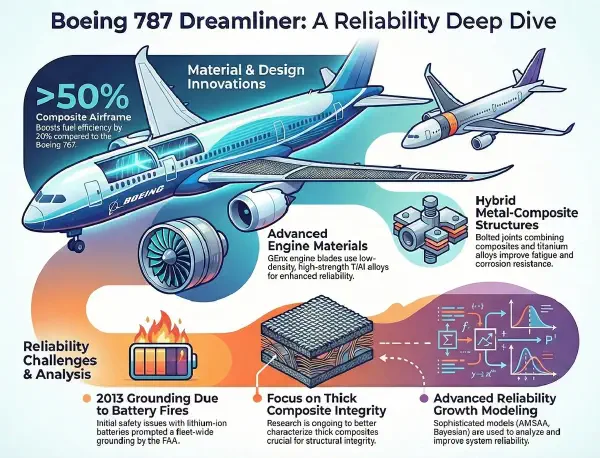
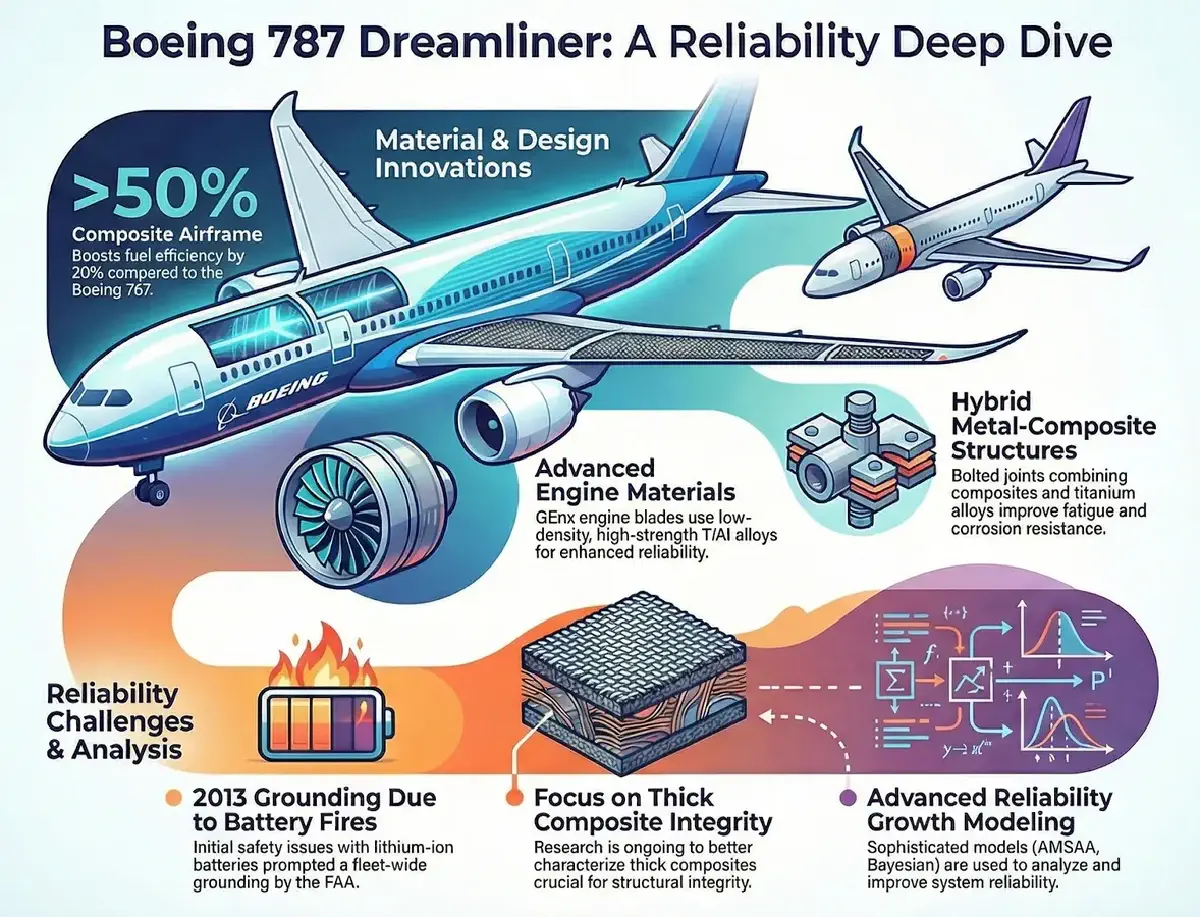
- Grounding Crisis: The entire Boeing 787 Dreamliner fleet was grounded in 2013 due to lithium-ion battery fires, highlighting the challenges of integrating new technologies in aviation.
- Composite Revolution: Over 50% of the Dreamliner's airframe is made from composite materials, significantly reducing weight and improving fuel efficiency.
- Thick Composites Challenge: The use of thick composite materials (>30mm) in structural components required new engineering methods and standards, as traditional aerospace design focused on thin composites.
- Micro-Engineered Turbine Blades: The Dreamliner's GEnx engines feature lamellar TiAl alloy turbine blades with precisely aligned microscopic layers for enhanced strength and damage tolerance.
- Hybrid Material Design: The Dreamliner employs a strategic combination of composites and metals in its structure, optimizing performance through hybrid design rather than relying solely on one material type.
50%+ The Boeing 787 Dreamliner: Revolutionary aircraft with 20% fuel efficiency gain and a remarkable grounded fleet recovery story.
Introduction: The Aircraft We Thought We Knew#
For millions of travelers, the Boeing 787 Dreamliner is a familiar part of the modern marvel of air travel—a sleek, quiet vessel that connects continents. We see it as an advanced mode of transport, but it’s easy to overlook the complex story of its creation and the revolutionary engineering hidden just beneath its skin.
Beneath its familiar exterior, the Dreamliner represents a case study in the immense rewards and inherent risks of aerospace innovation. It is a testament to a fundamental shift in how aircraft are designed, built, and operated, defined by both groundbreaking technologies and hard-won lessons.
This article will uncover five of the most surprising and impactful facts about the Dreamliner’s design, materials, and the challenging journey to make it one of the most advanced planes in the sky.
1. A Revolutionary Plane… That Was Grounded#
The Grounding of the Dream Fleet#
When the Boeing 787 Dreamliner was introduced in 2011, it was hailed as a revolutionary leap forward. However, it soon faced significant reliability issues. The most serious of these were safety problems related to its advanced lithium-ion batteries, which in some cases led to onboard fires.
The issue became so critical that in 2013, the U.S. Federal Aviation Administration (FAA) took the dramatic step of grounding the entire global fleet. This was a crucial, humbling lesson in aerospace engineering. The high-profile failure proved that even the most advanced designs can be sidelined by a single component and created a new industry-wide imperative for the rigorous validation of novel components, especially within aircraft power systems.
2. It’s More Composite Than Metal#
A Shift in Aircraft DNA#
One of the most defining features of the Dreamliner is its radical departure from traditional metal construction. Over 50% of the Dreamliner’s airframe is constructed from composite materials, primarily carbon fiber reinforced polymer (CFRP). This includes major structural components like the entire fuselage, the wings, and the tail.
This wholesale shift in material science yields a cascade of operational and environmental benefits, fundamentally altering the economic equation of long-haul flight. It resulted in a 20% improvement in fuel efficiency compared to older models like the Boeing 767, leading to reduced emissions and a lower acoustic impact. Furthermore, these composite structures offer exceptional stiffness, impact strength, and a high resistance to corrosion. Crucially, the innovation extended beyond performance, as the use of large composite sections also streamlined the fabrication and assembly of these complex structures.
3. Building with New Materials Created New Challenges#
Pioneering Comes with Problems#
The extensive use of composites was not a simple upgrade; it pushed engineering into uncharted territory. The Dreamliner features composite parts, such as structural lugs, with thicknesses exceeding 30 mm. This created a new kind of engineering problem.
Historically, aerospace design standards and material analysis were focused on thin composite applications. The Dreamliner’s use of thick composites required entirely new research and development to properly characterize the material properties and ensure the structural integrity of these critical components. This highlights a key aspect of technological progress: pioneering a new method often means you have to write the rulebook and solve problems that didn’t exist before.
4. The Hidden Genius is in the Engine Blades#
Engineering on a Microscopic Scale#
The genius of the Dreamliner exists at two opposite extremes: the macro level of its enormous composite fuselage and the microscopic level of components hidden deep inside its GEnx engines. The low-pressure turbine blades, for instance, are fabricated from an advanced material known as lamellar TiAl (titanium-aluminide) alloy, chosen for its low density and excellent performance at high temperatures.
But the real secret lies in how the material is structured. During fabrication, the material’s internal microscopic layers, or lamellae, are precisely aligned parallel to the radial direction of the blade. This specific alignment is the key to providing a superior combination of strength and damage tolerance under stress, preventing microscopic fractures from forming. It is a perfect example of how micro-level engineering, completely invisible to passengers, is absolutely critical for the safety and performance of the aircraft.
5. It’s Not Just a Machine, It’s a Hybrid Structure#
The Best of Both Worlds#
While the Dreamliner is famous for its composites, it is not an “all-composite” plane. The very challenges of working with thick composites (as noted earlier) informed a more sophisticated design philosophy: the use of hybrid structures that strategically combine composites with metallic materials like titanium alloys.
Engineers realized that instead of forcing composites to do every job, the optimal solution was an intelligent integration of materials. These hybrid structures are engineered to improve fatigue strength and corrosion resistance in key areas. Bolted joints connecting these different materials are critical elements for ensuring the plane’s safety, reliability, and load-carrying capability. This approach shows that modern aerospace engineering isn’t about choosing one “best” material, but about expertly blending different materials where their specific properties are most needed.
Conclusion: A Continuous Journey of Innovation#
The journey of the 787 Dreamliner demonstrates a crucial truth of modern engineering: innovation is not a single breakthrough, but a cascading process of action and reaction. The dramatic battery failure was an action that forced a reaction—a renewed, industry-wide focus on the reliability of new technologies. The revolutionary leap to composites was an action that created a reaction—new structural challenges with thick materials. And those challenges, in turn, were an action that prompted a final reaction—the sophisticated blending of materials in hybrid structures.
Ultimately, the Dreamliner is not just a finished product but a testament to a continuous process of learning, adaptation, and refinement driven by materials science and data analysis.
As new materials and data-driven insights continue to emerge, what new levels of efficiency and safety will the next generation of aircraft achieve?
References#
- PANDIAN G., PECHT M., ZIO E., HODKIEWICZ M. (2020). Data-driven reliability analysis of Boeing 787 Dreamliner. Chinese Journal of Aeronautics, 33. https://doi.org/10.1016/j.cja.2020.02.003
- Giurgiutiu V. (2022). Introduction. Stress, Vibration, and Wave Analysis in Aerospace Composites. https://doi.org/10.1016/B978-0-12-813308-8.00006-5
- Lee H., Hwang H. (2025). Validation of periodic microstructure micromechanics (PMM) as a material characterization tool for through-thickness properties of glass NCF/polymer matrix composites. Materials Today Communications, 44. https://doi.org/10.1016/j.mtcomm.2025.112085
- Benito A. (2018). Aircraft design. Energy Efficiency in Air Transportation. https://doi.org/10.1016/B978-0-12-5816.00004-1
- Oladele I., Onuh L., Taiwo A., Adelani S., Orisawayi A. (2025). Crash-proof and sustainable polymer-based composites in modern day transportation systems: A review on fabrication of lightweight components for land, sea and air travels. Next Materials, 9. https://doi.org/10.1016/j.nxmate.2025.101218
- Swornowski P. (2017). Destruction mechanism of the internal structure in Lithium-ion batteries used in aviation industry. Energy, 122. https://doi.org/10.1016/j.energy.2017.01.121
- LIN K., CHEN Y. (2021). Two new multi-phase reliability growth models from the perspective of time between failures and their applications. Chinese Journal of Aeronautics, 34. https://doi.org/10.1016/j.cja.2020.12.017
- Mccarville D. (2012). Intellectual property, patents and innovation in aeronautics. Innovation in Aeronautics. https://doi.org/10.1533/9780857096098.3.263
- Puttegowda M. (2025). Durability and performance of fiber-reinforced polymer composites. Fiber-Reinforced Polymer Composites. https://doi.org/10.1016/B978-0-443-27546-3.00004-2
- Retouniotis A., Papadopoulos Y., Sorokos I. (2025). Andromeda: A model-connected framework for safety assessment and assurance. Journal of Systems and Software, 220. https://doi.org/10.1016/j.jss.2024.112256
- Cao Y., Zuo D., Zhao Y., Cao Z., Zhi J., Zheng G., Tay T. (2021). Experimental investigation on bearing behavior and failure mechanism of double-lap thin-ply composite bolted joints. Composite Structures, 261. https://doi.org/10.1016/j.compstruct.2021.113565