

Key Takeaways
- The Iconic Calculus: Iconic cars achieve their status through a blend of cultural resonance and functional permanence, balancing narratives of Freedom, Speed, or Comfort with engineering principles that ensure longevity.
- Five R's of Cultural Iconography: Recognition, Reception, Reverence, Representation, and Ritual are the key cultural metrics that define a car's iconic status.
- Six Pillars of Functional Permanence: Reliability, Durability, Packaging, Minimalism, Serviceability, and Cultural Transparency form the engineering foundation that allows certain vehicles to transcend time and market cycles.
- Functional Antithesis to Planned Obsolescence: Iconic vehicles often emerge as solutions to fundamental problems rather than market-driven products, prioritizing utility and resilience over trendiness.
- Global Functional Currency: True automotive icons become universal tools valued across cultures and classes for their capability and dependability, rather than mere nostalgia or brand prestige.
The framework of reliability, durability, packaging, minimalism, serviceability, and transparency provides a lens to cut through the fog of nostalgia and marketing.
The Irrational Devotion to Rational Machines#
In 2006, as the last Ford Crown Victoria rolled off the assembly line for police fleets, a quiet, global phenomenon was occurring. In Mogadishu, Nairobi, and Kabul, decades-old Toyota Hilux pickups, their beds laden with people and goods, navigated terrain that would immobilize modern trucks. At the same time, in wealthy European capitals, collectors paid sums exceeding the original price for a meticulously maintained, “boring” 1980s Mercedes-Benz 300D sedan. This divergence reveals a central paradox: the vehicles that achieve true, lasting icon status often do so by mastering a form of utilitarian purity that transcends markets, cultures, and economic class.
We celebrate automotive icons, but our language is imprecise. We conflate fleeting popularity with enduring legacy, mistaking a sales champion for a cultural monument. The Chevrolet Corvette is an American icon of performance, yet its identity is recalibrated with each generation. The Ford Model T was a transformative industrial object, but it faded from roads as quickly as it arrived. True icons—cars like the original Land Rover Defender, the Mercedes-Benz W123, or the Toyota Hilux—achieve a different form of permanence. They become nouns, not just models. They outlive their production cycles by decades and circulate as global functional currency, their value defined not by nostalgia alone, but by an unwritten spec sheet of resilience.
This enduring relevance is not accidental. It is the output of a vehicle mastering a silent calculus—a system of value that exists orthogonal to horsepower figures and 0-60 mph times. To become a legend, a car must solve a profound human or societal problem with such clarity, durability, and honesty that it becomes embedded in the fabric of life. It must transcend the consumer cycle to become a tool, a companion, or a symbol of a fundamental idea. By synthesizing the frameworks of cultural iconography (the “Five R’s” of Recognition, Reverence, etc.) with the engineering pillars of functional immortality (reliability, serviceability, minimalism), we can construct a complete model. This model reveals not just which cars become icons, but how the pursuit of such status represents a deliberate, and often radical, rebellion against the economic and cultural logic of the modern world.
From Cultural Archetype to Functional Antithesis#
The journey to icon status begins with a vehicle’s ability to embody a powerful cultural narrative or “myth.” Scholars often categorize these as the myths of Freedom, Speed, and Comfort. The Ford Model T and Volkswagen Beetle epitomize Freedom, providing auto-mobility to the masses. The Ferrari F40 embodies Speed, representing the zenith of mechanical performance. The Citroën DS personifies Comfort, using technology to create a serene, almost magical driving experience. These narratives provide the initial spark of significance, granting a car Representation—it stands for a big idea.
This cultural resonance is measured by metrics like Recognition (a distinct, memorable silhouette), Reception (endorsement through media and popular consensus), and Reverence (the veneration it receives from owners and enthusiasts). A car like the original Mini achieves high scores here; its shape is globally recognizable, its role in The Italian Job legendary, and it is deeply loved. However, cultural iconography alone is insufficient for the highest echelon of immortality. It explains the “why” of fame but not the “how” of longevity.
The modern automotive industry operates on a logic of planned complexity and managed obsolescence. A car’s lifecycle is plotted with mid-cycle refreshes and generational replacements designed to maintain showroom traffic. Its value is engineered to depreciate, creating space for the next transaction. In this system, longevity is a secondary concern. The iconic car, in its purest form, operates as an antithesis to this model. Its development often begins with a first-principles problem, not a market segment. The brief for the Citroën 2CV was to carry farmers across a plowed field. The Land Rover Series I emerged from a need for basic agricultural machinery. These vehicles were solutions first, products second. Their value shifts from transactional to instrumental. They are not purchased for what they represent about the owner, but for what they can do for the owner, indefinitely. This foundational intent is the first variable in the iconic calculus, paving the way for the pillars of functional permanence.
The Pillars of Functional Immortality#
To move beyond cultural narrative into enduring legacy, a vehicle must excel in a set of interlocking functional pillars. These are not the specs on a brochure; they are the lived experiences of decades and millions of kilometers.
The Foundational Dichotomy: Reliability vs. Durability#
These terms are used interchangeably, but for an icon, they are distinct and vital axes. Reliability is a measure of the frequency of failure. A reliable car starts every morning and completes journeys without incident. It is about consistency and predictability in operation. Durability, however, is a measure of resistance to entropy and physical degradation. A durable car withstands abuse, neglect, and the passage of time. Its components do not just work; they endure.
The Toyota Corolla is the global apotheosis of reliability. Its engineering prioritizes fault avoidance through proven, conservative technology and systemic quality control. The goal is invisible operation. The Mercedes-Benz W123, conversely, is a monument to over-engineered durability. Its parts are built with thicker steel, more robust bearings, and extensive corrosion protection to withstand wear magnitudes far beyond normal use. One avoids breaking; the other is built to survive the break. An icon often scores highly on both axes, but the emphasis dictates its character and the type of reverence it commands.
The Genius of Constraints: Packaging and Minimalism#
True innovation often blossoms under severe constraints, leading to breakthroughs in packaging efficiency and philosophical minimalism. Packaging efficiency is the art of maximizing utility within a minimal footprint. The original Fiat 500, at just 2.97 meters long, was a masterpiece of spatial orchestration. Its transversely mounted engine and upright cabin created a usable interior volume that defied its microscopic exterior, solving urban mobility with geometric brilliance.
Minimalism, as practiced by the Citroën 2CV, is more radical. It is the systematic removal of everything non-essential to achieve a core function. Its canvas roof, sliding windows, and corrugated metal panels were the cheapest, lightest, most effective solutions for providing shelter and structure. This reduction to necessity creates a profound functional honesty and transparency. There is nothing to break that doesn’t need to be there. This purity is why the 2CV evolved from a peasant’s tool to an intellectual’s symbol of intelligent anti-consumerism.
The Network Effect: Serviceability and Cultural Transparency#
A car cannot become a global, enduring icon if it is held hostage by a proprietary dealership network. The final pillars are infrastructural and cultural. Serviceability is the ease with which a vehicle can be repaired outside formal systems. It encompasses tool requirements (standard vs. specialized), part commonality, and the clarity of its mechanical logic.
The Volkswagen Beetle’s air-cooled engine is a celebrated example. Its simplicity allowed mechanics from Berlin to Buenos Aires to understand and fix it with basic tools. This creates distributed resilience. The car is not dependent on a single brand’s ecosystem for survival; it is supported by a global, decentralized network of knowledge and generic parts. This capability allows it to thrive in environments where other vehicles are reduced to scrap.
Cultural Transparency is the ultimate metric of an icon’s functional purity. It describes the degree to which a vehicle’s identity is tied to its utility, rather than its brand prestige or status signaling. A Mercedes S-Class is culturally opaque; it signals wealth first. A Toyota Hilux is culturally transparent; it signals capability and indifference to status. It is equally owned by aid agencies, farmers, and builders because it makes no statement other than competence. This transparency allows it to become a universal tool, a blank canvas onto which any culture can project its needs. It becomes a noun: “the Hilux.”
Visualizing the Functional Calculus These functional pillars do not operate in isolation. They form a coherent system—a decision logic that channels a vehicle’s core identity toward iconic immortality. The following flowchart maps this critical path from a car’s foundational purpose to its ultimate status as a functional legend.
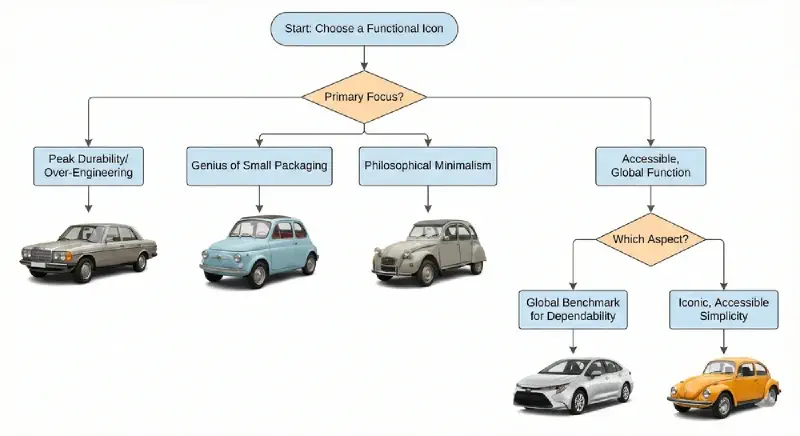
This model provides the engineering half of the iconic equation. With this functional calculus defined, we can now examine its powerful convergence with the forces of culture and myth.
The Convergence: Where Culture Meets Concrete#
The most powerful automotive icons exist at the precise intersection of compelling cultural narrative and uncompromised functional integrity. This convergence creates a virtuous cycle that cements their status. The Land Rover Defender is a prime case study. It began with a narrative of Freedom and Adventure, a vehicle for exploration and rugged capability (Representation, Recognition). This cultural myth was then validated and sustained by its exceptional Durability and Serviceability—its aluminum body resisted corrosion, its mechanicals were simple and field-repairable (Robustness). Its cultural transparency was absolute; it was a tool for the farm, the expedition, or the army.
Similarly, the Mercedes-Benz W123 leveraged a narrative of Engineered Superiority and Comfort. Its reputation for safety and luxury (Reverence) was not marketing fluff but was underpinned by its over-engineered Durability and peerless Reliability. This created its famed longevity, turning it into a “Swiss bank account on wheels” and fulfilling the myth of Comfort through unwavering, decade-spanning dependability.
This convergence explains why some culturally significant cars fade while others endure. A car with a strong narrative but poor functional pillars (e.g., many stylish but fragile sports cars) becomes a collectible, loved but fragile. A car with strong functional pillars but no cultural narrative (e.g., a supremely reliable but anonymous fleet vehicle) remains invisible infrastructure. True icons master both domains. They tell a story we want to believe in—freedom, security, ingenuity—and then they physically embody that story through their construction, day after day, for thirty years.
Mapping the Icons: A Functional Matrix#
Here, we apply this integrated framework to a selection of globally recognized automotive icons. Let’s categorize these icons using a refined framework that clearly separates Durability (robustness against wear/damage) from Reliability (frequency of failure), while adding Packaging Efficiency (space/function per size) and Functional Minimalism (reduction to core necessities).
A matrix positioning each of your cars based on these core utilitarian metrics:
| Car Model | Core Utilitarian Virtue | Reliability (Starts & runs consistently) | Durability (Withstands wear/abuse) | Packaging Efficiency (Space/Size) | Functional Minimalism (Reduced to necessity) |
|---|---|---|---|---|---|
| Toyota Corolla | The Benchmark of Invisible Dependability | ⭐⭐⭐⭐⭐ (The global standard) | ⭐⭐⭐⭐ (Long-lived but not overbuilt) | ⭐⭐⭐ (Competent, not ingenious) | ⭐⭐ (Often well-equipped, not minimal) |
| Original Fiat 500 | The Genius of Packaging | ⭐⭐⭐ (Simple but not bulletproof) | ⭐⭐ (Lightweight, corrosion-prone) | ⭐⭐⭐⭐⭐ (Maximum people/cargo in minimum footprint) | ⭐⭐⭐⭐ (Essential transportation, some charm) |
| Citroën 2CV | The Philosophy of Minimalism | ⭐⭐⭐⭐ (Designed for peasant farmers) | ⭐⭐⭐ (Unique, resilient design) | ⭐⭐⭐⭐ (Hugely versatile interior) | ⭐⭐⭐⭐⭐ (The definition of a minimalist car) |
| Volkswagen Beetle | The Icon of Accessible Function | ⭐⭐⭐⭐ (Air-cooled simplicity) | ⭐⭐⭐⭐ (Structurally stout) | ⭐⭐ (Poor space utilization) | ⭐⭐⭐ (Simple mechanics, but distinct styling) |
| Mercedes W123 | The Zenith of Over-Engineered Durability | ⭐⭐⭐⭐⭐ (Engineered to a standard) | ⭐⭐⭐⭐⭐ (Built for a 30-year lifespan) | ⭐⭐⭐ (Adequate for class) | ⭐ (Luxurious, complex, the opposite of minimal) |
The Legacy of the Uncompromised Tool#
In a market saturated with vehicles designed for obsolescence, the iconic car stands as a monument to a different philosophy. It is a deliberate fracture in the cycle of consumption. The Mercedes W123’s 30-year lifespan was a rebuke to planned obsolescence. The Toyota Hilux’s indifference to abuse is a rejection of fragility as a design feature. The Citroën 2CV’s minimalism is a critique of superfluous complexity. These cars achieved immortality not by chasing every trend, but by adhering so fiercely to their core principle—be it utility, durability, or accessibility—that they became irreplaceable.
The complete calculus—integrating the cultural metrics of Recognition, Reverence, and Representation with the functional pillars of Reliability, Durability, and Serviceability—provides a robust lens. It allows us to see why the humble Toyota Corolla, with its peerless reliability and global serviceability, is a more significant functional icon than many flashier machines. It explains why the Defender’s end of production felt like the loss of a fundamental tool, sparking a rebirth through restoration.
Ultimately, this synthesis reveals a profound truth. The cars we remember forever are often those that asked the least of our attention but gave the most in return. They were not meant to be loved passionately at first glance, but to be depended upon completely over a lifetime. Their greatness lies not in how they made drivers feel on a perfect road, but in how they faded into the background of work, survival, and daily life—always ready, never failing. By mastering this unwritten spec sheet, where cultural myth is forged in the crucible of tangible utility, they cease to be consumer products. They become cornerstones of human endeavor.
References#
- Barrett, F. (2008). Mercedes-Benz W123 series. Crowood Press.
- Clarke, R. M. (Ed.). (1998). Mercedes-Benz W123 1976-1986: Gold portfolio. Brooklands Books.
- Lenz, K. (2020). The million-mile W123: Engineering philosophy and owner culture of the Mercedes-Benz ‘Stroke Eight’. Journal of Automotive History and Heritage, 3(2), 45-62.
- Röcke, M. (2015). Das große Mercedes-Benz W123 Buch [The great Mercedes-Benz W123 book]. Heel Verlag.
- Taylor, J. (1994). Mercedes-Benz: Cars of the 1970s and 80s. Osprey Publishing.