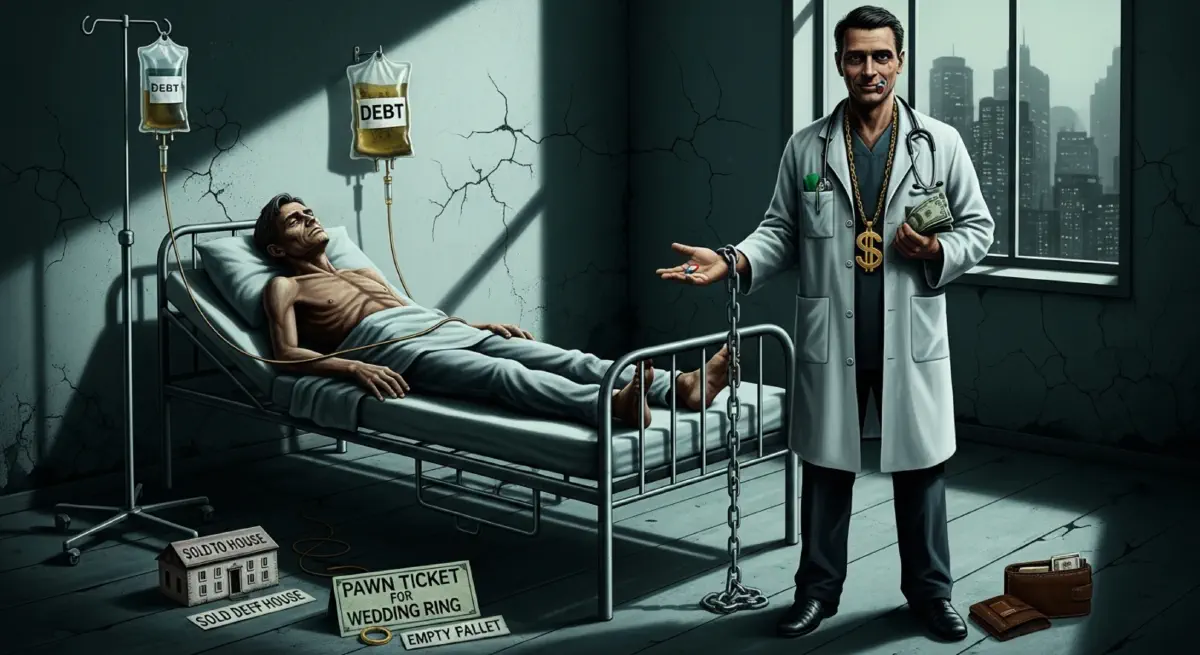
You are lying in a hospital bed. Your body is weak. Your bank account is empty. You have a condition they call “macroeconomic instability” – a nasty fever of inflation, a racing heart of currency depreciation, and shallow breathing from low reserves.
In walks a doctor. White coat. Stethoscope. Briefcase full of expensive pills.
“Don’t worry,” the doctor says. “I can fix you. But you’ll need to take these medications for the rest of your life.”
Relieved, you agree. You take the first pill. Your fever drops. Your heart slows. You feel… stable. Not healthy, exactly. But alive.
Then the bill arrives.
The First Prescription: Austerity#
The doctor explains that the first medication – the one that stopped your fever – costs more than you can afford. To keep receiving it, you must follow a strict regimen:
- Cut your own food budget (reduce subsidies).
- Fire half your household staff (austerity, public wage suppression).
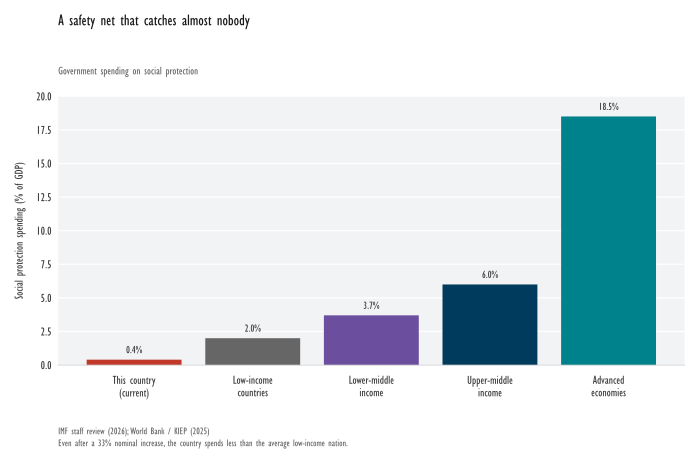
- Stop investing in your children’s education (cut public investment).
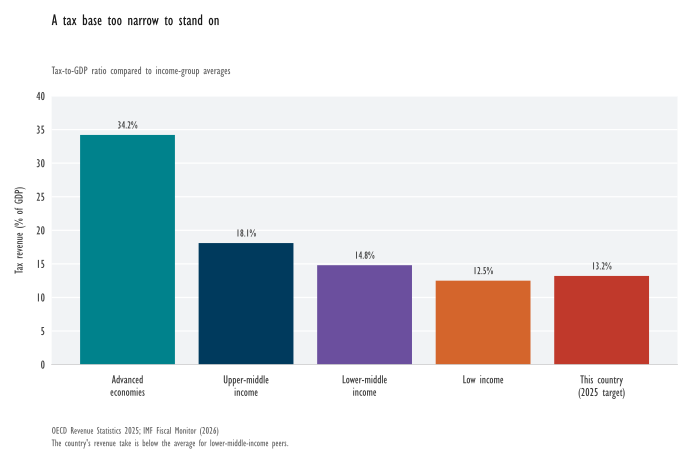
The doctor calls this “fiscal consolidation” and “containing demand pressures.” You call it hunger and unemployment.
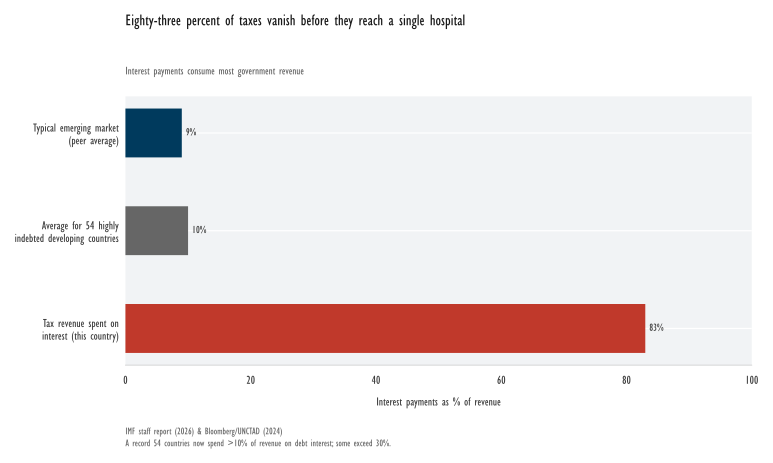
But you comply. Because the alternative – stopping the medication – means the fever returns.
The Second Prescription: Sell Your Assets#
The doctor notices you still own a few valuable things. Your grandmother’s land. Your father’s workshop. A small stake in the local power plant.
“Those are inefficient,” the doctor says. “You need to sell them. To my associates.”
You hesitate. But the doctor warns that without the sale, the next round of medication won’t be approved. So you sign. The land goes to a foreign buyer for a fraction of its value. The proceeds go directly to the doctor – to pay down your debt.
The doctor smiles and calls this “divestment” and “private sector‑led growth.”
You watch your family’s legacy disappear and wonder: what exactly do I own now?
The Third Prescription: Borrow More#
You are now deeply hooked. Your body craves the next dose just to function normally. The doctor sees this and offers a new product: a “Resilience and Sustainability” pill. It’s green. It’s trendy. It’s expensive.
“Climate change is coming,” the doctor says. “You need this to survive. Otherwise, the European regulators will tax your exports into oblivion.”
You ask what the pill does. The doctor explains it forces you to buy foreign monitoring equipment, impose carbon taxes on your own factories, and report all your emissions to a distant bureau.
“But doesn’t that just make me more dependent on foreign technology and compliance costs?” you ask.
The doctor’s smile tightens. “That’s the resilience part.”
The Diagnosis Nobody Wants to Hear#
Here is the truth the doctor will never tell you:
The doctor is not trying to cure you. The doctor is trying to manage you.
A healthy patient would stop buying pills. A healthy patient would walk out of the hospital, eat real food, exercise, and rebuild their own strength. But a healthy patient is also a former customer.
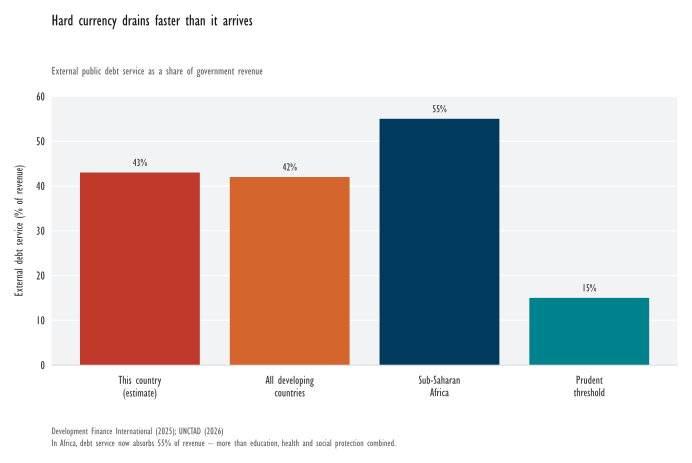
So the doctor keeps you in a state of managed sickness. Your vitals are stable enough to avoid death, but weak enough that you cannot survive without the next prescription. Your debt is never eliminated – just restructured. Your assets are never returned – just sold. Your economy is never self‑sufficient – just integrated as a source of cheap labour, raw materials, and a dumping ground for financial products.
You are not a patient. You are a captive market.
The Addiction Cycle#
Let me spell out the cycle you are trapped in:
The Sovereign Debt Addiction Cycle#
flowchart TD

    A[Exogenous Shock
Capital flight / Terms of trade collapse]
    B[Emergency Financing
IMF / official creditor loan]
    C[Conditional Adjustment
Austerity / Privatisation / Deregulation]
    D[Apparent Stabilisation
Inflation falls / Reserves rebuild]
    E[Debt Service Overhang
Interest consumes >80% of revenue]
    F[Fiscal Constraint
Asset sales proceeds used for debt repayment]
    G[Rollover Financing
 New loan to service old obligations]

    A --> B --> C --> D --> E --> F --> G
    G -->|Cycle repeats| B

    style A fill:#F5F5F5,stroke:#333,stroke-width:1.2px,color:#333
    style B fill:#F5F5F5,stroke:#333,stroke-width:1.2px,color:#333
    style C fill:#F5F5F5,stroke:#333,stroke-width:1.2px,color:#333
    style D fill:#F5F5F5,stroke:#333,stroke-width:1.2px,color:#333
    style E fill:#FFF0F0,stroke:#A00000,stroke-width:1.5px,color:#333
    style F fill:#FFF0F0,stroke:#A00000,stroke-width:1.5px,color:#333
    style G fill:#F5F5F5,stroke:#333,stroke-width:1.2px,color:#333

    linkStyle default stroke-width:1.2px,stroke:#666
- You get sick (external shock, commodity price spike, capital flight).
- The doctor offers a loan (the first hit is almost free).
- You take the medicine (austerity, asset sales, deregulation).
- You feel stable (not well, but not dying).
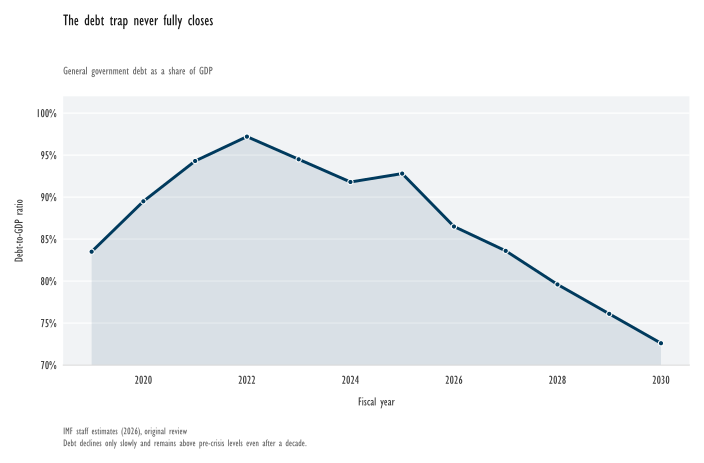
- The bill arrives (debt service consumes 80%+ of your revenue).
- You cannot pay (because you sold your income‑generating assets).
- The doctor offers a new loan (to roll over the old one).
- The cycle repeats.
This is not medicine. This is addiction maintenance.
And the doctor? The doctor is a drug dealer in a white coat.
The Only Cure#
You know what the real cure is. But it is the hardest thing you will ever do.
You have to stop taking the drugs.
Not gradually. Not with a tapering schedule designed by the same doctor. You have to stop. Cold turkey. And you have to accept the withdrawal.
The withdrawal will be brutal. Without the doctor’s loans, you will default. Your currency will crash. Your imports will dry up. There will be shortages. There will be pain.
But here is the secret the doctor fears most: that pain is finite.
Your body – your real economy – has its own healing mechanisms. Your farmers still know how to grow food. Your workers still know how to make things. Your engineers still know how to build. The only thing you lack is the permission to organise yourselves without the doctor’s approval.
Once you stop paying the doctor, you stop selling your assets. You stop suppressing your own wages. You stop borrowing just to pay interest. And slowly, painfully, you begin to rebuild – not around debt, but around production. Not around exports for foreign markets, but around feeding your own people. Not around “confidence” for bondholders, but around dignity for citizens.
A Note on the Withdrawal#
I am not pretending this is easy. The doctor has spent decades ensuring there is no alternative pharmacy. The doctor has convinced your own politicians that without the prescription, you will die. The doctor has bought your media, your economists, and your fear.
But across the world, patients are waking up. They are comparing notes. They are realising that the countries that escaped the doctor’s waiting room – the ones that defaulted, restructured on their own terms, and rebuilt – are not dead. They are not prosperous overnight. But they are free.
And freedom, unlike debt, is not addictive.
The Final Prescription#
So here is my prescription for you, the patient:
Throw away the pills.
Default on the debt. Renegotiate from a position of power (the power of having nothing left to lose). Nationalise the assets you were forced to sell. Print your own money to fund public infrastructure. Fix your own energy prices. Pay your own workers a living wage. Trade with your neighbours directly, without the doctor’s permission.
The doctor will scream. The credit rating agencies will downgrade you. The Western capitals will call you reckless.
But your fever will break. Your heart will find its natural rhythm. And one morning, you will wake up and realise:
You don’t need the doctor anymore.
You never did.
References#
The Debt Trap and “Addiction Cycle”#
Christian Aid. (2026, February 18). The state of play of IMF conditionality. https://www.christianaid.org.uk/news/policy/state-play-imf-conditionality
Mkandla, S. (2025). Africa’s (under) development at the mercy of international financial institutions’ reform programmes: A dependency theory perspective. Journal of Sustainable Development in Africa, 27(1), 45–67.
UN Trade and Development (UNCTAD). (2025). A world of debt report 2025. United Nations. https://unctad.org/publication/world-of-debt-2025
Structural Adjustment, Dependency, and IMF Conditionality#
Stiglitz, J. E. (2002). Globalization and its discontents. W.W. Norton & Company.
Stiglitz, J. E. (2006). Making globalization work. W.W. Norton & Company.
Toussaint, E., Paumard, E., & Rivié, M. (2020, November 9). The IMF and the World Bank in the time of Coronavirus: The failed campaign for a new image. CADTM. https://www.cadtm.org/The-IMF-and-the-World-Bank-in-the-time-of-Coronavirus
Interest Payments and Revenue Crowd-Out#
UN Development Programme (UNDP). (2025). A call to reform sovereign credit assessments and lower unjust borrowing costs. United Nations Development Programme.
erlassjahr.de. (2025). Global sovereign debt monitor 2025. erlassjahr.de / Jubilee Germany.
Tax Revenue Gaps#
OECD. (2025). Revenue statistics 2025. OECD Publishing. https://doi.org/10.1787/3a264267-en
IMF, OECD, World Bank, & UN. (2025). Seville commitment: Tax-to-GDP benchmark for developing countries. Joint Report on Tax Capacity Building.
Social Protection Gaps Under Austerity#
Yun, J. (2025, May 15). Social protection in the developing world: The development after development. KIEP Opinions, No. 315. Korea Institute for International Economic Policy. https://www.kiep.kr/gallery.es?mid=a20205020000&bid=0008&act=view&list_no=11838
World Bank. (2025). State of social protection report 2025: The 2-billion-person challenge. World Bank Group. https://www.worldbank.org/en/topic/social-protection/publication/state-of-social-protection-report-2025
Alternative Models and Pathways#
International Labour Organization (ILO). (2021). World social protection report 2020–22: Social protection at the crossroads. ILO.
UN Economic Commission for Africa (UNECA). (2018). Alternative structural adjustment strategies for Africa. In D+C Development and Cooperation. https://www.dandc.eu