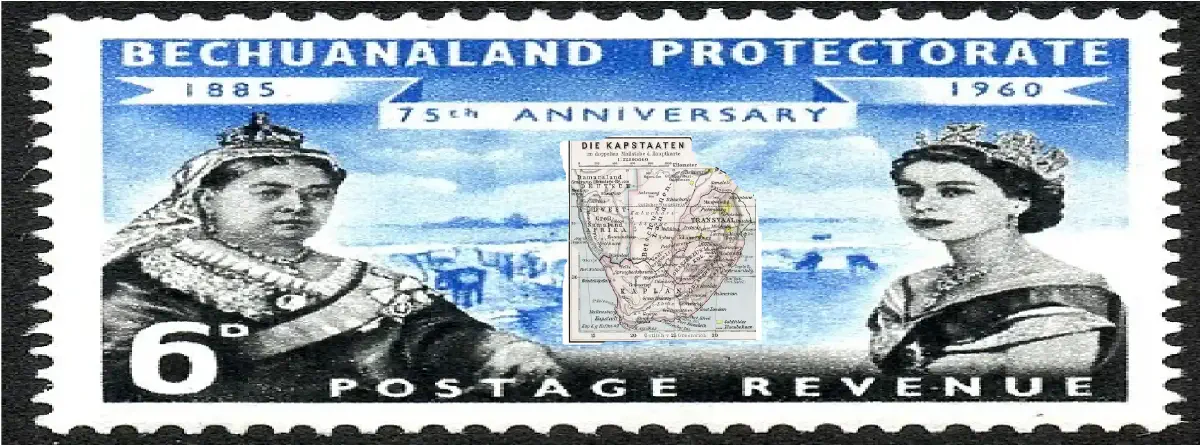
On 6th September 1895, the ocean liner Tantallon Castle docked at Plymouth. Three men disembarked: Khama, king of the Ngwato people; Sebele, chief of the Kwena; and Bathoen, chief of the Ngwaketse. They had crossed the Atlantic from what was then known as Bechuanaland, today Botswana, with a specific purpose: to prevent Cecil Rhodes from absorbing their territories into his British South Africa Company. Rhodes, who had already carved out the two Rhodesias to the north and east, described the trip contemptuously as "being beaten by three canting natives." His contempt was misplaced. The chiefs spent two months touring Britain, speaking in working-class towns from Sheffield to Bristol, building public support. They met the colonial secretary, Joseph Chamberlain, twice. When they sailed home, their territory was secure.
The three chiefs succeeded not merely because of personal skill, though skill was evident. They succeeded because they represented something unusual by the standards of sub-Saharan Africa: a set of tribal institutions that had maintained political pluralism and accountability alongside meaningful centralised authority. Those institutions survived colonial rule largely intact, because the British, uninterested in Bechuanaland as an economic prize, left it largely alone. When independence came in 1966, Botswana had those foundations to build on, and leaders willing to build on them rather than exploit them. The result was one of the most sustained periods of economic growth recorded anywhere in the developing world. The Botswana case, alongside Deng Xiaoping's China and the desegregation of the American South, illustrates the conditions under which vicious circles can be broken.
The Kgotla and the Diamond#
When the Tswana states achieved independence in 1966, Botswana was among the poorest countries in the world: twelve kilometres of paved roads, twenty-two university graduates, surrounded on three sides by the hostile white regimes of South Africa, Rhodesia, and South African-administered Namibia. It had no obvious route to prosperity.
The kgotla was one inheritance that mattered. This assembly of adult males had, for generations, provided a forum in which chiefs could consult their people, hear grievances, and be publicly challenged on their decisions. It was not democracy in any modern sense, but it embedded a principle of accountability into the political culture of the Tswana states. The South African anthropologist Isaac Schapera described it without sentimentality: "It is not unknown for the tribal assembly to overrule the wishes of the chief." The ruling proverb captured the constitutional logic precisely: kgosi ke kgosi ka morafe, "The king is king by the grace of the people."
Seretse Khama, who became Botswana's first president, was the hereditary chief of the Ngwato. When diamonds were discovered beneath Ngwato land shortly after independence, he made a decision that departed sharply from the pattern set by rulers across the rest of resource-rich Africa. Before the discovery was publicly announced, he introduced legislation vesting all subsoil mineral rights in the state rather than the tribe. The diamond revenues would be national property, available to fund public services. The first big diamond discovery was under his own tribe's land; he gave it to the nation anyway.
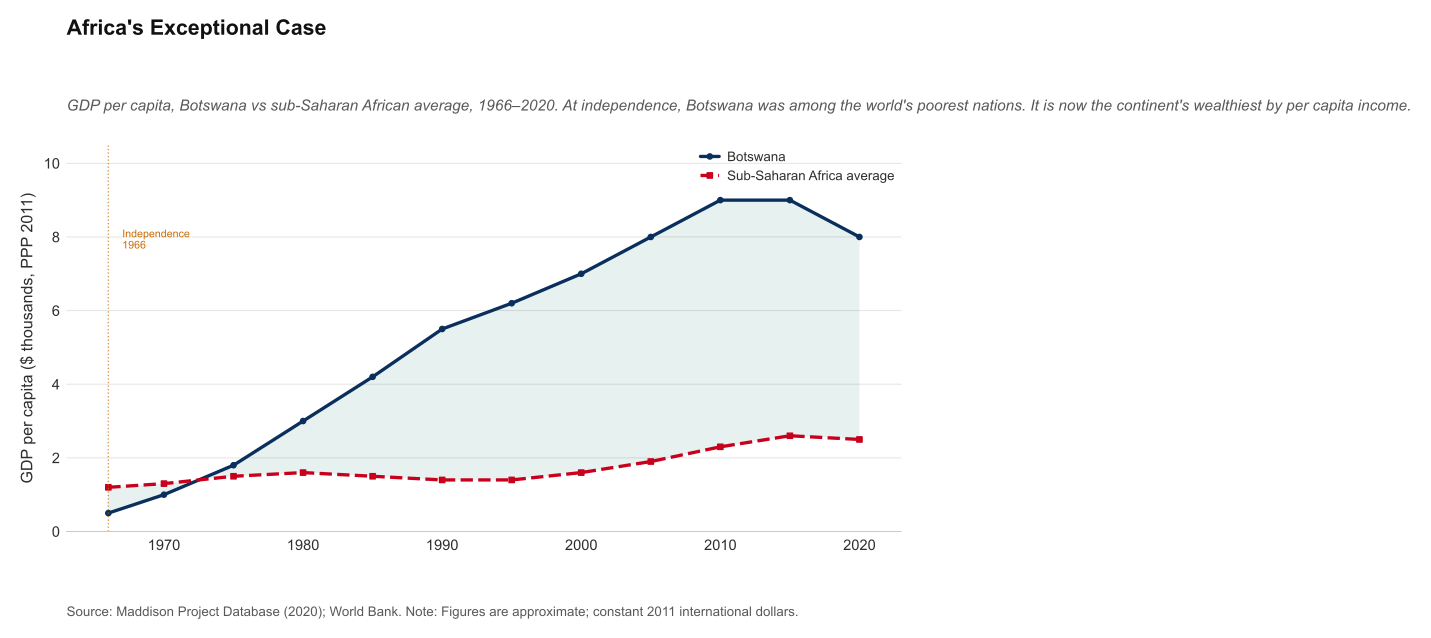
The consequences of this decision were substantial and cumulative. Diamond revenues funded roads, schools, and health clinics rather than a presidential palace and a private air force. They also reduced the incentive of any single group to seize and monopolise political power: when mineral wealth belonged to the state, controlling the state was less urgently rewarding. Botswana has held regular elections since independence and has never experienced a military coup or civil war, outcomes that remain exceptional in sub-Saharan Africa.
The comparison with Sierra Leone, which had similarly valuable diamond deposits and a similar colonial history, is instructive. In Sierra Leone, diamonds were and are extracted by whoever can control the mining areas by force. The result has been a decade-long civil war in which children were mutilated and entire communities displaced. In Botswana, diamonds built hospitals. The difference was not geography, not culture, and not an absence of political ambition. It was the institutional arrangement that determined who owned what lay underground.
Deng's Cat#
China's economic transformation after 1978 is sometimes presented as a story of technocratic insight: reformers finally recognising that markets work better than central planning. That account misses the essential mechanism. The economic reforms were the consequence of a political struggle, not its precondition.
When Mao Zedong died in September 1976, the Chinese Communist Party contained at least three factions with incompatible visions of the country's future. The Gang of Four, who had used the Cultural Revolution to eliminate their opponents, intended to continue that strategy. Hua Guofeng, Mao's chosen successor, wanted to preserve Mao's legacy while abandoning its most destructive excesses. Deng Xiaoping, who had been purged twice during the Cultural Revolution and sent to work in a tractor factory in Jiangxi province, believed that without significant moves toward market incentives, the party would lose the legitimacy it needed to maintain power.
The economic devastation of the Great Leap Forward and the Cultural Revolution had been profound. Per capita income had fallen by roughly a quarter during the Great Leap Forward alone, during which between twenty and forty million people died of famine. The Cultural Revolution had destroyed much of China's educational and technical capacity, sending university lecturers to the fields and closing schools for years. Deng concluded that the Communist Party could not survive another decade of this kind of governance. Economic reform was, for him, an instrument of political survival.
Within a month of Mao's death, Hua mounted a coup against the Gang of Four and had them arrested. He then rehabilitated Deng. Over the next three years, Deng filled the party apparatus at every level with his own supporters, outmanoeuvred Hua, and secured the Third Plenum of the Eleventh Central Party Committee in December 1978, which redirected the party's focus from class struggle to economic modernisation. Between 1980 and 1985, twenty-one of the twenty-six members of the Politburo, eight of the eleven members of the Party Secretariat, and ten of eighteen vice-premiers were replaced.
The household responsibility system, which restored individual incentives to farming, produced a third increase in grain output by 1984. Market reforms in industry followed. Foreign investment was invited. Township and Village Enterprises, allowed to compete with state-owned firms from 1979, became one of the most dynamic sectors of the Chinese economy. The phrase attributed to Deng, "It does not matter whether the cat is black or white, as long as it catches mice," is often quoted as evidence of pragmatic economic thinking. It was also a declaration of political war on the Maoist orthodoxy that had kept China poor.
China's institutional change was incomplete. The political reforms that would have produced genuinely inclusive institutions, a free press, independent courts, competitive elections, never came. The democracy activists who occupied Tiananmen Square in 1989 were met with tanks. The economic dynamism that Deng's reforms unleashed operated under, and was gradually constrained by, the extractive political institutions of a one-party state. Acemoglu and Robinson are candid about this: China's recent growth is growth under extractive political institutions with partially inclusive economic institutions. It is impressive, but it carries structural risks. An economy that cannot challenge its political arrangements cannot easily adapt when those arrangements begin to impede growth, as they may eventually do.
Rosa Parks and Federal Power#
The desegregation of the American South illustrates the role of pre-existing inclusive institutions in enabling reform. The system of racial exclusion that had governed the South since the end of the Civil War, enforced by Jim Crow laws, poll taxes, literacy tests, and the threat of violence, was an extractive institution in every meaningful sense: it transferred the economic surplus of black agricultural labour to white landowners, suppressed wages and productivity, and maintained a political system in which half the population was formally excluded from civic life.
The transformation began not when southern landowners changed their economic calculations, though that eventually mattered, but when the civil rights movement created sufficient political pressure to mobilise the federal institutions of the United States. Rosa Parks's arrest in Montgomery, Alabama, on 1st December 1955, for refusing to give up her seat on a city bus to a white passenger, triggered a bus boycott that lasted more than a year and was masterminded by Martin Luther King Jr. The Supreme Court's ruling that the segregation of public buses was unconstitutional was one element of a broader campaign; it was effective because the federal government had powers that the Montgomery city administration could not override.
The sequence of federal interventions that followed illustrates the virtuous circle of inclusive institutions at work. The courts and the legislature were responsive to the civil rights movement because the movement could organise, litigate, and increasingly vote. The civil rights movement could organise because the inclusive institutions of the United States, however imperfectly applied to black citizens in the South, provided legal and constitutional frameworks within which it could operate. Southern blacks could not vote away Jim Crow from within the southern states, where they were systematically disenfranchised. But they could litigate in federal courts, lobby in a federal legislature, and move to northern cities where they could vote and whose representatives would eventually support federal intervention.
In Mississippi, only about 5 per cent of eligible black voters were registered in 1960. By 1970, that figure had risen to 50 per cent. In textile mills across the South, black workers had constituted around 5 per cent of the workforce in 1960. By 1990, the proportion was 25 per cent. The income of the South relative to the national average, which had stagnated at around 50 per cent since the Civil War, began rising in the late 1940s and by 1990 had largely converged with the national figure.
The economic transformation of the South after desegregation is often attributed to air conditioning and the arrival of manufacturing from the North. These are real factors. But they explain the timing of investment, not its direction. Businesses did not invest in the South simply because it became cooler to work there. They invested because a labour market that had been artificially segmented by race, suppressing both wages and productivity, was gradually opened to competition. The institutional reform preceded and enabled the economic growth.
What They Share#
Botswana, China, and the American South differ in almost every particular. One is a small African country that preserved its tribal institutions through colonial rule. One is a one-party state that introduced market incentives while retaining political authoritarianism. One is a region of a large democracy that reformed its most egregious institutional failures through federal judicial and legislative intervention. Their only common structural feature is the mechanism of change: a critical juncture that disrupted the existing political equilibrium, combined with either pre-existing inclusive elements in institutions or a coalition broad enough to channel that disruption toward reform rather than toward a reshuffling of extractive elites.
Critical junctures alone are not sufficient. Many colonial independence movements, many post-conflict transitions, and many economic crises produced not reform but simply a new set of extractive arrangements. Sierra Leone's independence was a critical juncture. So was its civil war. Neither produced inclusive institutions. What distinguished the successful cases was the presence of institutions or coalitions that prevented the iron law of oligarchy: the tendency of any new regime, without structural constraint, to replicate the extraction of the regime it replaced.
graph TD
    A[Critical juncture\ndisrupts existing equilibrium] --> B{Pre-existing inclusive\nelements or broad coalition?}
    B -->|Yes| C[Reform possible:\nnew inclusive institutions]
    B -->|No| D[Iron law of oligarchy:\nnew extractive elite]
    C --> E[Virtuous circle\nbegins]
    D --> F[Vicious circle\ncontinues]
    style C fill:#007367,color:#ffffff
    style D fill:#C8001C,color:#ffffff
    style E fill:#2E6645,color:#ffffff
    style F fill:#C8001C,color:#ffffff
In Botswana, the pre-existing institution was the kgotla, which had survived the colonial period and provided a model of accountable governance that Seretse Khama and Quett Masire chose to build on rather than dismantle. In China, there was no pre-existing inclusive institution. Instead, there was a faction within the Communist Party that had survived two purges and concluded, from direct experience of the Great Leap Forward and the Cultural Revolution, that a different model was necessary. In the American South, the pre-existing inclusive institution was the federal constitutional system, which black Americans were finally able to mobilise after a century of being blocked from doing so.
The Limits of Optimism#
The lesson of these three cases is not that all extractive systems will eventually reform. The overwhelming majority do not. Botswana remains exceptional in sub-Saharan Africa, not typical of it. China's partial move toward market incentives has generated extraordinary growth, but the political institutions that permit and limit that move have also produced the Xinjiang camps and the Tibetan suppression, and are currently engaged in re-centralising economic control in ways that may eventually undermine the growth they initially enabled. The American South's desegregation took a century after the Civil War and required the mobilisation of the federal government, the Supreme Court, and a mass movement willing to risk lives to achieve it.
The lesson is more modest: institutional reform is possible. It is not structurally precluded. It requires specific conditions, particularly a critical juncture aligned with pre-existing inclusive elements or a broad coalition, and it often depends on contingent factors including the choices of specific individuals at decisive moments. Seretse Khama chose to vest diamonds in the nation. Deng Xiaoping chose market incentives over Maoist orthodoxy. Martin Luther King chose federal courts over state legislatures. In each case, those choices were shaped by institutional inheritances and political circumstances, but they were also genuinely choices, and different choices would have produced different outcomes.
History does not bend toward inclusive institutions of its own accord. It bends when enough people, at the right moment, with the right institutional inheritance, make it bend.
The Botswana that three African chiefs saved from Cecil Rhodes in 1895 is today wealthier than any other country in sub-Saharan Africa. It is tempting to read this as proof that good institutions always win in the end. The more honest reading is simpler and harder: sometimes they win. The conditions under which they do are worth understanding precisely, because there is nothing automatic about the outcome.
Return to the series overview: Rigged from Birth: Why Institutions Determine the Fate of Nations