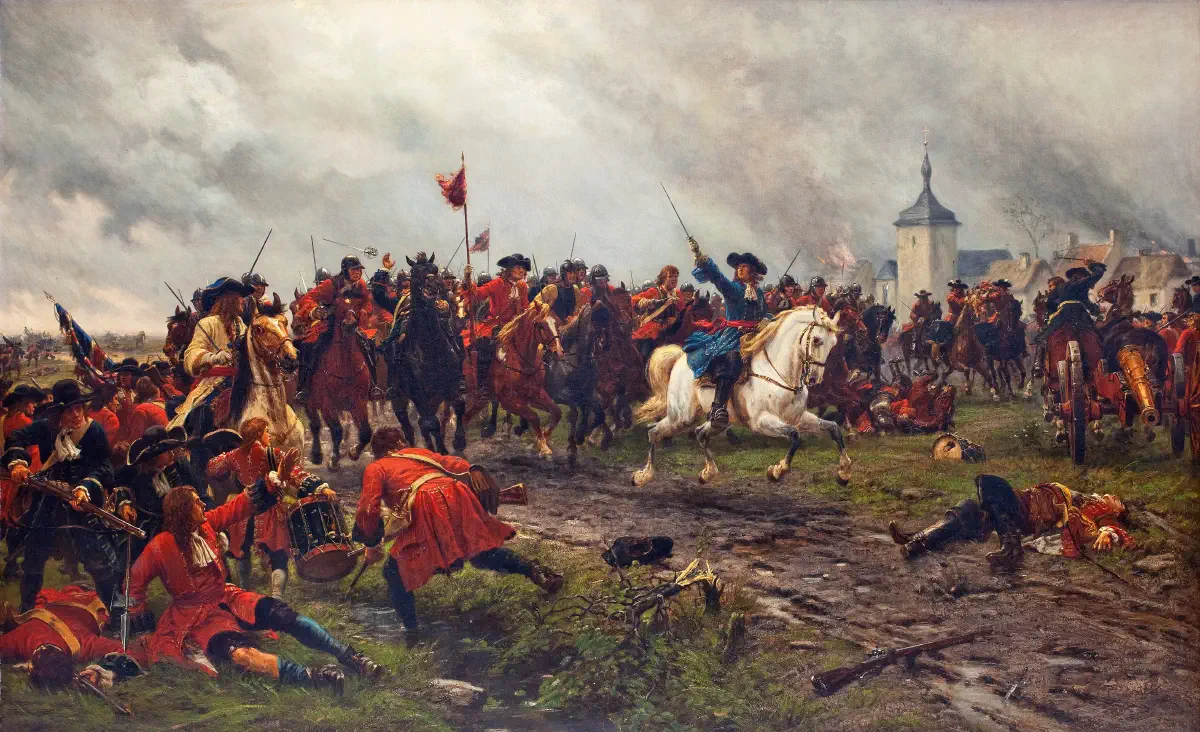
On 5th November 1688, William, Prince of Orange, landed near Brixham in Devon with a fleet and an army. He had not invaded England. He had been invited by seven peers and bishops who had sent him a letter six months earlier, outlining their discontents with James II and asking William to come. The letter was not a revolutionary manifesto. It was a property dispute: the signatories believed that James was dismantling the constitutional arrangements that protected their rights and privileges. James, recognising that the army would not fight for him, fled to France in December. Parliament convened, declared the throne vacant, and offered it to William and his wife Mary, James's daughter. Before accepting, William agreed to the Bill of Rights. It was the least glamorous revolution in English history. It was also, arguably, the most consequential in economic terms.
The Glorious Revolution transferred effective political power from the Crown to Parliament, establishing constitutional constraints on executive power that would make property rights more secure and innovation more profitable. The Bank of England followed in 1694. A reformed patent system encouraged inventors to profit from their ideas without the Crown's caprice. Within a century, the Industrial Revolution was under way in England and nowhere else. Meanwhile, the absolutist regimes of Russia, China, and the Ottoman Empire were explicitly suppressing the same transformation. The contrast is not a matter of accident or geography. It is a matter of institutions, and specifically of what an inclusive political settlement allows that absolutism prevents.
Before the Revolution#
The institutional preconditions for the Glorious Revolution had been accumulating for centuries. Magna Carta in 1215 established the principle, however imperfectly realised, that the Crown was subject to law. Parliament had existed in various forms since the thirteenth century, giving representatives of the nobility and later the gentry a venue in which to contest royal demands for taxation. The English Civil War of the 1640s had temporarily abolished the monarchy and established a republic under Oliver Cromwell, who turned out to be as inclined toward personal rule as the king he had replaced. When the monarchy was restored in 1660, it returned with no clear constitutional settlement of the disputes that had produced the civil war.
James II, who came to the throne in 1685, pushed the unresolved tensions to breaking point. He sought to use the royal prerogative to overturn laws passed by Parliament, to appoint Catholics to military and civil offices in violation of the Test Act, and to govern without parliamentary oversight of royal finances. The coalition that opposed him was broad, crossing the usual divisions between Tories and Whigs, merchants and landowners, Anglican bishops and dissenting Protestants. Their opposition was institutional rather than ideological. They wanted constraints on royal power, not the abolition of monarchy. That breadth of coalition was decisive: it meant that the Glorious Revolution, unlike the Civil War, would not simply transfer power from one narrow group to another.
What Changed in 1688#
The Bill of Rights of 1689 established several key principles. Parliament would meet regularly and control taxation. Suspending or dispensing with laws without parliamentary consent was illegal. The Crown could not maintain a standing army in peacetime without parliamentary approval. Free elections to Parliament were guaranteed. These constraints transformed the relationship between the state and the economy.
The practical consequences were rapid. The Bank of England was chartered in 1694, giving the government a mechanism for borrowing at lower interest rates and giving merchants access to credit at scale. Government debt became credible: lenders could trust that a parliament of property-owning investors would not permit default. Interest rates on government borrowing fell from around 14 per cent in the early 1690s to under 6 per cent by 1700, and continued to decline thereafter. That fall in the cost of capital had direct implications for investment in new industries, new machinery, and new ventures.
The reformed patent system, building on the Statute of Monopolies of 1623, now operated in a political environment where patents could not be arbitrarily revoked by a Crown seeking to reward favourites. An inventor could spend the years and money required to develop a new technology with reasonable confidence that his rights would be enforced by an independent judiciary rather than overridden by a royal whim. Between 1700 and 1800, the number of patents granted in England grew from roughly 10 per year to over 100. After 1760, as the technologies of the Industrial Revolution multiplied, the rate accelerated dramatically.
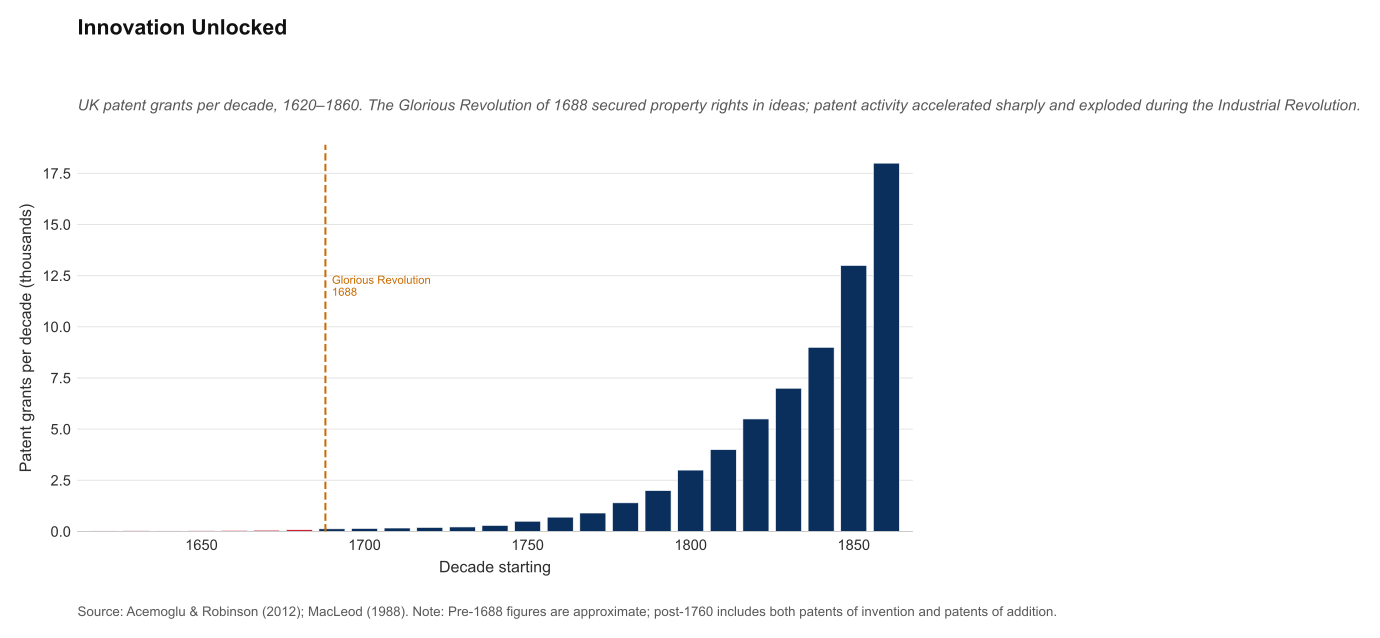
The Social Breadth of Innovation#
The social breadth of innovation in the decades following 1688 was as striking as its pace. Between 1820 and 1845, only 19 per cent of American patentees, who had inherited the English institutional template through the Constitution, came from professional or major landowning families. Forty per cent had only primary schooling. Thomas Edison, the inventor of the lightbulb and the phonograph, was the son of a man who had variously split shingles, tailored clothes, and kept a tavern. James Watt's father was a merchant and ship carpenter. Richard Arkwright, who invented the water frame that launched the mechanisation of textile production, began his career as a barber and wig-maker.
None of these men required political connection to commercialise their inventions. They needed property rights, enforceable contracts, and access to credit: precisely the institutional infrastructure that the Glorious Revolution had established. The Industrial Revolution was not the achievement of a narrow aristocratic elite. It was the product of a wide variety of people, drawn from across the social spectrum, who could invest in new ideas because inclusive institutions protected the returns on that investment.
The Absolutist Contrast#
The reason the Industrial Revolution spread rapidly to North America and Belgium, more slowly to France and Germany, and very slowly or not at all to Russia, China, and most of Latin America was not a matter of resources or geography. It was a matter of institutions: specifically, whether the ruling elites of those societies could prevent the economic and political disruption that industrialisation inevitably produces.
Russia's Tsars were explicit about this. Railway construction in western Russia was deliberately blocked well into the nineteenth century, partly on the advice of military officers who worried that good roads would help foreign armies invade and partly because ministers feared that rapid communication would spread dangerous political ideas and make it harder to control the movement of serfs. The map of European railways in 1870 shows Britain and north-western Europe crisscrossed with lines; Russia has almost none west of Moscow. That map is the map of institutional divergence.
China under the Ming and Qing dynasties provides the sharpest contrast with England. In the fifteenth century, China possessed sophisticated technologies that Europe did not: gunpowder, the compass, paper money, blast furnaces, and spinning wheels. The Ming admiral Zheng He commanded fleets that dwarfed anything Europe could muster, undertaking voyages to East Africa decades before Portuguese ships rounded the Cape. Then, beginning in the 1420s, the Ming court banned overseas trade, prohibited the construction of seagoing ships, and periodically ordered the evacuation of the entire southern coastal population. The reasoning was precisely the institutional reasoning described in the previous post: international trade was politically destabilising, enriching merchants who might challenge imperial authority. Emperor Kangxi, in 1661, ordered that all people living along the southern coast should move seventeen miles inland, patrolled the empty coastline with troops, and periodically reimposed the ban on shipping throughout the eighteenth century.
England was not naturally superior to China. In 1500, Chinese living standards were probably at least as high as English ones. The difference was institutional: the English Crown, after 1688, could not stop trade, suppress innovation, or revoke property rights at will. The Chinese emperors could, and did.
The Ottoman and Habsburg Cases#
The Ottoman Empire and the Habsburg monarchy in Austria-Hungary both faced the critical juncture of the Industrial Revolution with extractive political institutions largely intact. Both suppressed industrialisation for the same reasons the Russian Tsars and Chinese emperors did.
The Habsburg court explicitly blocked railways in the Austrian Empire, particularly in the western regions, after railway advocates argued that railways would accelerate the movement of people and ideas in ways that would threaten the existing political order. They were not wrong about this. The social and economic disruptions that accompanied industrialisation in Britain did indeed produce the political pressures that eventually forced institutional reform. The Habsburg ministers who feared railways were correctly anticipating the consequences. They chose to avoid those consequences by avoiding the railways.
The Ottoman sultans similarly blocked the development of private enterprise and commerce, channelling economic activity through state-controlled guilds and prohibiting the establishment of printing presses for nearly three centuries after Gutenberg's invention reached Europe. The religious and political justifications offered for these choices varied. The underlying logic was constant: creative destruction threatens those at the top, and those at the top have the means to prevent it.
The Virtuous Circle in Practice#
The institutional transformation of 1688 produced a virtuous circle of the kind described in the second post of this series. Secure property rights encouraged investment; investment generated economic growth; economic growth strengthened the middle class; the middle class demanded and received further institutional refinements. The National Debt created by the Bank of England in 1694 gave investors, who were also often members of Parliament, a direct financial stake in the stability and creditworthiness of the state. They became, in effect, lobbyists for the rule of law and property rights: their investments would be worth nothing if the constitutional settlement that secured them were reversed.
The contrast with France is instructive. France in 1688 was the richest and most powerful state in Europe, with a population three times England's and a more sophisticated cultural and intellectual tradition. Its absolute monarchy, however, could not credibly commit to protecting property rights or honouring its debts. French interest rates remained substantially higher than English ones throughout the eighteenth century, making investment more expensive and innovation less rewarding. When the Industrial Revolution arrived, France was able to adopt technologies developed in England, but it could not originate them at the same pace. The institutional gap had to be closed, gradually, before France could fully participate. It was not closed until the Revolution of 1789 and the subsequent decades of constitutional reform.
The Glorious Revolution was, at its heart, a constitutional argument about who had the right to revoke property. The men who invited William of Orange to England were not visionaries. They were landowners protecting their estates and merchants protecting their contracts. In defending their narrow interests through institutional reform, they accidentally built the foundations of the modern world.
Next in the series: Breaking the Mold: How Botswana, China, and the American South Escaped the Grip of Extractive Institutions