On 3rd October 1286, a proposal came before Venice's Great Council. It was a small amendment to the rules governing council membership. The proposal was defeated. Two days later, a slightly different version was put forward. It passed. Under the new rule, a man whose father and grandfather had served on the council would be automatically confirmed as a member; everyone else would require explicit approval. It was a modest change in procedural language, but it was the beginning of the end for the most sophisticated commercial civilisation the medieval world had produced. Over the next three decades, Venice's ruling class would transform an open, dynamic commercial republic into a closed aristocratic order, ban the financial innovations that had generated its wealth, and nationalise the trade that had made it famous. Venice would not recover.
Venice's fate is not an obscure medieval curiosity. It is a template. Acemoglu and Robinson identify it as one of the clearest historical examples of the mechanism by which inclusive institutions revert to extractive ones: a ruling elite, sensing the threat that open economic competition poses to its position, uses its political control to close the economy to new entrants. The commenda contracts that had allowed young merchants without capital to accumulate wealth through talent were abolished. Long-distance trade was nationalised. The upward mobility that had characterised Venetian commercial life for two centuries was replaced by hereditary privilege. The process was gradual, legal, and devastating. Rome and the Maya city-states trace the same arc. The common force is the fear of creative destruction: the recognition, by those who benefit from existing arrangements, that economic dynamism threatens not only their wealth but their political power.
Venice's Rise#
Venice in the eleventh and twelfth centuries built something genuinely unusual for its time: a commercial republic with access to economic opportunity that extended beyond a narrow elite. The instrument that made this possible was the commenda contract, a rudimentary joint-stock structure in which a sedentary merchant provided capital and a travelling merchant provided labour. Profits were shared; losses were proportionate to capital contributed. The travelling merchant could be a young man with talent, energy, and local knowledge but no capital. The commenda gave him access to the economy on the basis of merit rather than birth.
The result was upward social mobility on a scale remarkable for medieval Europe. Documents from 960, 971, and 982 show that between 65 and 81 per cent of the names appearing in official Venetian records were new, belonging to families not previously prominent in Venetian life. Venice was creating new economic elites at a rate that would have seemed extraordinary even in today's meritocracies. The city grew accordingly: from perhaps 45,000 people in 1050 to 110,000 by 1330, larger than Paris and three times the size of London.
These inclusive economic institutions were supported by, and in turn supported, inclusive political institutions. The doge's power was gradually constrained by new councils. The city developed independent magistrates, bankruptcy law, and an appeals system. Each institutional innovation expanded the circle of those with a stake in the system's survival.
La Serrata#
The process of closure was gradual. The Great Council in 1286 was a moderately open body. By 1315, when the Libro d'Oro, the Gold Book, compiled the official registry of Venetian nobility, it had become a hereditary aristocracy. The precise mechanism was a series of incremental rule changes, each individually defensible, that collectively transformed a body renewed by performance into one determined by birth.
Having secured political power, the new aristocracy moved to secure economic power. The commenda was banned. Long-distance trade was progressively nationalised, with state galleys replacing private merchant ships for the most lucrative routes. From 1324, individuals who wished to trade had to pay heavy taxes to the state. The economic institutions that had created Venice's wealth became instruments for concentrating that wealth in the hands of the hereditary elite that controlled the state galleys.
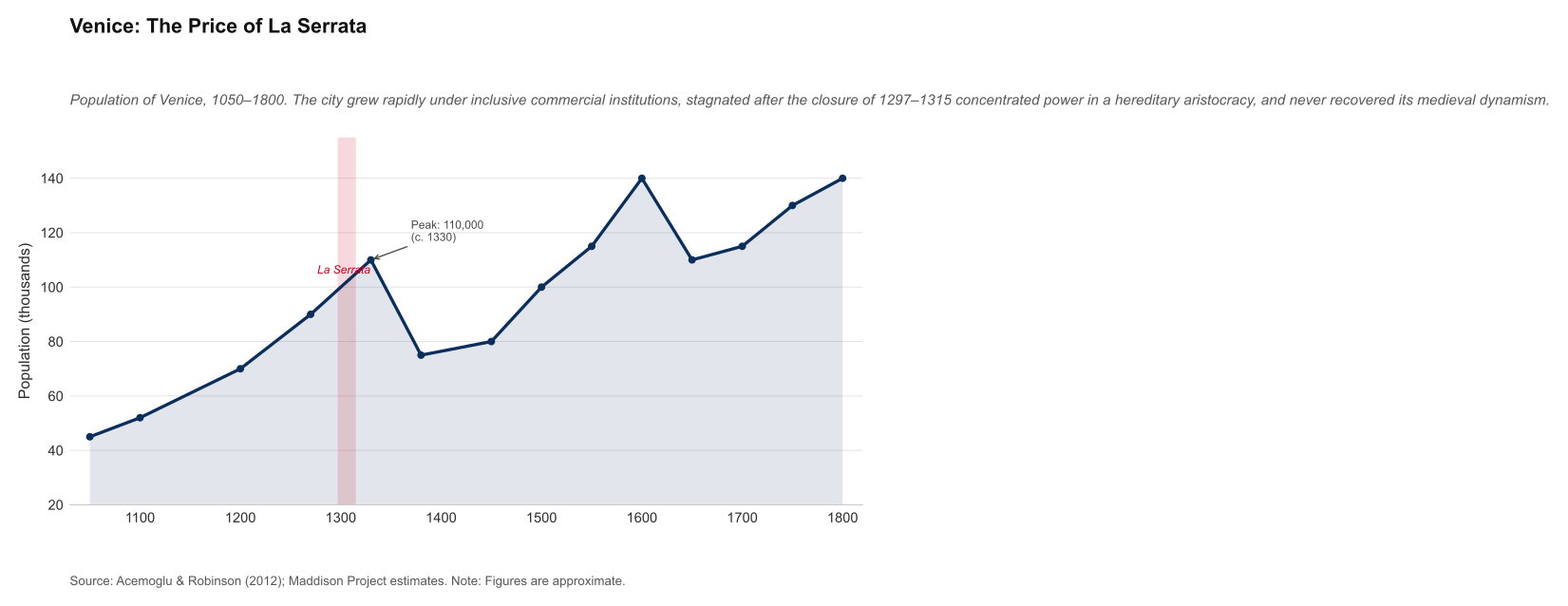
Venice's population, which had reached 110,000 by 1330, was down to 100,000 by 1500. The tourists who now fill its narrow streets to see the Doge's Palace and the columns of St Mark's are looking at the architectural achievements of the period before La Serrata, built by the commercial republic that the aristocracy dismantled. The monuments outlasted the system that produced them.
The Serrata also produced a social psychology of stagnation that the economic historian Frederic Lane documented in detail. The great families of the republic, having secured their political position, ceased to compete commercially in the ways their forebears had. They became passive investors, drawing rents from their state-conferred trading privileges rather than searching for new markets or new financial instruments. The Venetian economy did not collapse immediately; it contracted slowly, over decades and centuries, as the innovative dynamism of the commenda era gave way to the administrative torpor of an entrenched aristocracy managing declining returns.
Rome and the Technological Ceiling#
Rome's trajectory from republic to empire to collapse traces the same institutional logic over a longer arc. During the Republic, partially inclusive political institutions and relatively secure property rights allowed some economic expansion and the development of long-distance trade across the Mediterranean. Shipwrecks datable by radiocarbon analysis increased from about 20 per decade in 500 BC to around 180 per year at the time of Christ: a rough but useful proxy for the expansion of Mediterranean commerce and living standards.
But the Republic was always partially extractive: slavery was pervasive, and land distribution was highly unequal. The tension between plebeian and senatorial interests produced the crises of the late Republic, culminating in the assassination of Julius Caesar and the eventual consolidation of power by Augustus. The Roman Empire that resulted was more extractive: property rights became less secure as the emperor's capacity to confiscate grew; civil war became endemic as factions competed for the lucrative position of emperor. By AD 500, the 180 shipwrecks per year had shrunk back to 20. Mediterranean trade had collapsed.
The technological stagnation of the late Empire was not accidental. Pliny the Elder records that an inventor presented Emperor Tiberius with a formula for unbreakable glass. Tiberius had the man executed, reportedly reasoning that if glass were unbreakable, gold would become worthless. He was not irrational. He was correctly identifying the economic disruption that the innovation would cause, and choosing political stability over economic progress.
The Romans, who used ships as their primary means of economic exchange and who reached a remarkable level of naval engineering for their era, never developed the stern rudder. The device, which would have transformed the efficiency of Mediterranean shipping, was available to Chinese and Arab sailors from the first century AD. The Romans had the technical knowledge to develop it. The absence of market incentives for merchants and innovators, in a system where economic power flowed through political connection rather than commercial achievement, meant that no one with resources had the incentive to develop it.
The Maya and the Mathematics of Collapse#
The Maya city-states of Mesoamerica, which flourished between roughly 250 and 900 AD, provide a third illustration of the extractive ceiling. Their civilisation was sophisticated: they developed writing, a sophisticated calendar, advanced mathematics, and architectural techniques including the independent invention of cement. Their kings organised tribute, labour, and long-distance trade across a network of fifty or more city-states.
But the system was inherently unstable. Extractive institutions concentrated wealth in the hands of the k'uhul ajaw, the divine lord, and his supporting aristocracy. This concentration made the position of divine lord enormously valuable and therefore worth fighting for. The inscriptions that the Maya left behind, datable by the Long Count calendar, record a steady escalation of inter-city warfare over the eighth and ninth centuries. Copán, which had supported perhaps 28,000 people at its height in the late eighth century, lost roughly 90 per cent of its population over the following four centuries as the extractive political system that had sustained its urban complexity collapsed under the weight of its own instabilities.
The Classic Maya collapse did not result from a single cause. Drought, deforestation, and soil exhaustion all played roles. But the political institutions of the Maya city-states, by concentrating wealth and making the right to extract enormously valuable, ensured that the response to any environmental stress would be escalating conflict over that right rather than collective problem-solving. Extractive institutions, by their nature, produce the internal conflicts that destroy them. The question is only one of timing.
graph TD
    A[Extractive political institutions] --> B[Wealth concentrated in elite]
    B --> C[Right to extract becomes\nenormously valuable]
    C --> D[Factional conflict over\ncontrol of the state]
    D --> E[Political instability\nand collapse]
    E --> A
    B --> F[Innovation suppressed\nto protect existing interests]
    F --> G[Growth hits ceiling\nthen reverses]
    style A fill:#C8001C,color:#ffffff
    style C fill:#C96A00,color:#ffffff
    style E fill:#C8001C,color:#ffffff
    style G fill:#C96A00,color:#ffffff
The Common Logic#
Venice, Rome, and the Maya share a structural similarity that transcends their historical particularity. In each case, an economic system generated enough surplus to support a political elite. That elite, once established, used its political power to protect its economic position from challenge. In doing so, it dismantled or prevented the institutions that had generated the surplus in the first place. Sustained growth requires innovation; innovation requires creative destruction; creative destruction threatens existing elites; threatened elites suppress it. The logic is circular, and it is the logic of the vicious circle.
What varies across these cases is the pace of collapse. Venice declined slowly over centuries, its aristocracy managing a gradual diminution of commercial ambition as it retreated from trade into rent-seeking. Rome collapsed in waves, each recovery under a strong emperor providing a temporary respite before the underlying institutional dynamics reasserted themselves. The Maya collapsed more rapidly, as inter-city warfare accelerated the breakdown of the tributary system that had sustained urban populations.
The implication for any contemporary analysis of poor countries is direct. The question is not whether the elites of extractive systems intend their societies to fail. They generally do not. The question is whether the political incentives they face, the rewards for maintaining extraction and the costs of tolerating creative destruction, will lead them to make decisions that gradually undermine the institutional foundations of sustained prosperity. The historical record, from Venice to the contemporary oil states, suggests the answer is usually yes.
Venice today makes pizza and ice cream for tourists who come to admire the monuments built before La Serrata. It is a museum of institutional failure, preserved in amber by the very dynamics that produced it: the decision of a ruling elite to choose security over dynamism, and to use political power to stop the clock. The clock was stopped. The economy went with it.
Next in the series: The Revolution That Paid Off: England's Glorious Revolution and the Institutional Foundations of the Industrial Revolution