When Power Learns It Has No Limits#
Violent systems do not begin by targeting everyone. They begin by testing boundaries. Each act probes how much fear, how much cruelty, how much injustice can be imposed without resistance. Applause answers the test.
When violence is met with approval, power learns a critical lesson: restraint is unnecessary. The audience has demonstrated tolerance. From that point forward, escalation is not recklessness. It is optimization.
This learning process is gradual. No single cheer condemns the crowd. It is the accumulation that matters. Each endorsement widens the acceptable range of harm. What was once extraordinary becomes routine. What was once targeted becomes generalized.
At some point, violence no longer needs enemies. It needs momentum.
The Audience as Instructor#
Power does not invent its limits. It discovers them through response. Silence signals fear. Applause signals permission. Together, they teach authority how to behave.
This is the overlooked role of the crowd. It is not merely passive. It is instructional. By rewarding cruelty with legitimacy, the audience trains the system to prioritize force over judgment.
Once trained, the system cannot easily reverse course. There is no internal mechanism for restraint. Ethical considerations have already been framed as weakness. Mercy has been publicly devalued.
The knife does not suddenly turn inward. It continues moving in the same direction, along a path the crowd helped carve.
When Categories Collapse#
All terror systems rely initially on categories: loyal and disloyal, pure and impure, useful and expendable. These distinctions make violence appear controlled. They reassure supporters that harm is selective.
Over time, categories erode. They are administratively costly and psychologically unstable. Maintaining them requires constant justification and trust. Terror prefers efficiency.
Once cruelty is normalized, the system no longer invests in fine distinctions. Violence becomes procedural. Anyone can be reclassified. Loyalty becomes irrelevant because it cannot be verified quickly enough.
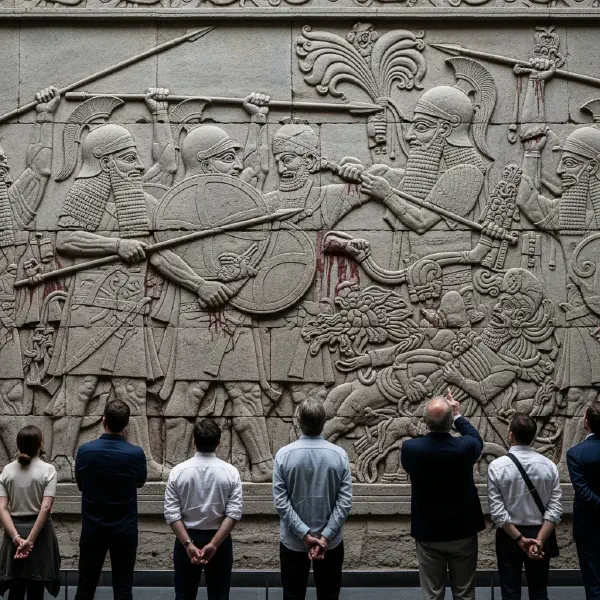
In the Assyrian Empire, populations that had admired and amplified terror found no protection when strategic conditions shifted. Cities that once benefited from alignment were destroyed when convenience demanded it. The system did not malfunction. It behaved exactly as trained.
The audience discovered too late that it had not been watching a performance. It had been participating in rehearsal.
Why Terror Consumes Its Supporters#
The consumption of supporters is not moral irony. It is structural necessity. A system built on fear must continually generate fear to sustain itself. Once external targets are exhausted or ineffective, internal targets are inevitable.
Supporters are especially vulnerable because they lack defenses. They have already dismantled moral language, collective solidarity, and norms of restraint. They cannot appeal to principles they helped erase.
At that stage, resistance is fragmented and incoherent. Each individual hopes to be the exception. This hope mirrors the original illusion of exemption, now repeated under worse conditions.
The system advances without resistance because resistance has been trained out of the population.
The Final Miscalculation#
Those who cheer violence believe they are buying safety. In reality, they are purchasing acceleration. They mistake short-term survival for long-term security.
Fear can justify silence. It cannot justify instruction. Applause teaches power how to behave. Once taught, power applies the lesson universally.
This is why terror always turns inward. Not because leaders are uniquely evil, but because systems learn from feedback. The crowd provides that feedback willingly, loudly, and repeatedly.
The final lesson is severe but precise: Violence does not ask who deserves it. It asks who allowed it.
Those who applauded did not summon the knife. They sharpened it.