Political Psychology and Sociology
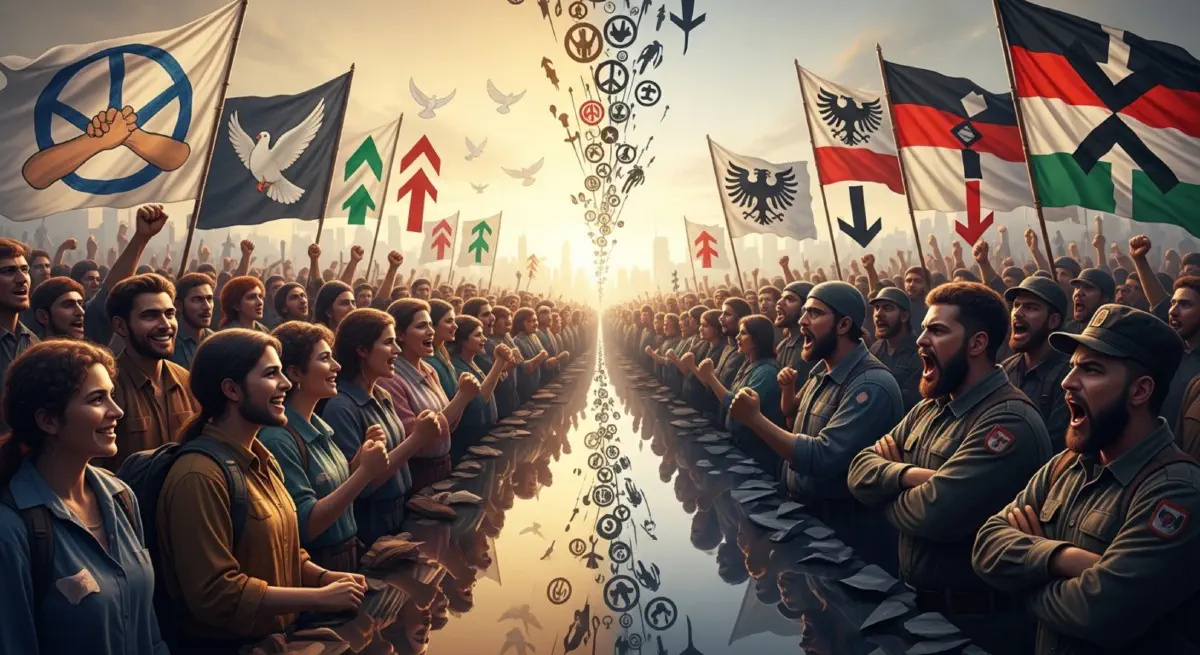
Consider a simple and frequently observed fact: two people, given the same economic statistics, the same crime figures, the same environmental data, and the same assessment of institutional performance, reach opposite political conclusions and find each other's position not merely wrong but incomprehensible.
The standard explanation — that one of them is misinformed, or irrational, or acting in bad faith — is almost certainly wrong in a large proportion of cases. The more parsimonious explanation, supported by thirty years of empirical research in political psychology, is that they are ordering their values differently. They are not disagreeing about facts. They are disagreeing about which values should take precedence when facts and values collide — which they always do.
This distinction sounds academic. It is not. It changes what political disagreement is, what it requires, and what could possibly resolve it.
The Circumplex in the Ballot Box#
In Article 4, Schwartz's ten universal value types were introduced as a map of the motivational structure of human goals. The map has a political dimension that is, by now, extensively documented.
Conservatives, across multiple countries and measurement instruments, tend to score higher on the conservation axis: security, tradition, and conformity. They weight order, predictability, and the preservation of established institutions more heavily than their opponents. Liberals tend to score higher on self-transcendence and openness to change: universalism, benevolence, self-direction, and stimulation. They weight inclusion, novelty, and the extension of rights to outgroups more heavily than their opponents.
These are aggregate tendencies, not deterministic rules — there is more value heterogeneity within political camps than between them, and many individuals hold combinations that do not fit either archetype. But the statistical signal is robust across cultures that range from the United States to Norway, from Brazil to South Korea. Left-right political orientation is, in significant part, a value orientation. The electoral contest is, in significant part, a contest about which values should be lexically prior when they conflict.
The practical implication is immediate. Policy debates that present themselves as disputes about facts — about immigration's economic effects, climate change's magnitude, crime's causes, trade's consequences — are frequently, beneath the fact-level surface, disputes about values. Which matters more: national cohesion or global solidarity? Present welfare or future generations? Individual liberty or collective security? These questions do not have answers derivable from data. They require value judgments. And people with different value priorities will reach different answers from identical facts.
Why Facts Alone Cannot Settle Value Conflicts#
This is not a relativist claim. It is an observation about the logical structure of policy arguments.
Every policy argument has two components: an empirical claim about what the world is like, and a normative claim about what outcomes we should prefer. The empirical component can, in principle, be settled by evidence. The normative component cannot. Showing that immigration produces a net economic gain at the national level does not resolve the immigration debate for someone who weights the welfare of incumbent low-wage workers above aggregate national income, or who weights cultural continuity above economic efficiency. The evidence is relevant — it changes the expected consequences of the policy — but it does not override the value weighting.
The political psychologist Philip Tetlock demonstrated this with the concept of value pluralism: the finding that most political disagreements involve genuine conflicts between values that most people would endorse in isolation. Freedom matters. Equality matters. Security matters. Prosperity matters. They conflict with each other in specific policy domains, and the conflict requires a choice about priority. Conservatives and liberals make different choices — not because one side lacks values and the other possesses them, but because they possess different value hierarchies.
This is not a comfortable conclusion for either side of most political arguments. It implies that the opponent is not primarily confused, dishonest, or self-interested — they may simply be applying different weights to values that both parties, in principle, share. The implication for political discourse is significant: arguments that present themselves as factual corrections are frequently disguised value assertions, and they will fail — as they reliably do — because the real disagreement is upstream.
The Personality Layer#
Values do not emerge from nowhere. The political psychologist John Jost and his colleagues have documented a systematic pathway running from basic personality traits through value priorities to political ideology — what Jost calls elective affinities.
The path runs, approximately, as follows. People who score high on openness to experience — one of the Big Five personality traits — tend to find uncertainty stimulating rather than threatening. They are comfortable with ambiguity, novelty, and complexity. This personality orientation is associated with higher scores on self-direction and universalism values in the Schwartz circumplex. Those value orientations are, in turn, associated with liberal political positions.
People who score high on conscientiousness — order, rule-following, self-discipline — tend to find uncertainty threatening and structure reassuring. This orientation correlates with higher conservation values: security, conformity, tradition. Those values are associated with conservative political positions.
The pathway is probabilistic and multiply mediated. It does not predict individual political affiliation with precision. But it does suggest that political ideology is not primarily a rational response to the evaluation of policies. It is, in significant part, a downstream expression of personality and value structures that were established long before the political positions were adopted.
This has a disquieting implication for political persuasion: the target of most political argument — the proposition about a specific policy — is the most distal and least tractable element of the causal chain. Arguing about the policy, without engaging the values and personality orientations that generate the policy preference, is arguing at the symptom rather than the cause.
The Moral Foundations of Political Division#
The moral psychologist Jonathan Haidt has extended the analysis beyond the Schwartz circumplex with his moral foundations theory. He identifies six innate moral-psychological dispositions — care/harm, fairness/cheating, loyalty/betrayal, authority/subversion, sanctity/degradation, and liberty/oppression — and argues that political liberals and conservatives differ systematically in which foundations they activate.
Liberals, Haidt finds, draw primarily on care and fairness. They evaluate policies through the lens of who might be harmed and whether the outcome is equitable. Conservatives draw on all six foundations — including loyalty, authority, and sanctity — which Haidt calls the binding foundations, because they bind groups together through shared commitments to hierarchy, in-group solidarity, and the sacred.
The political consequence is a systematic asymmetry in moral communication. When liberals argue for a policy on harm-and-fairness grounds, the argument resonates with conservatives only if the policy also engages binding foundations. When conservatives argue on loyalty-and-authority grounds, the argument frequently does not resonate with liberals, who may not experience those foundations as morally salient at all. Both sides are speaking moral languages the other has only partial literacy in.
What Follows from This#
None of this analysis is an argument for relativism or for the conclusion that all political positions are equally valid. Values can be more or less consistent with each other, more or less responsive to evidence about consequences, more or less respectful of other people's humanity. The recognition that value pluralism underlies political disagreement does not dissolve the disagreement or immunize any position from criticism.
What it does do is change the appropriate register of political argument. Arguments that present value choices as factual corrections tend to fail — and to generate contempt for the opponents who refuse to be corrected. Arguments that explicitly acknowledge the underlying value conflict — that name the trade-off between security and openness, between present welfare and future generations, between national solidarity and global justice — have a better chance of producing genuine dialogue, even where they do not produce agreement.
Political disagreement will not end because value pluralism is recognized. But it might, at the margin, become more honest. And honesty about what is actually being disputed is a precondition for any political process that deserves the name democratic.
Next in the series: Article 7 — What Is a Good Life Worth Living?