Psychology, Sociology, and History
In 1963, the social psychologist Milton Rokeach asked several thousand Americans to rank eighteen terminal values — things they considered desirable end-states of existence — in order of personal importance. The list included freedom, equality, happiness, wisdom, national security, salvation, and a dozen others. Respondents took the task seriously. They deliberated. They revised. They treated the exercise as a genuine act of self-examination.
What Rokeach found, and what sixty years of subsequent research have confirmed, is that these rankings were not random. They clustered in systematic ways, correlated with political affiliation, religious practice, educational level, and age. They were not, in any straightforward sense, freely chosen. They were, instead, recognizably structured — shaped by forces the respondents had encountered long before they sat down to complete a survey.
The uncomfortable implication is one that most adults resist: much of what you believe is worth pursuing was decided before you were old enough to disagree.
The Map of Human Values#
In the 1980s, the Israeli psychologist Shalom Schwartz set out to do what Rokeach had begun: map the universal structure of human values. The ambition was extraordinary. If values were merely cultural artifacts — products of history, religion, and circumstance — there would be no universal structure to find. If they had a common architecture, that architecture would be detectable across cultures.
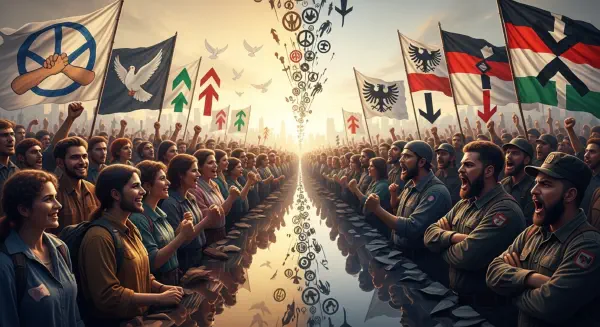
Schwartz and his collaborators surveyed populations across more than eighty countries over three decades. They found a structure: ten distinct value types, organized in a circular arrangement, governed by two orthogonal axes. One axis runs from self-enhancement (power, achievement) to self-transcendence (universalism, benevolence). The other runs from openness to change (stimulation, self-direction) to conservation (conformity, tradition, security).
The arrangement is not merely taxonomic. Adjacent values are compatible — pursuing one makes pursuing the neighboring ones easier. Opposing values conflict — pursuing one makes pursuing the values directly across the circle harder. A person who strongly prioritizes power and achievement will find it difficult to simultaneously prioritize benevolence and universalism. A person who prioritizes self-direction and stimulation will experience friction with tradition and conformity. The conflicts are not logical contradictions but motivational tensions — the kind that make ordinary life feel, at moments, like a negotiation with oneself.
This structure has been replicated, with variations, across cultures that share almost nothing else. It holds in rural Tanzania and urban Tokyo, in Catholic Poland and secular Sweden, in societies that have never shared a language, a religion, or a trade route. The content of specific values varies substantially — what counts as appropriate authority, what specific traditions deserve preservation, what equality actually requires. But the structure — the pattern of compatibilities and conflicts — is remarkably stable.
Where Values Come From#
Universal structure does not imply innate content. The circumplex tells us how values are organized; it does not tell us which point on the circle a particular person will occupy, or why.
The evidence on origins is layered and, at first pass, humbling.
Genetics accounts for more than expected. Twin studies consistently find that identical twins raised apart have more similar value priorities than fraternal twins raised together. Heritability estimates for specific value dimensions range from 30 to 60 percent. This does not mean values are genetically determined — the remaining variance is substantial, and gene-environment interactions are complex. But it does mean that the comfortable belief that values are purely the product of experience and choice understates the role of biology.
Parents matter, but less than they think. The socialization literature documents that parents successfully transmit broad value orientations — religion, broadly construed political leanings, the relative weight given to self-enhancement versus self-transcendence. They are much less successful at transmitting specific value priorities within those orientations. Adolescents whose parents place a high value on achievement frequently develop high achievement values — or they rebel against them with equal intensity. The transmission mechanism appears to be emotional salience, not instruction: values that parents treat as genuinely important, in ways that children can observe, tend to be internalized. Values that are professed but not demonstrated tend not to be.
Peers matter, and the influence intensifies across adolescence. The peer group is not merely a social context; it is an active value-formation environment. Adolescents' value priorities shift measurably toward those of their peer groups during the years when identity is most actively constructed. This is not weakness or conformity in any pejorative sense. It is how humans have always calibrated social belonging — by updating their values to match the communities they inhabit.
Historical disruption resets the baseline. The most dramatic value changes observed in longitudinal data coincide with historical discontinuities: wars, economic crises, rapid urbanization, the collapse of established institutions. Inglehart's post-materialist thesis — that rising economic security shifts populations from survival values toward self-expression values — is the most cited example. Societies that have recently experienced famine, war, or economic collapse reliably prioritize security and conformity. Societies with several generations of material stability shift toward self-direction and universalism. Values, at the population level, track material conditions with a generational lag.
What Changes and What Does Not#
The stability of adult values is well-documented and routinely underestimated. Values established by early adulthood are highly resistant to deliberate revision. People who believe they have fundamentally changed their values in response to a book, a conversation, or a compelling argument have usually changed their vocabulary more than their motivational structure. The underlying priorities — the weights assigned to security versus stimulation, to self-enhancement versus self-transcendence — shift measurably only in response to prolonged and significant life experience: major illness, immigration, religious conversion, extended contact with radically different communities.
This is not a counsel of fatalism. The circumplex shows that values exist in a dynamic tension, not a fixed hierarchy. A person who strongly prioritizes conformity under ordinary conditions may discover, in crisis, that the suppressed universalism on the opposite side of the circle is more powerful than they knew. People contain more value diversity than their habitual behavior suggests. The question is what conditions allow different parts of the value structure to become salient.
The Sociological Dimension#
Values do not only live inside individuals. They are also constituted socially — maintained, reinforced, and transmitted through practices, rituals, and institutions that most participants do not consciously examine.
The sociologist Christian von Scheve argues that evaluative feelings are not merely personal but inter-subjective: the feeling of admiration, contempt, or moral outrage is shaped by the social contexts in which it occurs, and those contexts are, in turn, shaped by the distribution of those feelings across populations. Market prices, social hierarchies, political ideologies, and religious practices all function, in part, as mechanisms for stabilizing value orientations across large numbers of people who have never met.
This is why wholesale value change is so difficult — and why, when it does occur, it tends to involve the collapse of the stabilizing institutions rather than the persuasion of individuals. The French Revolution did not change French values by argument. It changed them by destroying the institutions — church, monarchy, aristocracy — that had made certain value orientations socially mandatory and others socially costly.
The question of where your values come from, then, has several true answers at several levels of analysis. Partly genetics, partly parents, partly peers, partly history, partly the institutions you inhabit, partly the disruptions you survive. The question of which of these you can deliberately revise — and how — is harder than most people find comfortable.
But recognizing the architecture is itself something. Knowing that your value priorities are not uniquely yours, that they are structurally related to other priorities you hold, that they conflict with adjacent values in predictable ways — this does not dissolve the values. It clarifies them. And clarity, if not freedom, is available to everyone.
Next in the series: Article 5 — Feeling Is Knowing