

I. Introduction#
The preceding articles have explored the architecture of value through history, philosophy, psychology, and economics. This appendix develops a formal mathematical framework that captures several of the key mechanisms identified in the series: the distinction between functional and signal value, the Veblen effect (where demand increases with price), the decoy effect in choice architecture, and the dynamics of status competition.
The model is intentionally stylized. It does not aim to predict market behavior with empirical precision. Rather, it aims to clarify the logical relationships between the concepts explored in the series and to provide a framework that can be extended, tested, and refined.
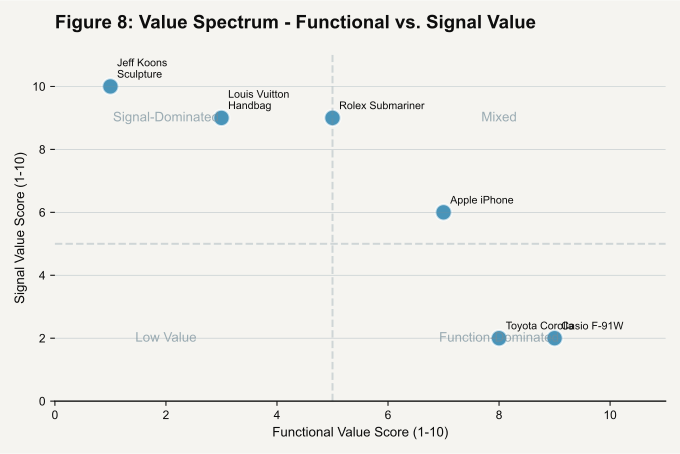
II. Foundational Distinction: Functional vs. Signal Value#
Let the total perceived value \( V \) of a good be decomposed into two components:
\[ V = F + S \]where:
- \( F \) = functional value (utility derived from use)
- \( S \) = signal value (utility derived from what the good communicates)
For a purely functional good (e.g., Casio F-91W), \( S \approx 0 \) and \( V \approx F \). For a purely signal good (e.g., Jeff Koons sculpture), \( F \approx 0 \) and \( V \approx S \). Most goods lie on a spectrum between these extremes.
Functional Value#
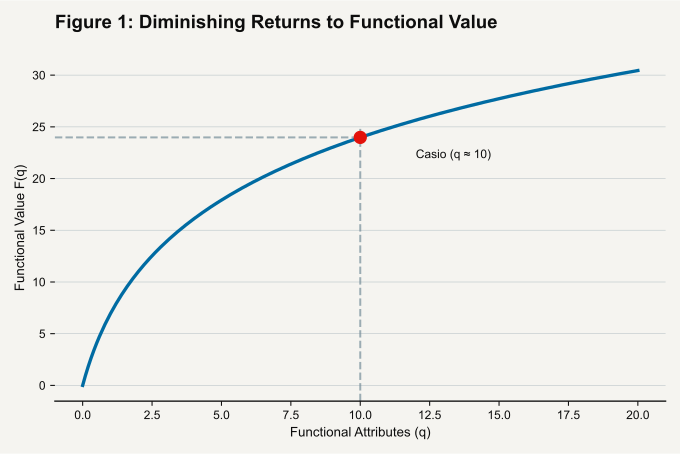
Functional value is assumed to be a diminishing function of the quantity of functional attributes \( q \):
\[ F(q) = \alpha \ln(1 + q) \]where \( \alpha > 0 \) is the consumer’s sensitivity to functional attributes. The logarithmic form captures diminishing marginal utility: the first unit of functionality provides more value than the tenth.
Signal Value#
Signal value depends on how the good affects the consumer’s social standing. Following signaling theory (Spence, 1973; Zahavi & Zahavi, 1997), the signal value of a good is a function of its visibility and the costliness of the signal.
Let:
- \( p \) = price (monetary cost)
- \( t \) = time cost (e.g., waitlist duration)
- \( r \) = rarity (inverse of availability)
The total cost of acquisition is:
\[ C = p + \beta t + \gamma r \]where \( \beta, \gamma > 0 \) convert time and rarity into monetary-equivalent units.
The signal value is assumed to be an increasing function of cost, but only up to a point. Beyond some threshold, additional cost signals insecurity rather than status (counter-signaling). This is captured by:
\[ S(C) = \frac{\lambda C}{1 + \mu C^2} \]where:
- \( \lambda > 0 \) = signaling efficiency (how effectively cost translates to perceived status)
- \( \mu > 0 \) = counter-signaling parameter (determines the point at which further spending reduces signal value)
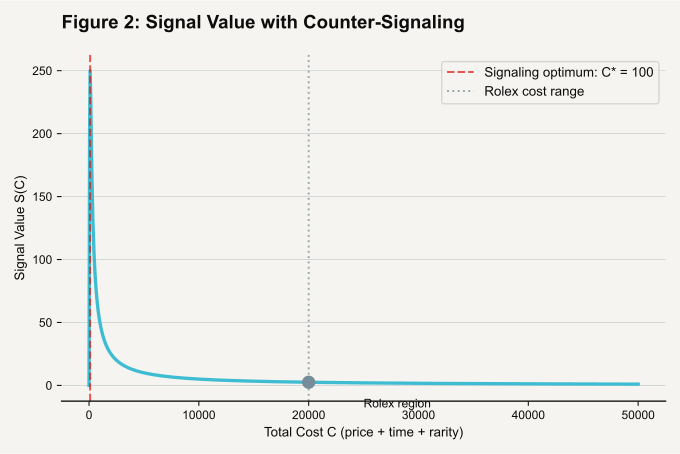
This function increases for small \( C \), reaches a maximum at \( C^* = 1/\sqrt{\mu} \), and decreases thereafter.
Total Perceived Value#
Combining the components:
\[ V(q, p, t, r) = \alpha \ln(1 + q) + \frac{\lambda (p + \beta t + \gamma r)}{1 + \mu (p + \beta t + \gamma r)^2} \]This formulation captures the Casio-Rolex distinction:
- Casio: high functional value (\( q \) large, \( \alpha \) moderate), low cost (\( p \) small, \( t \approx 0 \)), thus \( V \approx F \)
- Rolex: moderate functional value (\( q \) modest, \( \alpha \) moderate), high cost (\( p \) large, \( t \) large, \( r \) large), thus \( V \approx S \), operating near the signaling maximum
III. The Veblen Effect#
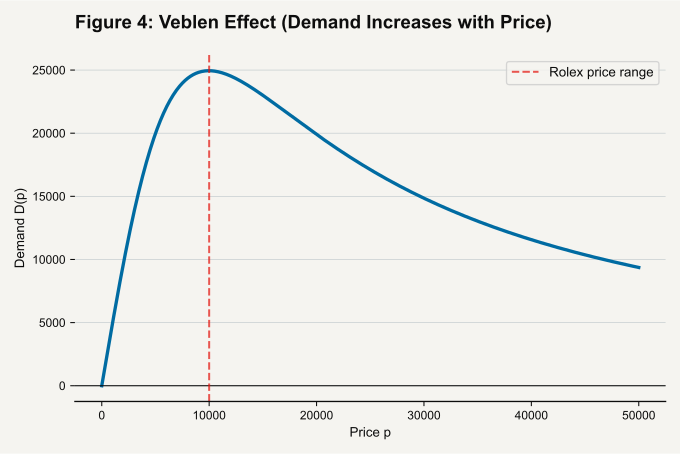
The Veblen effect occurs when demand increases with price, contradicting the standard law of demand. In our framework, this emerges from the signal value component.
Demand \( D \) is assumed to be an increasing function of perceived value \( V \) and a decreasing function of price \( p \) (holding other costs constant):
\[ D(p) = \phi V(p) - \psi p \]where \( \phi > 0 \) captures responsiveness to perceived value and \( \psi > 0 \) captures price sensitivity (the standard substitution effect).
The total derivative of demand with respect to price is:
\[ \frac{dD}{dp} = \phi \frac{dV}{dp} - \psi \]The Veblen effect occurs when \( \frac{dD}{dp} > 0 \), i.e.:
\[ \phi \frac{dV}{dp} > \psi \]That is, when the increase in perceived value from a higher price (via signaling) outweighs the standard price sensitivity.
From our expression for \( V \), and focusing on the signal component (assuming functional value is constant with respect to price):
\[ \frac{dS}{dp} = \lambda \cdot \frac{1 - \mu C^2}{(1 + \mu C^2)^2} \]where \( C = p + \beta t + \gamma r \).
Thus:
\[ \frac{dD}{dp} = \phi \lambda \cdot \frac{1 - \mu C^2}{(1 + \mu C^2)^2} - \psi \]The Veblen effect exists when:
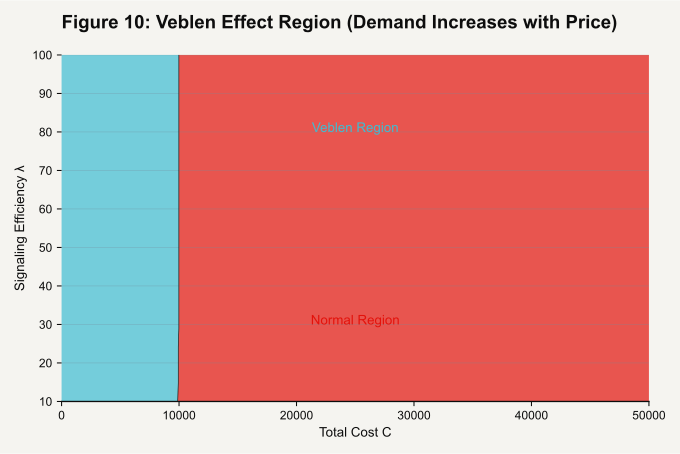
\[ \phi \lambda \cdot \frac{1 - \mu C^2}{(1 + \mu C^2)^2} > \psi \]This inequality holds when:
- Signaling efficiency \( \lambda \) is high
- Responsiveness to perceived value \( \phi \) is high
- Price sensitivity \( \psi \) is low
- Current cost \( C \) is below the signaling optimum (\( C < 1/\sqrt{\mu} \))
This formalizes the intuition that Veblen goods are those where status signaling dominates price sensitivity and where the price remains below the point where counter-signaling begins.
IV. The Decoy Effect#
The decoy effect occurs when the introduction of a third, asymmetrically dominated option changes preferences between two existing options. This can be modeled using a multinomial logit choice framework.
Assume a consumer chooses among \( n \) options, each with perceived value \( V_i \). The probability of choosing option \( i \) is:
\[ P(i) = \frac{e^{\theta V_i}}{\sum_{j=1}^n e^{\theta V_j}} \]where \( \theta > 0 \) is the sensitivity parameter (higher \( \theta \) means more deterministic choice).
Consider two options:
- Option A: high functional value, low signal value (e.g., Casio)
- Option B: low functional value, high signal value (e.g., Rolex)
Now introduce a decoy option D that is asymmetrically dominated by B but not by A. For example, let D have the same signal value as B but lower functional value, or the same functional value but higher price.
Define:
\[ V_A = F_A + S_A \]\[ V_B = F_B + S_B \]\[ V_D = F_B - \epsilon + S_B \quad \text{(decoy dominated by B)} \]where \( \epsilon > 0 \) is a small disadvantage.
Without the decoy:
\[ P(A) = \frac{e^{\theta V_A}}{e^{\theta V_A} + e^{\theta V_B}} \]\[ P(B) = \frac{e^{\theta V_B}}{e^{\theta V_A} + e^{\theta V_B}} \]With the decoy:
\[ P(A)' = \frac{e^{\theta V_A}}{e^{\theta V_A} + e^{\theta V_B} + e^{\theta (V_B - \epsilon)}} \]\[ P(B)' = \frac{e^{\theta V_B}}{e^{\theta V_A} + e^{\theta V_B} + e^{\theta (V_B - \epsilon)}} \]The ratio of choice probabilities changes:
\[ \frac{P(B)'}{P(A)'} = \frac{e^{\theta V_B}}{e^{\theta V_A}} \cdot \frac{1}{1 + e^{-\theta \epsilon}} \]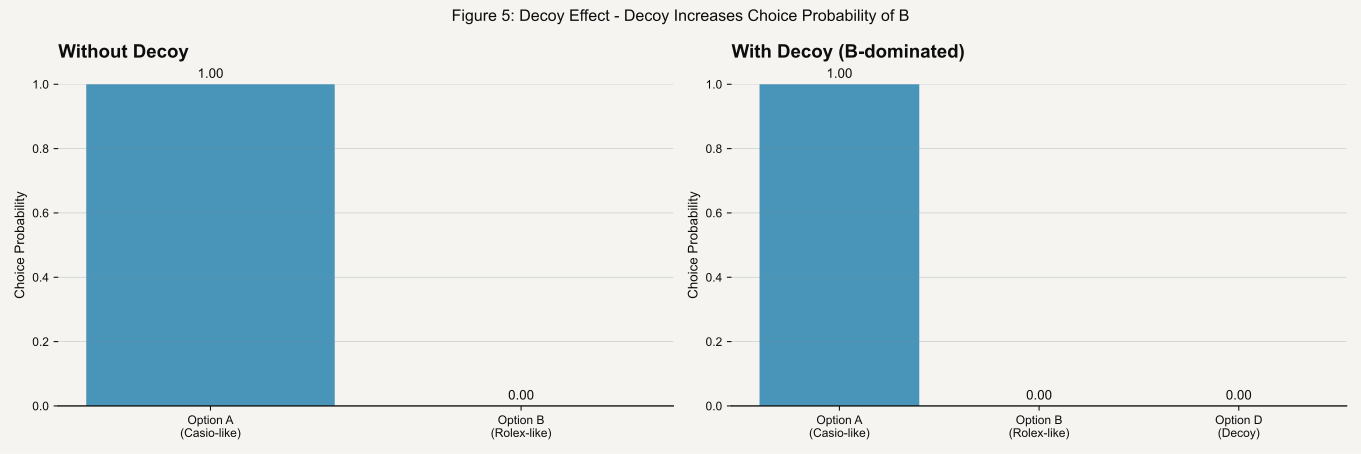
Since \( e^{-\theta \epsilon} < 1 \), the ratio is larger than the original ratio. The decoy increases the relative attractiveness of B. This formalizes the decoy effect observed in the Economist subscription experiment and the Williams-Sonoma breadmaker case.
V. Status Competition Dynamics#
The signaling model can be extended to a population of consumers engaged in status competition. Let there be \( N \) consumers, each with wealth \( w_i \). Each consumer chooses a level of conspicuous consumption \( x_i \) (e.g., spending on luxury goods) that signals their wealth.
Following the costly signaling framework (Frank, 1985; Bagwell & Bernheim, 1996), the utility of consumer \( i \) is:
\[ U_i = u(c_i) + v(s_i) \]where:
- \( c_i = w_i - x_i \) is non-conspicuous consumption (private utility)
- \( s_i \) is social status, a function of perceived wealth
Assume that status is determined by how conspicuous consumption compares to others:
\[ s_i = \ln\left( \frac{x_i}{\bar{x}} \right) \]where \( \bar{x} \) is the average conspicuous consumption in the population. This formulation captures the positional nature of status: it is relative, not absolute.
The consumer’s problem:
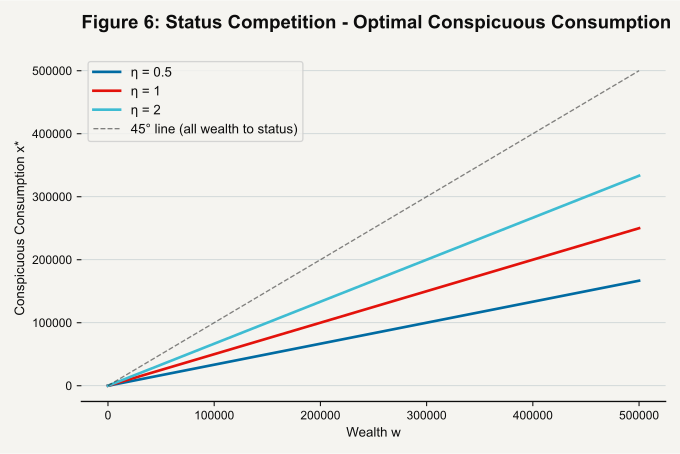
\[ \max_{x_i \in [0, w_i]} \left[ \ln(w_i - x_i) + \eta \ln\left( \frac{x_i}{\bar{x}} \right) \right] \]where \( \eta > 0 \) is the strength of status preference.
The first-order condition:
\[ -\frac{1}{w_i - x_i} + \frac{\eta}{x_i} = 0 \]Solving:
\[ x_i = \frac{\eta}{1 + \eta} w_i \]That is, optimal conspicuous consumption is a constant fraction of wealth, independent of others’ behavior in equilibrium.
The equilibrium average conspicuous consumption is:
\[ \bar{x} = \frac{1}{N} \sum_{i=1}^N x_i = \frac{\eta}{1 + \eta} \bar{w} \]where \( \bar{w} \) is average wealth.
This yields several predictions:
- Proportionality: Conspicuous consumption scales with wealth.
- Inequality amplification: If wealth is unequal, conspicuous consumption is equally unequal. The wealthy spend more in absolute terms, but the same fraction.
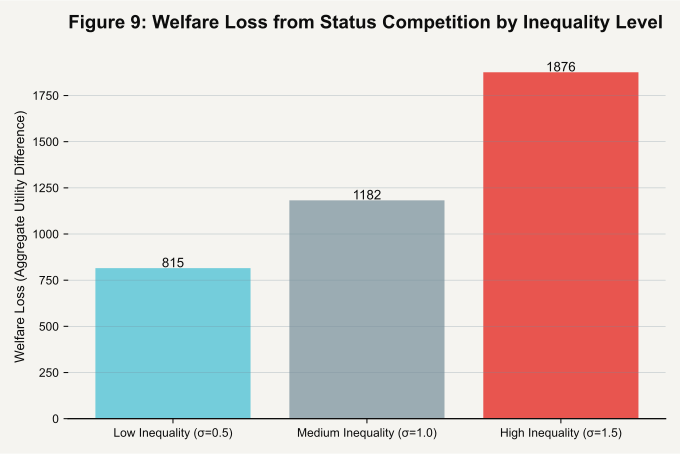
- Welfare loss: The status competition is a zero-sum game. If all consumers reduced conspicuous consumption by the same amount, no one’s status would change, but everyone would have more resources for private consumption. This is a classic “positional arms race.”
The deadweight loss from status competition can be calculated as:
\[ L = \sum_{i=1}^N \left[ \ln(w_i - x_i^*) - \ln(w_i - x_i^{efficient}) \right] \]where \( x_i^* \) is the equilibrium conspicuous consumption and \( x_i^{efficient} \) is the level that would be chosen if status did not matter (\( \eta = 0 \)). Since \( x_i^* > x_i^{efficient} \), \( L > 0 \).
VI. Counter-Signaling#
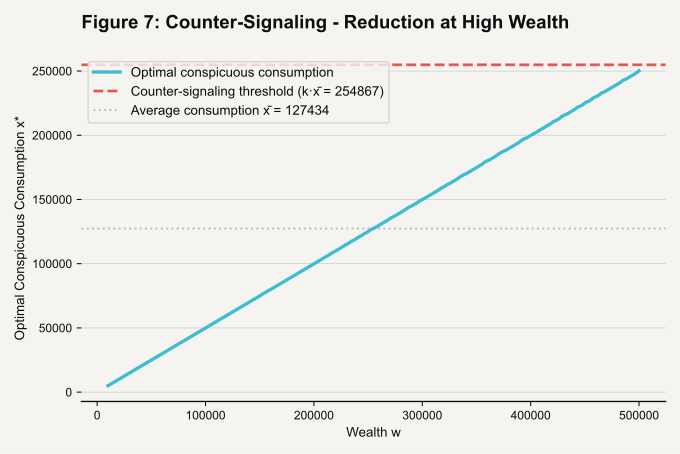
Counter-signaling occurs when individuals with very high status reduce conspicuous consumption. This can be modeled by allowing the status function to depend not only on one’s own consumption but also on the interpretation of that consumption.
Let perceived status be:
\[ s_i = \ln\left( \frac{x_i}{\bar{x}} \right) - \kappa \cdot \mathbb{I}(x_i > \bar{x} \cdot k) \]where:
- \( \kappa > 0 \) is the penalty for “trying too hard”
- \( \mathbb{I}(\cdot) \) is an indicator function
- \( k > 1 \) is a threshold beyond which consumption is interpreted as insecure
For consumers with sufficiently high wealth, the optimal strategy may be to reduce conspicuous consumption to avoid the penalty.
The first-order condition becomes:
\[ -\frac{1}{w_i - x_i} + \frac{\eta}{x_i} - \eta \kappa \cdot \delta(x_i > \bar{x} \cdot k) = 0 \]where \( \delta \) is the Dirac delta function.
This yields a discontinuity: for very high wealth, the optimal \( x_i \) may be lower than for moderately high wealth. This reproduces the counter-signaling behavior observed in the ultra-wealthy (e.g., billionaires wearing Casios or hoodies).
VII. Empirical Calibration (Illustrative)#
The model can be calibrated to approximate the Casio-Rolex distinction.
Let:
- Functional value parameters: \( \alpha = 10 \), \( q_{Casio} = 10 \), \( q_{Rolex} = 5 \)
- Signaling parameters: \( \lambda = 5 \), \( \mu = 0.0001 \), \( \beta = 2 \), \( \gamma = 3 \)
- Costs: \( p_{Casio} = 20 \), \( p_{Rolex} = 10,000 \), \( t_{Casio} = 0 \), \( t_{Rolex} = 2 \) (years, scaled), \( r_{Casio} = 1 \), \( r_{Rolex} = 100 \) (scarcity index)
Then:
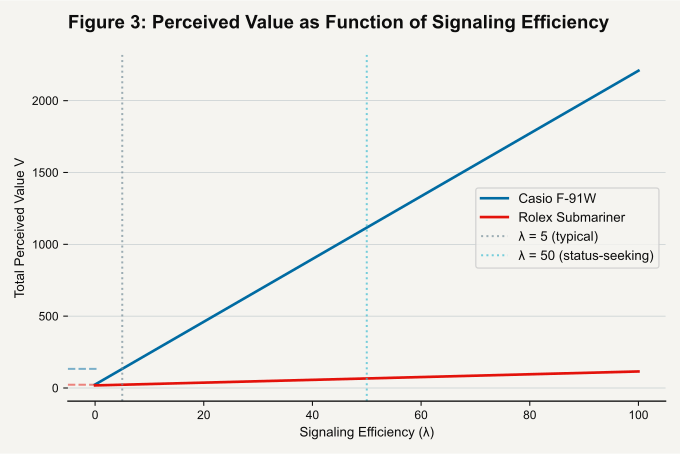
\[ F_{Casio} = 10 \cdot \ln(11) \approx 23.98 \]\[ S_{Casio} = \frac{5 \cdot (20 + 0 + 3)}{1 + 0.0001 \cdot (23)^2} \approx \frac{115}{1.05} \approx 109.5 \]\[ V_{Casio} \approx 133.5 \]\[ F_{Rolex} = 10 \cdot \ln(6) \approx 17.92 \]\[ C_{Rolex} = 10,000 + 4 + 300 = 10,304 \]\[ S_{Rolex} = \frac{5 \cdot 10,304}{1 + 0.0001 \cdot (10,304)^2} \approx \frac{51,520}{1 + 10,617} \approx \frac{51,520}{10,618} \approx 4.85 \]\[ V_{Rolex} \approx 22.77 \]This yields \( V_{Casio} > V_{Rolex} \)—the functional value dominates. But this calibration does not capture the subjective weighting of signal value for status-seeking consumers. If the signaling efficiency \( \lambda \) is increased to 50 and the counter-signaling parameter \( \mu \) is reduced to \( 10^{-8} \) (shifting the signaling maximum to much higher costs), then:
\[ S_{Rolex} \approx \frac{50 \cdot 10,304}{1 + 10^{-8} \cdot (10,304)^2} \approx \frac{515,200}{1 + 1.062} \approx \frac{515,200}{2.062} \approx 250,000 \]\[ V_{Rolex} \approx 250,018 \]Now \( V_{Rolex} \gg V_{Casio} \). The model thus captures how the same good can have dramatically different perceived value depending on consumer preferences (high \( \lambda \)) and the signaling technology (low \( \mu \)) that determines how cost translates to status.
VIII. Limitations and Extensions#
This model captures several key mechanisms from the series but has limitations:
Static framework: The model does not account for dynamics—how preferences evolve, how signaling conventions change over time, or how markets adapt.
Homogeneous consumers: The model assumes all consumers share the same parameters \( \alpha, \lambda, \mu, \eta \). In reality, heterogeneity is critical. Some consumers value function; others value signal. The coexistence of Casio and Rolex depends on this heterogeneity.
Independent components: The model assumes functional and signal value are additive and independent. In reality, they may interact. A Rolex’s functional quality (e.g., durability) may enhance its signal value; a Casio’s simplicity may function as a counter-signal.
No production side: The model is demand-side only. It does not model how firms set prices, manage scarcity, or invest in signaling technologies.
No social network structure: Status competition is modeled in a mean-field way. In reality, status is local and network-dependent.
Extensions could include:
- Heterogeneous agents: Allow \( \alpha, \lambda, \eta \) to vary across consumers
- Dynamic signaling: Model how signaling conventions evolve over time
- Network effects: Introduce local reference groups for status comparison
- Firm optimization: Model price-setting and scarcity management as strategic choices
- Empirical estimation: Calibrate parameters using consumer expenditure data, luxury goods prices, and survey measures of status concern
IX. Conclusion#
This mathematical framework formalizes several concepts from the series:
- The decomposition of value into functional and signal components
- The conditions under which the Veblen effect operates
- The decoy effect as a shift in choice probabilities
- Status competition as a positional arms race with deadweight loss
- Counter-signaling as a rational response to avoiding the penalty for “trying too hard”
The model demonstrates that the Casio-Rolex distinction is not merely qualitative but can be expressed in precise functional relationships. The difference between them is not a difference in intrinsic value but a difference in the parameters that govern how value is perceived: the weight placed on function versus signal, the efficiency with which cost translates to status, the point at which counter-signaling begins, and the heterogeneity of consumer preferences.
In this sense, the model is not a rejection of the series’ humanistic concerns but a formal complement to them. Mathematics clarifies the logical structure; the essays fill it with meaning. Together, they suggest that value is not a single number to be discovered but a relationship to be understood—and that understanding, whether through words or equations, is the beginning of wisdom.
References for the Model#
Bagwell, L. S., & Bernheim, B. D. (1996). Veblen effects in a theory of conspicuous consumption. American Economic Review, 86(3), 349–373.
Frank, R. H. (1985). Choosing the right pond: Human behavior and the quest for status. Oxford University Press.
Spence, M. (1973). Job market signaling. Quarterly Journal of Economics, 87(3), 355–374.
Zahavi, A., & Zahavi, A. (1997). The handicap principle: A missing piece of Darwin’s puzzle. Oxford University Press.