
IN 1987, A 38-YEAR-OLD FRENCH BUSINESSMAN named Bernard Arnault acquired the bankrupt holding company that owned Christian Dior. It was an audacious move. Arnault had no experience in fashion. His family fortune came from construction. But he saw something others did not: that luxury, once the preserve of family ateliers and aristocratic patrons, was becoming an industry. And industries, Arnault understood, could be consolidated, professionalized, and scaled.
Today, Arnault is the richest man in the world. His company, LVMH Moët Hennessy Louis Vuitton, controls more than 75 luxury brands, from Louis Vuitton and Dior to Tiffany & Co. and Bulgari. It generates more than €80 billion in annual revenue. Its market capitalization exceeds €400 billion—more than the GDP of Portugal. The luxury goods industry as a whole, encompassing personal luxury goods, luxury automobiles, hospitality, and fine wine and spirits, is estimated at over €1.5 trillion.
This is a remarkable transformation. Sixty years ago, luxury was a cottage industry: family-owned, small-scale, serving a tiny global elite. Today, it is a global industry, publicly traded, relentlessly professionalized, and increasingly dependent on the aspirational middle classes of China, the United States, and the Gulf states. Yet the industry’s survival depends on maintaining the fiction that it is not an industry at all—that it remains the preserve of artisans, the guardian of heritage, the antithesis of mass production.
The tension between these two realities—the industrial scale of modern luxury and the artisanal mythology that sustains it—is the central contradiction of the luxury sector. It is a contradiction that the industry has managed with extraordinary skill. But it is also a contradiction that produces constant pressure, periodic crises, and the quiet anxiety that the very machinery of growth will destroy what it seeks to preserve.
The Casio F-91W exists entirely outside this contradiction. It is mass-produced, openly so. It makes no claim to artisanal heritage. Its value is transparent, its price a function of manufacturing efficiency. The Rolex, by contrast, lives within the contradiction. It is mass-produced in factories that employ thousands, yet its marketing emphasizes the human touch, the tradition, the singularity. To understand the Rolex is to understand the machinery of modern luxury—and the discontents that machinery generates.
The Invention of Modern Luxury#
The modern luxury industry was not born in the ateliers of Paris or the workshops of Geneva. It was born in the boardrooms of the 1980s and 1990s, when a generation of entrepreneurs—Arnault at LVMH, François Pinault at Kering, Johann Rupert at Richemont—recognized that luxury brands could be managed as portfolios.
The insight was simple. Luxury brands possessed something that ordinary consumer goods lacked: pricing power. A consumer who buys a bottle of detergent will switch brands for a few cents. A consumer who buys a Louis Vuitton handbag is paying for the logo, the status, the story. That consumer is loyal—and willing to pay whatever the brand demands.
The strategy that emerged from this insight had four components. First, acquire heritage brands that had fallen into decline—brands with storied pasts but mediocre management. Second, professionalize their operations: modern supply chains, rigorous quality control, sophisticated marketing. Third, expand their product lines beyond their core categories, moving into fragrance, cosmetics, and accessories that could be produced at scale with high margins. Fourth, raise prices relentlessly, reinforcing the perception of exclusivity while capturing the value created by the brand’s heritage.
The strategy worked beyond any reasonable expectation. LVMH has delivered an average annual return to shareholders of more than 15% for three decades. The luxury sector as a whole has outperformed almost every other consumer goods category. And the prices of the most coveted luxury goods have risen far faster than inflation. A Rolex Submariner that cost $300 in 1960—roughly $3,000 in today’s money—now costs $9,000 or more on the secondary market, if one can find one. The price machine, in luxury, operates with exceptional efficiency.
But the strategy also created a paradox. Luxury, by its nature, requires scarcity. A good that everyone can buy is not a luxury good. Yet the logic of corporate growth requires expansion: more stores, more customers, more revenue. The luxury conglomerates have spent decades navigating this paradox, and their success has come at a cost. The more they grow, the more they risk diluting the exclusivity that makes their products valuable in the first place.
The Tiered Pyramid#
The solution to the paradox of growth and exclusivity has been the tiered pyramid. The luxury conglomerates have structured their brands into hierarchies that allow them to capture value at every level while preserving the aura of exclusivity at the top.
At the apex of the pyramid is ultra-luxury: high jewelry, haute horlogerie, bespoke tailoring. These products are produced in vanishingly small quantities. A Patek Philippe Grand Complication might take two years to make, with a single watchmaker assembling hundreds of tiny components by hand. The prices are astronomical—$500,000, $1 million, more. These products are not intended to generate significant revenue. Their function is to anchor the brand at the highest level of prestige, to create the halo that makes everything else beneath them seem attainable by comparison.
The middle of the pyramid is the profit center: handbags, watches, ready-to-wear clothing, shoes. These products are produced at scale, though the scale is carefully managed. A classic Louis Vuitton handbag is manufactured in factories—modern, efficient factories—but the company does not advertise this fact. The margins on these products can exceed 80%. They are the engine of the luxury industry, generating the cash flow that funds the ultra-luxury halo and the entry-level gateway.
The base of the pyramid is entry luxury: fragrances, cosmetics, sunglasses, small leather goods. These products are priced at a few hundred dollars or less. They are produced in enormous quantities and distributed widely. Their function is to bring consumers into the brand at an accessible price point, to create an emotional connection that will, ideally, lead them up the pyramid over time. A young woman who buys a Dior lipstick at $50 may, in a decade, buy a Dior handbag at $5,000. The entry luxury tier is not a profit center. It is a customer acquisition channel.
This tiered structure allows the luxury conglomerates to have it both ways. They maintain the appearance of exclusivity through the ultra-luxury tier, while capturing the reality of scale through the profit and entry tiers. The consumer at the top of the pyramid believes she is buying something rare and precious. The consumer at the bottom believes she is buying a piece of the same world. Both are correct, in their way. And both are essential to the economic logic of modern luxury.
The Waitlist as Technology#
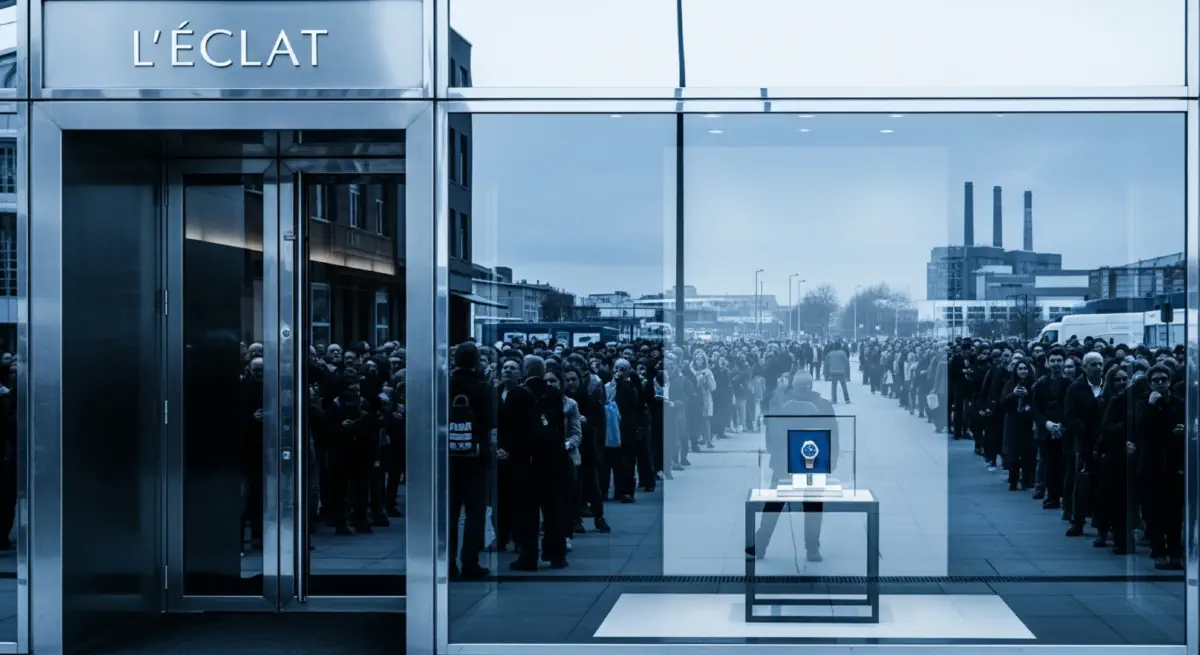
Nowhere is the paradox of luxury more visible than in the phenomenon of the waitlist. A Rolex Submariner, at an authorized dealer, typically requires a wait of one to five years. A Hermès Birkin bag cannot be purchased at all without a prior relationship with the brand; prospective buyers are invited to express interest and may wait years for the privilege of purchase.
The waitlist is often interpreted as a sign of scarcity—and it is, but not in the way it appears. The scarcity is manufactured. Rolex produces more than a million watches a year. It is capable of producing more. But it chooses not to. The waitlist is not a failure of supply to meet demand; it is a deliberate strategy to manage demand.
The economic logic of the waitlist is subtle. By restricting supply, the brand maintains pricing power. A watch that is freely available at retail cannot command a premium; a watch that requires a five-year wait can. The waitlist also generates the secondary market, where coveted models trade at substantial premiums. The Rolex Submariner that retails for $9,000 might sell for $15,000 on the secondary market. This premium reinforces the perception of value: if someone is willing to pay $15,000 for a watch that retails for $9,000, the watch must be worth it.
But the waitlist serves another function as well. It transforms the purchase from a transaction into a relationship. The customer who waits five years for a watch does not feel like a consumer; he feels like a chosen one. The wait creates anticipation, desire, and ultimately, gratitude. The brand has not merely sold a watch; it has conferred a privilege. This is the alchemy of luxury: the transformation of a commercial exchange into something that feels like recognition.
The waitlist also serves to exclude. Luxury is, at its core, about exclusion. A product that everyone can have is not a luxury product. The waitlist ensures that not everyone can have it—or at least, not everyone can have it easily. The exclusion is not absolute; the watch is available to anyone with sufficient patience and resources. But the friction of the waitlist is itself a barrier, and barriers are the essence of luxury.
The Demographics of Desire#
The luxury industry’s growth over the past three decades has been driven by a single demographic shift: the emergence of a global middle class with disposable income and a desire for status. Nowhere has this shift been more pronounced than in China.
In 2000, Chinese consumers accounted for roughly 1% of global luxury spending. By 2020, they accounted for more than 35%—and that figure was depressed by the pandemic. Chinese consumers, particularly younger consumers, have embraced luxury with a fervor that recalls the Gilded Age in America or the Belle Époque in France. For a generation raised amid breakneck economic growth, luxury goods are not merely status markers; they are evidence of arrival, proof of participation in a new global class.
The luxury conglomerates have responded with relentless focus on the Chinese market. They have opened flagship stores in Shanghai, Beijing, and Chengdu. They have adapted their marketing to Chinese cultural sensibilities. They have courted Chinese celebrities as brand ambassadors. And they have priced their goods accordingly: luxury goods in China are often 20-40% more expensive than in Europe, a premium that Chinese consumers have been willing to pay.
But the dependence on China creates vulnerability. When China’s economy slows, luxury stocks fall. When the Chinese government signals a shift away from conspicuous consumption—as it did in the early 2010s with an anti-corruption campaign that targeted luxury gifting—the industry feels the effect. The luxury conglomerates have attempted to diversify, building markets in Southeast Asia, the Middle East, and the United States. But the Chinese consumer remains central to the industry’s growth story.
The demographic shift also creates a generational tension. Younger luxury consumers—millennials and Gen Z—have different values than their predecessors. They are more concerned with sustainability, more skeptical of overt status signaling, more attracted to “stealth wealth” aesthetics. They are also more likely to buy second-hand, more likely to rent, and more likely to be influenced by social media rather than traditional advertising. The luxury industry is adapting—investing in resale platforms, developing sustainability initiatives, courting influencers—but the adaptations are not always comfortable. The tension between the industry’s traditional model (exclusivity, heritage, price as signal) and the values of its emerging customer base is one of the central discontents of contemporary luxury.
The Sustainability Contradiction#
The most profound discontent facing the luxury industry is sustainability. Luxury, by its nature, is about excess. It is about materials that are rare, processes that are labor-intensive, products that are meant to signal that one can afford to waste. This is not a bug; it is a feature. Veblen’s “conspicuous consumption” was precisely about waste as status.
But the world in which waste was unproblematic is ending. The climate crisis, the biodiversity crisis, and the growing awareness of supply chain ethics have made the luxury industry’s traditional model increasingly untenable. Consumers—particularly younger consumers—are demanding transparency about where materials come from, how products are made, and what the environmental impact is.
The luxury industry has responded with a flurry of sustainability initiatives. Kering publishes a detailed environmental profit-and-loss account. LVMH has committed to reducing its carbon emissions. Gucci has eliminated fur from its collections. Stella McCartney has built a brand around sustainability. But these initiatives exist in tension with the industry’s core logic. A Birkin bag, which requires the skin of two or three crocodiles and months of artisanal labor, cannot be made sustainably in any meaningful sense. The waste is the point.
The tension is not lost on consumers. There is a growing awareness that the luxury industry’s claims to sustainability are, at best, partial. The industry is caught between the logic of its own model—which requires excess—and the demands of its emerging customer base—which increasingly reject excess. How this tension resolves will shape the future of luxury. It may be that luxury adapts, finding new forms of excess that are less environmentally destructive. Or it may be that the contradiction becomes unsustainable, and the industry faces a reckoning.
The Casio as Escape#
The Casio F-91W exists outside these tensions. It is not exclusive; it is ubiquitous. It does not require a waitlist; it is available at any drugstore. It is not dependent on Chinese consumers or subject to the vagaries of the global luxury market. It does not struggle with sustainability; it is a simple electronic device with a minimal environmental footprint. It is, in short, the opposite of luxury.
For some consumers, this is precisely its appeal. The Casio is an escape from the machinery of luxury—from the waitlists, the status anxiety, the constant pressure to signal. It is a watch for people who do not want to think about watches. It is functional, durable, and cheap. It is, in its way, a form of liberation.
But the Casio is not a solution to the discontents of luxury. It is an alternative. Most consumers will continue to want what luxury offers: status, beauty, the pleasure of owning something rare and precious. The question is whether the luxury industry can continue to deliver these things without destroying the conditions that make them possible. The Casio will remain, a quiet reminder that there is another way. But for most of the world, the Rolex—and the machinery that produces it—will remain the object of desire.
This is the sixth in a ten-part series on the architecture of value. Next: “The Art of the Deal”, on how the art market functions as a pure laboratory of perceived value.