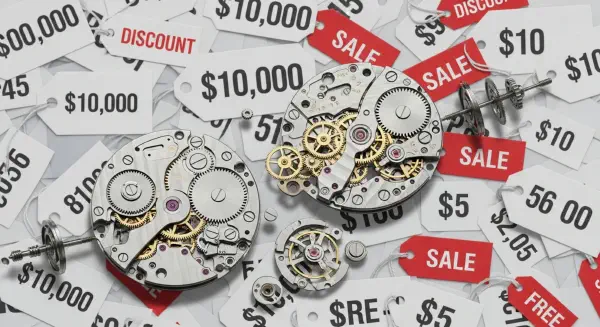
THE CASIO F-91W costs about twenty dollars. It tells time accurately, survives immersion in water, and requires a battery replacement approximately once a decade. The Rolex Submariner costs between nine and forty thousand dollars, depending on the reference. It also tells time accurately, though less so than the Casio. It also survives immersion in water, though few owners test this. By any functional metric, the Casio is the superior timekeeping instrument. And yet the Rolex commands a premium of several orders of magnitude. The gap between them is not a measure of engineering. It is a measure of signal.
Humans are not rational maximisers of utility. If they were, every wrist would bear a Casio, every car would be a Toyota Corolla, and every home would be judged solely by square footage and structural integrity. Instead, humans are social animals who evolved in environments where reputation determined survival. The ability to signal—credibly—was a matter of life and death. That evolutionary inheritance has not been erased by modern abundance. It has merely found new expressions.
The Rolex is not a watch. It is a costly signal. Its price, its weight, its recognisability, even its slight mechanical imprecision relative to quartz—all of these are features, not bugs. They communicate something that cannot be directly observed: resources, taste, discipline, membership in a certain class. The Casio communicates something different: practicality, indifference to status, or perhaps a deliberate counter-signal. Both are acts of communication. Neither is just a watch.
The Veblen Inheritance#
The foundational text for understanding this phenomenon remains Thorstein Veblen’s “The Theory of the Leisure Class”, published in 1899. Veblen, a Norwegian-American economist with a savage wit, observed that in industrialised society, status was no longer signalled by martial prowess or noble lineage but by conspicuous consumption—the public display of waste. The gentleman of leisure did not merely own fine things; he demonstrated that he could afford to be unproductive. His starched collar, his polished boots, his wife’s elaborate gowns—all signalled that someone else performed the labour.
Veblen coined the term “conspicuous consumption” but also identified a subtler phenomenon: “conspicuous leisure”. The gentleman did not merely display wealth; he displayed the freedom from useful toil. The modern heir to this tradition is not the hedge-fund manager in a Brioni suit but the venture capitalist who affects hoodies and sneakers. The signal has changed form, but the underlying logic—demonstrating that one is exempt from ordinary economic pressures—remains intact.
Veblen’s insight was that consumption is never merely consumption. It is always also communication. The goods one buys, the clothes one wears, the neighbourhoods one inhabits—these form a vocabulary through which one announces one’s place in the social order. The vocabulary evolves, but the grammar does not. A Victorian mansion with a manicured lawn signalled that the owner could afford unproductive land and the servants to maintain it. A Tesla in a driveway today signals something different—environmental virtue, technological sophistication, a particular political tribe—but the act of signalling is identical.
Costly Signals and Honest Advertising#
Why must signals be costly? Why can one not simply say “I am wealthy” or “I am virtuous” and be believed? The answer lies in evolutionary biology, specifically in the theory of costly signalling first developed by Amotz Zahavi in the 1970s. Zahavi was studying Arabian babblers, a species of bird, and observed that they engaged in apparently self-endangering behaviours—making loud calls, exposing themselves to predators—when competing for mates. The puzzle was why such risky behaviour would evolve. Zahavi’s answer was that the risk was precisely the point.
A costly signal is honest because it cannot be faked. The peacock’s tail is metabolically expensive and impedes escape from predators. Only a male in excellent condition can afford to carry it. The tail is not merely attractive; it is credible evidence of fitness. The same logic applies to human signalling. A Rolex costs thousands of dollars. Anyone can claim to be successful, but only someone with actual resources can afford to wear a watch that costs as much as a used car. The price is not a barrier to signalling; it is the mechanism that makes the signal credible.
This framework explains a great deal of otherwise puzzling consumer behaviour. Why do people buy luxury goods whose quality is indistinguishable from mid-range alternatives? Because the quality is not the point. The point is the demonstration that one can afford to pay for quality that one does not strictly need. Why do people queue for hours for a limited-edition sneaker or a hyped restaurant reservation? Because the willingness to waste time—the most non-fungible of resources—signals commitment and discernment. Time, like money, is a cost. And costs, when publicly visible, confer credibility.
The Grammar of Status#
Signalling, however, is not a simple matter of spending more to appear more. It is a complex language with dialects, registers, and the ever-present possibility of misreading. What reads as status to one audience may read as vulgarity to another. What reads as effortless elegance to one may read as studied pretension to another. The signaller must know not only what to signal but to whom.
Pierre Bourdieu, the French sociologist, mapped this terrain in his 1979 masterwork “Distinction”. Bourdieu argued that taste—what one likes, what one disdains, what one finds beautiful or tacky—is not a matter of individual sensibility but a marker of class position. The bourgeoisie, the petite bourgeoisie, the working class—each has a distinct aesthetic disposition, a distinct way of consuming and judging. The bourgeoisie favour form over function, distance over immediacy, the subtle over the obvious. The working class, in Bourdieu’s analysis, prefer the functional, the substantial, the straightforward. These are not merely preferences. They are signals of social position, learned so early and so thoroughly that they feel like nature.
This is why the luxury industry is so attentive to the nuances of signalling. A logo-emblazoned handbag signals one thing—a desire for recognisability, a certain aspirational posture—while an unbranded handbag of equivalent cost signals something else: a confidence that one’s taste will be recognised without the crutch of branding. The former is for those who wish to be seen as having money; the latter is for those who wish to be seen as having class. Both are signals. Neither is merely a handbag.
The Counter-Signal#
If expensive goods signal wealth, what does it signal when a wealthy person wears a Casio? This is the domain of counter-signalling, a phenomenon that has received increasing attention from economists and sociologists in recent years. The logic is simple: when status is sufficiently secure, one can afford to signal indifference to status.
Consider the billionaire who wears a hoodie and sneakers to a business meeting. He is not failing to signal; he is signalling something quite specific. He is signalling that he is so wealthy, so powerful, that he no longer needs to perform wealth. He can dress like a graduate student because everyone in the room already knows what he is worth. The hoodie becomes, paradoxically, a more exclusive signal than a suit—because it is available only to those whose status is beyond question.
The same logic applies to the Casio. A twenty-dollar watch on the wrist of a billionaire is not a failure of conspicuous consumption. It is a different kind of conspicuousness: the conspicuous refusal to participate in status competition. It signals that one has transcended the game, that one’s identity is no longer bound up with the objects one owns. Of course, this too can become a performance. The “stealth wealth” aesthetic—unbranded cashmere, minimalist watches, discreet tailoring—is itself a highly codified status language, accessible only to those who can afford to signal without shouting.
Counter-signalling is not limited to the ultra-wealthy. It appears in subcultures of all kinds: the punk who wears torn jeans, the academic who affects sartorial indifference, the tech worker who wears the same black t-shirt every day. In each case, the signal is the same: I am not competing on your terms. The irony, of course, is that this too is a form of competition. One cannot opt out of the signalling game. One can only choose which signals to send.
The Social Media Amplifier#
If signalling has always been central to human social life, social media has transformed its scale, speed, and intensity. Before Instagram, the audience for one’s consumption was limited to one’s immediate social circle. Now it is potentially global. Before TikTok, the means of signalling were relatively constrained: what one wore, what one drove, where one lived. Now one can signal through curated feeds, carefully posed photographs, and the relentless documentation of experience.
The effect has been an arms race of perceived value. If everyone is signalling, the threshold for what constitutes a meaningful signal rises. A holiday in France was once a signal of sophistication; now it is a baseline expectation. A handbag that cost a month’s salary was once a marker of achievement; now it is merely entry-level. The platforms themselves are designed to intensify this dynamic. The like button, the follower count, the verification badge—these are not neutral features. They are mechanisms for quantifying and displaying status, turning social standing into a metric that can be tracked, compared, and optimised.
This has produced a new kind of anxiety. The sociologist Erving Goffman, writing in the 1950s, described social life as a performance in which individuals manage the impressions they give off to others. But Goffman’s performances were local, bounded, and largely synchronous. The social media performance is global, permanent, and asynchronous. One is always, potentially, on stage. The signal never stops.
The consequences are not trivial. Studies have linked heavy social media use to increased rates of anxiety and depression, particularly among adolescents. The mechanism appears to be precisely this: the constant pressure to perform value, to signal status, to compare one’s own signals against the curated highlights of others. The Rolex on the wrist is a signal; the Rolex on Instagram is a signal about a signal—a second-order performance that can never fully satisfy, because there is always a more impressive feed, a more enviable holiday, a more exclusive watch.
The Return of the Real#
And yet. The Casio remains on the wrist of its wearer, indifferent to the status games being played around it. It tells the time. It does not judge. It does not perform.
There is, perhaps, a quiet wisdom in this. The sociologists and the evolutionary biologists are not wrong: humans are signalling animals, and to pretend otherwise is naive. But they are also incomplete. Humans are also creatures who seek meaning, who value competence, who find satisfaction in mastery. The Casio is not a counter-signal for everyone. For some, it is simply a watch. For some, the Rolex is genuinely appreciated—for its engineering, its history, its beauty—rather than merely for what it says.
The distinction between these motives is not always clear, even to the actor herself. One can buy a Rolex for the engineering and also, without quite admitting it, for the signal. One can wear a Casio for the practicality and also, without quite admitting it, for the pleasure of not caring. The human animal is not a clean machine; motives mingle, overlap, contradict.
But the act of reflection—of asking why one values what one values—is itself a form of freedom. The philosopher Harry Frankfurt, in his essay “On Bullshit”, distinguished between the liar, who cares about the truth and seeks to conceal it, and the bullshitter, who simply does not care. The uncritical consumer of perceived value is not lying to others but bullshitting oneself—moving through the world of signals without asking what, if anything, they signify.
To ask the question—Why do I want this? Am I buying a thing or a signal?—is to step outside the machinery of perceived value, if only for a moment. It does not guarantee an answer. It does not guarantee liberation from status competition. But it does something perhaps more important: it introduces the possibility of choosing one’s signals deliberately, rather than merely emitting them by reflex.
The Casio versus the Rolex is not a choice between true value and false value. It is a choice between different ways of being in the world, different relationships to the social self. One can signal with intention or signal by default. One can compete for status or, occasionally, decline the competition. What one cannot do is escape signalling altogether. The human animal is a signalling animal. The only question is whether one signals with awareness—or mistakes the signal for the self.
This is the fourth in a ten-part series on the architecture of value. Next: “The Authenticity Mirage”, on how modern commerce learned to manufacture the very quality it claims only to preserve.