
BEFORE THERE WAS value, there was necessity. The earliest humans ate what they found, sheltered where they could, and owed nothing to anyone beyond their immediate kin. In such a world, the question of value did not arise. A berry was not valuable; it was simply eaten. A stone was not valuable; it was simply used. Value, as a category of thought, emerged only when humans began to do something distinctly human: exchange.
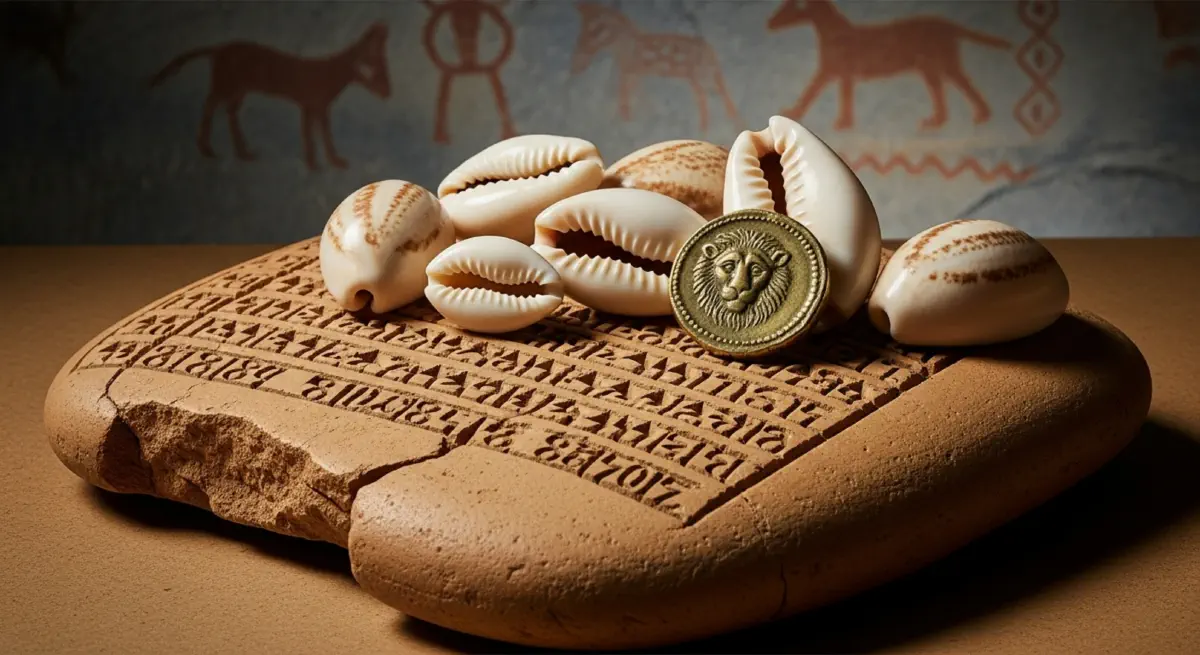
The archaeological record offers no precise date for the invention of value. But it offers clues. Burials from the Upper Paleolithic, some 30,000 years ago, contain goods—shells, ochre, carved ivory—that had no utilitarian function. These objects were not tools. They were not food. They were something else: markers of status, of ritual, of relationship. Someone had deemed them worth transporting, worth preserving, worth burying with the dead. Value, in other words, existed before money. It existed before markets. It existed as a social fact, embedded in bonds of obligation and distinction, long before it became a price.
The history of value is the history of how something so deeply social became something so seemingly mathematical. It is a story of abstraction: from the concrete to the symbolic, from the gift to the coin, from the sacred to the secular. And it is a story that continues today, as the Casio and the Rolex sit side by side in the same display case of human invention, each representing a different moment in that long arc.
The Gift Before the Bargain#
The Polish anthropologist Bronisław Malinowski, studying the Trobriand Islanders in the early 20th century, observed a system of exchange that defied Western economic logic. The islanders participated in the kula ring, a ceremonial circuit in which shell necklaces (soulava) travelled clockwise from island to island and shell armbands (mwali) travelled counter-clockwise. These objects had no practical use. They were not traded for food or tools. Yet they were intensely valued. Men risked life and limb to acquire them, and their possession conferred enormous prestige.
Malinowski’s insight was that the kula was not a primitive form of commerce. It was something different entirely. The exchange of shells was not about material gain but about social relationships. To give a gift was to create an obligation. To receive a gift was to accept a bond. The kula ring held together a far-flung network of islands, creating peace, facilitating trade in ordinary goods, and establishing hierarchies of reputation and renown.
A decade later, the French sociologist Marcel Mauss generalized this insight in his classic “The Gift” (1925). Mauss argued that in pre-market societies, there was no such thing as a free gift. Gifts carried three obligations: to give, to receive, and to reciprocate. To refuse a gift was to refuse a relationship. To fail to reciprocate was to lose status, even to enslave oneself. The gift, in other words, was not an economic transaction but a social one. Value was not a property of the object but a function of the relationship it mediated.
This world—the world of the gift—is the deep background against which modern value must be understood. In the gift economy, value was inalienable. A shell necklace was valuable not because of its material properties but because of its history: who had given it, who had worn it, what obligations it carried. Value was personal, not anonymous. It could not be reduced to a number.
The Invention of the Measure#
The transition from gift economies to market economies required a revolution in thought: the invention of commensuration. Commensuration is the practice of rendering qualitatively different things quantitatively comparable. How many baskets of wheat equal one cow? How many days of labor equal one cloak? These questions seem simple, but they are anything but. They require treating unlike things as though they were alike. They require abstraction.
The earliest solutions were concrete. In Mesopotamia, the great temple economies of the third millennium BCE used standardized measures—the sila for grain, the shekel for silver—to keep accounts. But these measures were not yet money in the modern sense. Grain and silver were themselves valuable commodities, and transactions were recorded in clay tablets as credits and debits. The system was less a market than an elaborate administrative apparatus for redistributing resources.
Grain had advantages as a medium of exchange. It was divisible, reasonably durable, and universally needed. But it was bulky and perishable. Silver, by contrast, was compact, non-perishable, and rare. By the second millennium BCE, silver had emerged throughout the Near East as the dominant measure of value. People spoke not of prices but of “silver equivalents.” A slave was worth so many shekels of silver; a field, so many minas. The abstraction had begun.
Yet silver was still a commodity. Its value fluctuated with supply and demand. True money—money that could serve as a pure measure of value, detached from the value of the material that embodied it—required another step: the invention of coinage.
The Lydian Revolution#
According to Herodotus, the Lydians were the first people to use gold and silver coinage. Modern archaeology confirms the story. In the seventh century BCE, in what is now western Turkey, the Lydian king Alyattes minted coins of electrum, a natural alloy of gold and silver. These coins were stamped with a lion’s head—a mark that guaranteed their weight and purity. For the first time, value was certified by authority, not determined by weighing at each transaction.
The innovation spread rapidly. The Greeks adopted coinage and refined it, minting silver owls in Athens, gold staters in Macedon. The Persians followed. By the fifth century BCE, coinage had transformed the Mediterranean world. It made possible the professional soldier (paid in coin), the merchant (free from cumbersome barter), and the lender (charging interest on standardized units). It also made possible something more subtle: the idea that value could be anonymous.
Before coinage, a gift carried the history of its giving. A cow traded for grain was a cow that belonged to someone. But a coin, passed from hand to hand, carried no history. Its value was intrinsic to its metal content and its stamp, not to its biography. The coin was the first truly alienable object—value that could travel without leaving a trace of its journey. It was the ancestor of the price tag, the receipt, the bank transfer. It was the invention of value as number.
The Sacred and the Profane#
Not everything, however, could be reduced to coin. The ancient world retained a distinction—sometimes explicit, sometimes implicit—between things that could be priced and things that could not. Sacred objects, human beings, and certain forms of obligation resisted commodification. The Roman satirist Juvenal complained that “everything is now for sale,” suggesting that the boundary between the sacred and the profane was under pressure even then.
The tension persists. Modern markets have extended the logic of commodification to domains the ancients would have found unthinkable: human organs, reproductive labor, social status, even attention. Yet resistance remains. The idea that some things “should not be for sale” is not a relic of pre-market morality but a continuing feature of market societies. The Casio is unproblematically for sale. But a Rolex, in its marketing, gestures toward something beyond price: heritage, craftsmanship, the sacred. The distinction between the two watches is, in part, a distinction between the profane and the sacred—a line that has been drawn and redrawn for millennia.
The Great Transformation#
The Hungarian economic historian Karl Polanyi, writing in the 1940s, argued that the self-regulating market was a historical aberration. For most of human history, Polanyi claimed, economies were “embedded” in social relations. People did not pursue material gain for its own sake; they pursued status, security, and obligation. The market, when it existed, was subordinate to these social ends.
The great transformation, Polanyi argued, occurred in the 19th century, when markets began to disembed from society. Land, labor, and money—what Polanyi called the “fictitious commodities”—were treated as though they were produced for sale, when in fact they were not. Land was nature. Labor was human life. Money was a social convention. To treat them as commodities, Polanyi argued, was to invite catastrophe. The result was a century of instability, culminating in the world wars and the Great Depression.
Polanyi’s analysis is contested. Critics note that pre-modern societies were more market-oriented than he allowed, and that post-war social democracies have successfully re-embedded markets in social institutions. But his central insight—that markets are not natural but constructed, that they rest on social and political foundations—remains essential. The Casio is a product of markets. So is the Rolex. But the meaning we attach to each, the distinction we draw between them, is not given by the market. It is given by the social world in which the market sits.
The Weight of History#
What does this history have to do with the Casio on one wrist and the Rolex on the other? Everything. The distinction between the two watches is not merely a matter of price. It is a distinction between two different histories of value.
The Casio belongs to the world of mass production, of standardized goods, of price competition. Its value is transparent: it is a function of its utility, its durability, and the efficiency with which it is made. It is the heir to the coin—anonymous, fungible, profane.
The Rolex, by contrast, belongs to an older tradition. Its marketing emphasizes heritage, craftsmanship, and the continuity of generations. It gestures toward the inalienable—the object that carries history, that cannot be reduced to its material components. It is the heir to the gift—singular, personal, sacred.
Neither, of course, is pure. The Casio has its own history; the F-91W has been in continuous production since 1989 and has acquired a cult following. It is, in its own way, an object of affection, even of status. And the Rolex is a product of industrial manufacturing, produced in factories, subject to the same economic pressures as any other consumer good. The distinction is not a binary but a spectrum.
But the spectrum itself is the product of history. The capacity to perceive value—to distinguish the sacred from the profane, the gift from the commodity, the Casio from the Rolex—is not innate. It has been built over millennia, through the invention of measure, the creation of coinage, and the endless negotiation between the social and the economic. To understand why one watch costs twenty dollars and another costs twenty thousand is to understand that history.
The next article in this series will examine the philosophical quarrel over whether value is intrinsic to things or merely projected onto them—a quarrel that began with Aristotle and continues in every boardroom and every marketplace today. But before turning to the philosophers, it is worth sitting with the deeper lesson of the prehistorians: value is not a fact of nature. It is a human invention, as old as society itself, and as new as the next transaction.
This is the first in a ten-part series on the architecture of value. Next: “The Philosophers’ Quarrel”, on the 2,500-year debate over whether value resides in things or in the mind.